

Advanced Relativistic Energy Approach in Spectroscopy …
17
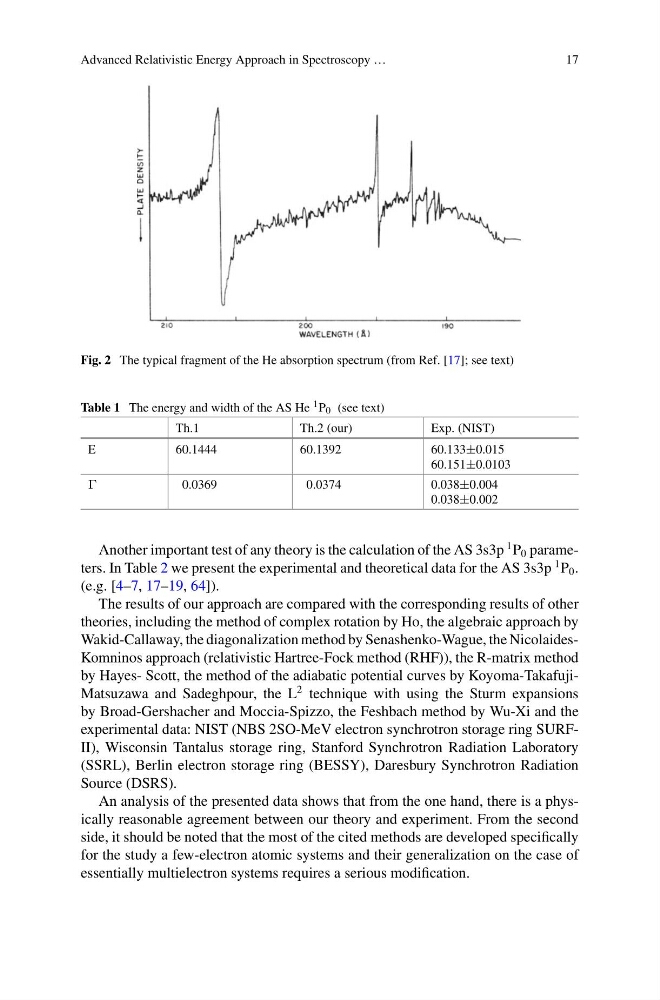
Fig. 2 The typical fragment of the He absorption spectrum (from Ref. [17]; see text)
Table 1 The energy and width of the AS He 1 P 0 (see text)
Th.1
Th.2 (our)
Exp. (NIST)
E
60.1444
60.1392
60.133±0.015
60.151±0.0103
G
0.0369
0.0374
0.038±0.004
0.038±0.002
Another important test of any theory is the calculation of the AS 3s3p
1 P 0 parameters. In Table 2 we present the experimental and theoretical data for the AS 3s3p
1 P 0 .
(e.g. [4–7, 17–19, 64]).
The results of our approach are compared with the corresponding results of other
theories, including the method of complex rotation by Ho, the algebraic approach by
Wakid-Callaway, the diagonalization method by Senashenko-Wague, the NicolaidesKomninos approach (relativistic Hartree-Fock method (RHF)), the R-matrix method
by Hayes- Scott, the method of the adiabatic potential curves by Koyoma-TakafujiMatsuzawa and Sadeghpour, the L
2 technique with using the Sturm expansions
by Broad-Gershacher and Moccia-Spizzo, the Feshbach method by Wu-Xi and the
experimental data: NIST (NBS 2SO-MeV electron synchrotron storage ring SURFII), Wisconsin Tantalus storage ring, Stanford Synchrotron Radiation Laboratory
(SSRL), Berlin electron storage ring (BESSY), Daresbury Synchrotron Radiation
Source (DSRS).
An analysis of the presented data shows that from the one hand, there is a physically reasonable agreement between our theory and experiment. From the second
side, it should be noted that the most of the cited methods are developed specifically
for the study a few-electron atomic systems and their generalization on the case of
essentially multielectron systems requires a serious modification.
17
Fig. 2 The typical fragment of the He absorption spectrum (from Ref. [17]; see text)
Table 1 The energy and width of the AS He 1 P 0 (see text)
Th.1
Th.2 (our)
Exp. (NIST)
E
60.1444
60.1392
60.133±0.015
60.151±0.0103
G
0.0369
0.0374
0.038±0.004
0.038±0.002
Another important test of any theory is the calculation of the AS 3s3p
1 P 0 parameters. In Table 2 we present the experimental and theoretical data for the AS 3s3p
1 P 0 .
(e.g. [4–7, 17–19, 64]).
The results of our approach are compared with the corresponding results of other
theories, including the method of complex rotation by Ho, the algebraic approach by
Wakid-Callaway, the diagonalization method by Senashenko-Wague, the NicolaidesKomninos approach (relativistic Hartree-Fock method (RHF)), the R-matrix method
by Hayes- Scott, the method of the adiabatic potential curves by Koyoma-TakafujiMatsuzawa and Sadeghpour, the L
2 technique with using the Sturm expansions
by Broad-Gershacher and Moccia-Spizzo, the Feshbach method by Wu-Xi and the
experimental data: NIST (NBS 2SO-MeV electron synchrotron storage ring SURFII), Wisconsin Tantalus storage ring, Stanford Synchrotron Radiation Laboratory
(SSRL), Berlin electron storage ring (BESSY), Daresbury Synchrotron Radiation
Source (DSRS).
An analysis of the presented data shows that from the one hand, there is a physically reasonable agreement between our theory and experiment. From the second
side, it should be noted that the most of the cited methods are developed specifically
for the study a few-electron atomic systems and their generalization on the case of
essentially multielectron systems requires a serious modification.