

12
A. V. Glushkov
Naturally, the set of orbitals is introduced assault with a specially prescribed
asymptotics that is crucial for the convergence of the spectral decomposition, including spectral decomposition of the Green’s function. Among examples of the effective
using the Sturm expansions in various problems in atomic and molecular physics one
should indicate the works by Dalgarno et al., Buchachenko et al., Ivanova-Ivanov
et al., Gruzdev et al., Glushkov et al. etc. (e.g., [1–4, 11, 12, 114]). In a practical
implementation the Sturm expansions method is as follows. In the first phase one
should solve the system of relativistic DKS equation with respect to the Dirac radial
functions and diagonal Lagrange parameters ε
nlj . In the second stage it is numerically
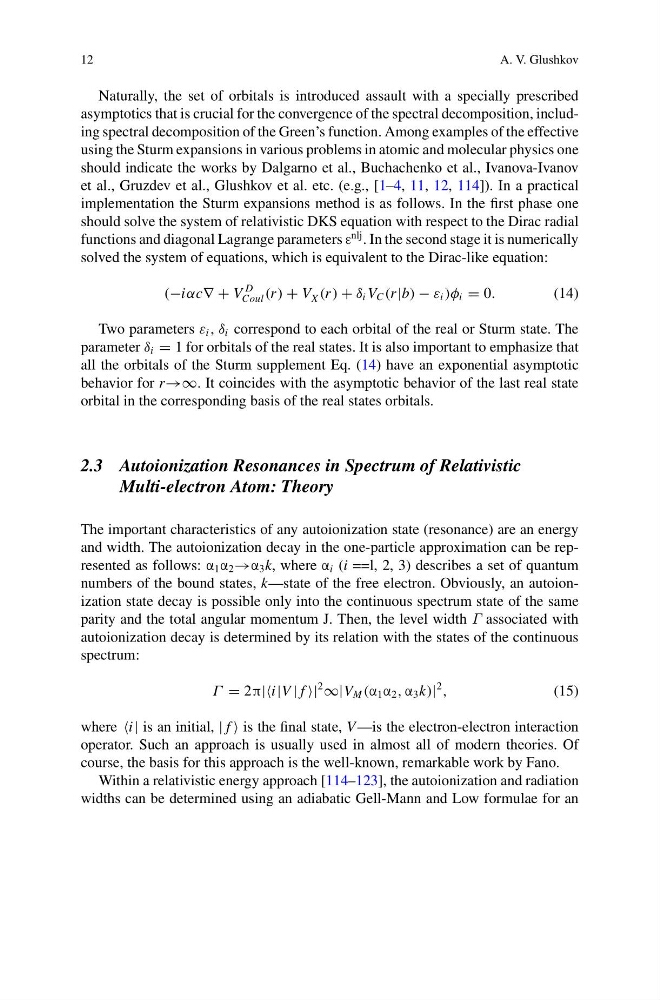
solved the system of equations, which is equivalent to the Dirac-like equation:
(−iαc∇ + V
D
Coul (r ) + V X (r ) + δ i V C (r |b) − ε i )φ i = 0.
(14)
Two parameters ε i , δ i correspond to each orbital of the real or Sturm state. The
parameter δ i = 1 for orbitals of the real states. It is also important to emphasize that
all the orbitals of the Sturm supplement Eq. (14) have an exponential asymptotic
behavior for r→∞. It coincides with the asymptotic behavior of the last real state
orbital in the corresponding basis of the real states orbitals.
2.3 Autoionization Resonances in Spectrum of Relativistic
Multi-electron Atom: Theory
The important characteristics of any autoionization state (resonance) are an energy
and width. The autoionization decay in the one-particle approximation can be represented as follows: α 1 α 2 →α 3 k, where α i (i ==l, 2, 3) describes a set of quantum
numbers of the bound states, k—state of the free electron. Obviously, an autoionization state decay is possible only into the continuous spectrum state of the same
parity and the total angular momentum J. Then, the level width G associated with
autoionization decay is determined by its relation with the states of the continuous
spectrum:
Γ = 2π||i|V | f |
2
∞|V M (α 1 α 2 , α 3 k)|
2
,
(15)
where i| is an initial, | f is the final state, V —is the electron-electron interaction
operator. Such an approach is usually used in almost all of modern theories. Of
course, the basis for this approach is the well-known, remarkable work by Fano.
Within a relativistic energy approach [114–123], the autoionization and radiation
widths can be determined using an adiabatic Gell-Mann and Low formulae for an
A. V. Glushkov
Naturally, the set of orbitals is introduced assault with a specially prescribed
asymptotics that is crucial for the convergence of the spectral decomposition, including spectral decomposition of the Green’s function. Among examples of the effective
using the Sturm expansions in various problems in atomic and molecular physics one
should indicate the works by Dalgarno et al., Buchachenko et al., Ivanova-Ivanov
et al., Gruzdev et al., Glushkov et al. etc. (e.g., [1–4, 11, 12, 114]). In a practical
implementation the Sturm expansions method is as follows. In the first phase one
should solve the system of relativistic DKS equation with respect to the Dirac radial
functions and diagonal Lagrange parameters ε
nlj . In the second stage it is numerically
solved the system of equations, which is equivalent to the Dirac-like equation:
(−iαc∇ + V
D
Coul (r ) + V X (r ) + δ i V C (r |b) − ε i )φ i = 0.
(14)
Two parameters ε i , δ i correspond to each orbital of the real or Sturm state. The
parameter δ i = 1 for orbitals of the real states. It is also important to emphasize that
all the orbitals of the Sturm supplement Eq. (14) have an exponential asymptotic
behavior for r→∞. It coincides with the asymptotic behavior of the last real state
orbital in the corresponding basis of the real states orbitals.
2.3 Autoionization Resonances in Spectrum of Relativistic
Multi-electron Atom: Theory
The important characteristics of any autoionization state (resonance) are an energy
and width. The autoionization decay in the one-particle approximation can be represented as follows: α 1 α 2 →α 3 k, where α i (i ==l, 2, 3) describes a set of quantum
numbers of the bound states, k—state of the free electron. Obviously, an autoionization state decay is possible only into the continuous spectrum state of the same
parity and the total angular momentum J. Then, the level width G associated with
autoionization decay is determined by its relation with the states of the continuous
spectrum:
Γ = 2π||i|V | f |
2
∞|V M (α 1 α 2 , α 3 k)|
2
,
(15)
where i| is an initial, | f is the final state, V —is the electron-electron interaction
operator. Such an approach is usually used in almost all of modern theories. Of
course, the basis for this approach is the well-known, remarkable work by Fano.
Within a relativistic energy approach [114–123], the autoionization and radiation
widths can be determined using an adiabatic Gell-Mann and Low formulae for an