

Advanced Relativistic Energy Approach in Spectroscopy …
11
where j i are the entire single electron momentums, t i —their projections; Q
Cul
λ and
Q
Br
λ are connected with the Coulomb and Breit magnetic parts of the operator (4).
Two fourth order polarization diagrams b, c (Fig. 1) should be considered further.
The corresponding contributions are gauge-dependent and the typical representatives
of the interelectron correlation effects. It is self-understood that the results of the exact
calculation of any physical quantity must be gauge independent.
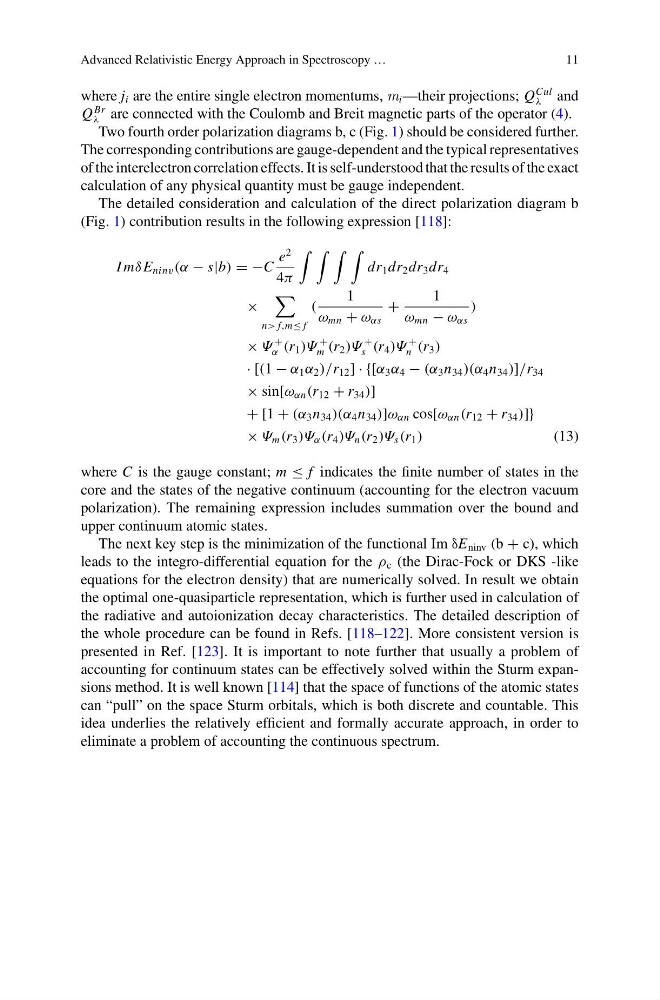
The detailed consideration and calculation of the direct polarization diagram b
(Fig. 1) contribution results in the following expression [118]:
I mδ E ninv (α − s|b) = −C
e
2
4π
dr 1 dr 2 dr 3 dr 4
×
n> f,m≤ f
(
1
ω mn + ω αs
+
1
ω mn − ω αs
)
× Ψ
+
α (r 1 )Ψ
+
m (r 2 )Ψ
+
s (r 4 )Ψ
+
n (r 3 )
· [(1 − α 1 α 2 )/r 12 ] · {[α 3 α 4 − (α 3 n 34 )(α 4 n 34 )]/r 34
× sin[ω αn (r 12 + r 34 )]
+ [1 + (α 3 n 34 )(α 4 n 34 )]ω αn cos[ω αn (r 12 + r 34 )]}
× Ψ m (r 3 )Ψ α (r 4 )Ψ n (r 2 )Ψ s (r 1 )
(13)
where C is the gauge constant; m ≤ f indicates the finite number of states in the
core and the states of the negative continuum (accounting for the electron vacuum
polarization). The remaining expression includes summation over the bound and
upper continuum atomic states.
The next key step is the minimization of the functional Im δE ninv (b + c), which
leads to the integro-differential equation for the ρ c (the Dirac-Fock or DKS -like
equations for the electron density) that are numerically solved. In result we obtain
the optimal one-quasiparticle representation, which is further used in calculation of
the radiative and autoionization decay characteristics. The detailed description of
the whole procedure can be found in Refs. [118–122]. More consistent version is
presented in Ref. [123]. It is important to note further that usually a problem of
accounting for continuum states can be effectively solved within the Sturm expansions method. It is well known [114] that the space of functions of the atomic states
can “pull” on the space Sturm orbitals, which is both discrete and countable. This
idea underlies the relatively efficient and formally accurate approach, in order to
eliminate a problem of accounting the continuous spectrum.
11
where j i are the entire single electron momentums, t i —their projections; Q
Cul
λ and
Q
Br
λ are connected with the Coulomb and Breit magnetic parts of the operator (4).
Two fourth order polarization diagrams b, c (Fig. 1) should be considered further.
The corresponding contributions are gauge-dependent and the typical representatives
of the interelectron correlation effects. It is self-understood that the results of the exact
calculation of any physical quantity must be gauge independent.
The detailed consideration and calculation of the direct polarization diagram b
(Fig. 1) contribution results in the following expression [118]:
I mδ E ninv (α − s|b) = −C
e
2
4π
dr 1 dr 2 dr 3 dr 4
×
n> f,m≤ f
(
1
ω mn + ω αs
+
1
ω mn − ω αs
)
× Ψ
+
α (r 1 )Ψ
+
m (r 2 )Ψ
+
s (r 4 )Ψ
+
n (r 3 )
· [(1 − α 1 α 2 )/r 12 ] · {[α 3 α 4 − (α 3 n 34 )(α 4 n 34 )]/r 34
× sin[ω αn (r 12 + r 34 )]
+ [1 + (α 3 n 34 )(α 4 n 34 )]ω αn cos[ω αn (r 12 + r 34 )]}
× Ψ m (r 3 )Ψ α (r 4 )Ψ n (r 2 )Ψ s (r 1 )
(13)
where C is the gauge constant; m ≤ f indicates the finite number of states in the
core and the states of the negative continuum (accounting for the electron vacuum
polarization). The remaining expression includes summation over the bound and
upper continuum atomic states.
The next key step is the minimization of the functional Im δE ninv (b + c), which
leads to the integro-differential equation for the ρ c (the Dirac-Fock or DKS -like
equations for the electron density) that are numerically solved. In result we obtain
the optimal one-quasiparticle representation, which is further used in calculation of
the radiative and autoionization decay characteristics. The detailed description of
the whole procedure can be found in Refs. [118–122]. More consistent version is
presented in Ref. [123]. It is important to note further that usually a problem of
accounting for continuum states can be effectively solved within the Sturm expansions method. It is well known [114] that the space of functions of the atomic states
can “pull” on the space Sturm orbitals, which is both discrete and countable. This
idea underlies the relatively efficient and formally accurate approach, in order to
eliminate a problem of accounting the continuous spectrum.