

10
A. V. Glushkov
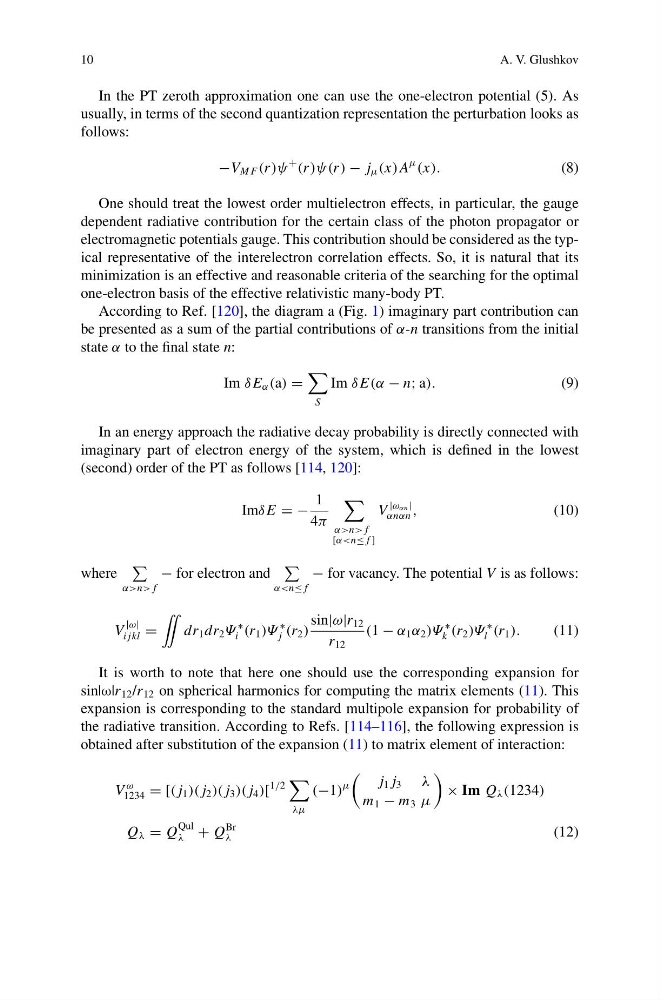
In the PT zeroth approximation one can use the one-electron potential (5). As
usually, in terms of the second quantization representation the perturbation looks as
follows:
−V M F (r )ψ
+
(r )ψ(r ) − j μ (x)A
μ
(x).
(8)
One should treat the lowest order multielectron effects, in particular, the gauge
dependent radiative contribution for the certain class of the photon propagator or
electromagnetic potentials gauge. This contribution should be considered as the typical representative of the interelectron correlation effects. So, it is natural that its
minimization is an effective and reasonable criteria of the searching for the optimal
one-electron basis of the effective relativistic many-body PT.
According to Ref. [120], the diagram a (Fig. 1) imaginary part contribution can
be presented as a sum of the partial contributions of α-n transitions from the initial
state α to the final state n:
Im δ E α (a) =
S
Im δ E(α − n; a).
(9)
In an energy approach the radiative decay probability is directly connected with
imaginary part of electron energy of the system, which is defined in the lowest
(second) order of the PT as follows [114, 120]:
Imδ E = −
1
4π
α>n> f
[α
|ω αn |
αnαn ,
(10)
where
α>n> f
− for electron and
α
V
|ω|
i jkl =
¨
dr 1 dr 2 Ψ
∗
i (r 1 )Ψ
∗
j (r 2 )
sin|ω|r 12
r 12
(1 − α 1 α 2 )Ψ
∗
k (r 2 )Ψ
∗
l (r 1 ).
(11)
It is worth to note that here one should use the corresponding expansion for
sin|ω|r 12 /r 12 on spherical harmonics for computing the matrix elements (11). This
expansion is corresponding to the standard multipole expansion for probability of
the radiative transition. According to Refs. [114–116], the following expression is
obtained after substitution of the expansion (11) to matrix element of interaction:
V
ω
1234 = [( j 1 )( j 2 )( j 3 )( j 4 )[
1/2
λμ
(−1)
μ
j 1 j 3 λ
m 1 − m 3 μ
× Im Q λ (1234)
Q λ = Q
Qul
λ + Q
Br
λ
(12)
A. V. Glushkov
In the PT zeroth approximation one can use the one-electron potential (5). As
usually, in terms of the second quantization representation the perturbation looks as
follows:
−V M F (r )ψ
+
(r )ψ(r ) − j μ (x)A
μ
(x).
(8)
One should treat the lowest order multielectron effects, in particular, the gauge
dependent radiative contribution for the certain class of the photon propagator or
electromagnetic potentials gauge. This contribution should be considered as the typical representative of the interelectron correlation effects. So, it is natural that its
minimization is an effective and reasonable criteria of the searching for the optimal
one-electron basis of the effective relativistic many-body PT.
According to Ref. [120], the diagram a (Fig. 1) imaginary part contribution can
be presented as a sum of the partial contributions of α-n transitions from the initial
state α to the final state n:
Im δ E α (a) =
S
Im δ E(α − n; a).
(9)
In an energy approach the radiative decay probability is directly connected with
imaginary part of electron energy of the system, which is defined in the lowest
(second) order of the PT as follows [114, 120]:
Imδ E = −
1
4π
α>n> f
[α
|ω αn |
αnαn ,
(10)
where
α>n> f
− for electron and
α
V
|ω|
i jkl =
¨
dr 1 dr 2 Ψ
∗
i (r 1 )Ψ
∗
j (r 2 )
sin|ω|r 12
r 12
(1 − α 1 α 2 )Ψ
∗
k (r 2 )Ψ
∗
l (r 1 ).
(11)
It is worth to note that here one should use the corresponding expansion for
sin|ω|r 12 /r 12 on spherical harmonics for computing the matrix elements (11). This
expansion is corresponding to the standard multipole expansion for probability of
the radiative transition. According to Refs. [114–116], the following expression is
obtained after substitution of the expansion (11) to matrix element of interaction:
V
ω
1234 = [( j 1 )( j 2 )( j 3 )( j 4 )[
1/2
λμ
(−1)
μ
j 1 j 3 λ
m 1 − m 3 μ
× Im Q λ (1234)
Q λ = Q
Qul
λ + Q
Br
λ
(12)