

Advanced Relativistic Energy Approach in Spectroscopy …
9
interaction (through the polarizable core) potential are presented in Refs. [96, 114–
135, 141–179]. An effective approach to accounting for the polarization diagrams
contributions is in adding the effective two- quasiparticle polarizable operator into
the PT first order matrix elements. In Ref. [114] the corresponding non-relativistic
polarization functional has been derived. More correct relativistic expression has
been presented in the Refs. [120, 121, 180–182].
2.2 Radiative Decay in an Energy Approach
and the Optimized One-Electron Representation
It is well known that the topic of the searching and construction of the optimal
one-electron (one-quasiparticle) representation is one of the oldest in the theory of
multielectron atoms and generally speaking, in quantum chemistry. A great number
of different approaches have been developed (c.g. [39–63]). One could mention the
known Davidson’s “natural orbitals” representation. The density functional method
represents one of the simplified recipes too. It is well-known that the density functional theory is very effective approach in a modern quantum chemistry, however,
generally speaking, it doesn’t provide a regular and precise refinement procedure
in the case of the complicated atom with few quasiparticles (electrons or vacancies
above a core of the closed electronic shells). Other approaches are in details described
in Refs. [4, 120].
An effective ab initio approach to construction of the optimized PT basis has been
developed in Refs. [118–120] and reduced to consistent treating gauge-dependent
multielectron contributions ImδE ninv of the lowest relativistic PT corrections to the
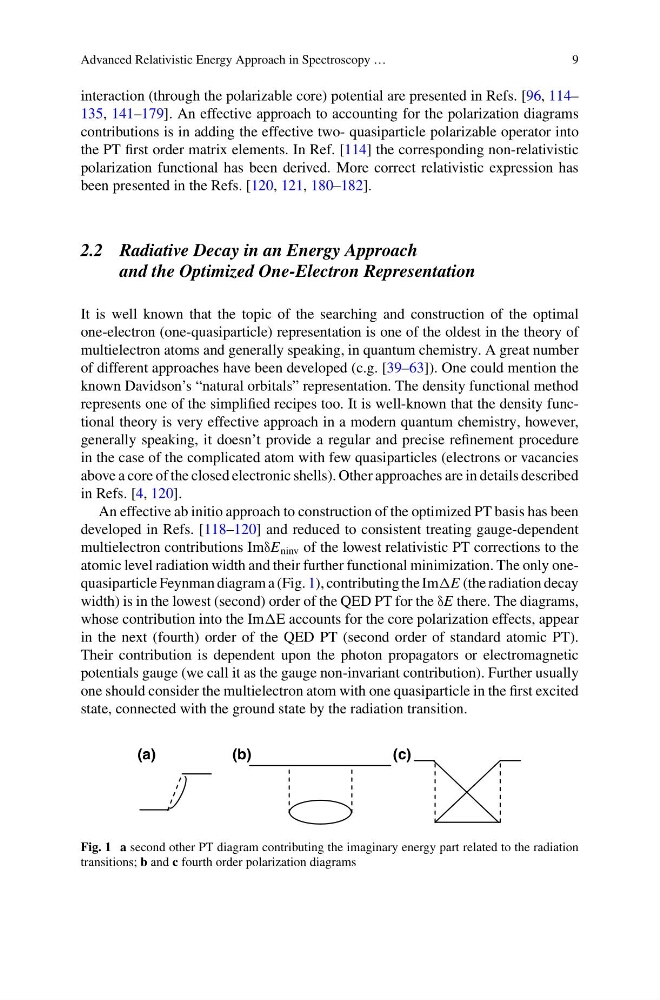
atomic level radiation width and their further functional minimization. The only onequasiparticle Feynman diagram a (Fig. 1), contributing the Im (the radiation decay
width) is in the lowest (second) order of the QED PT for the δE there. The diagrams,
whose contribution into the ImE accounts for the core polarization effects, appear
in the next (fourth) order of the QED PT (second order of standard atomic PT).
Their contribution is dependent upon the photon propagators or electromagnetic
potentials gauge (we call it as the gauge non-invariant contribution). Further usually
one should consider the multielectron atom with one quasiparticle in the first excited
state, connected with the ground state by the radiation transition.
(a)
(b)
(c)
Fig. 1 a second other PT diagram contributing the imaginary energy part related to the radiation
transitions; b and c fourth order polarization diagrams
9
interaction (through the polarizable core) potential are presented in Refs. [96, 114–
135, 141–179]. An effective approach to accounting for the polarization diagrams
contributions is in adding the effective two- quasiparticle polarizable operator into
the PT first order matrix elements. In Ref. [114] the corresponding non-relativistic
polarization functional has been derived. More correct relativistic expression has
been presented in the Refs. [120, 121, 180–182].
2.2 Radiative Decay in an Energy Approach
and the Optimized One-Electron Representation
It is well known that the topic of the searching and construction of the optimal
one-electron (one-quasiparticle) representation is one of the oldest in the theory of
multielectron atoms and generally speaking, in quantum chemistry. A great number
of different approaches have been developed (c.g. [39–63]). One could mention the
known Davidson’s “natural orbitals” representation. The density functional method
represents one of the simplified recipes too. It is well-known that the density functional theory is very effective approach in a modern quantum chemistry, however,
generally speaking, it doesn’t provide a regular and precise refinement procedure
in the case of the complicated atom with few quasiparticles (electrons or vacancies
above a core of the closed electronic shells). Other approaches are in details described
in Refs. [4, 120].
An effective ab initio approach to construction of the optimized PT basis has been
developed in Refs. [118–120] and reduced to consistent treating gauge-dependent
multielectron contributions ImδE ninv of the lowest relativistic PT corrections to the
atomic level radiation width and their further functional minimization. The only onequasiparticle Feynman diagram a (Fig. 1), contributing the Im (the radiation decay
width) is in the lowest (second) order of the QED PT for the δE there. The diagrams,
whose contribution into the ImE accounts for the core polarization effects, appear
in the next (fourth) order of the QED PT (second order of standard atomic PT).
Their contribution is dependent upon the photon propagators or electromagnetic
potentials gauge (we call it as the gauge non-invariant contribution). Further usually
one should consider the multielectron atom with one quasiparticle in the first excited
state, connected with the ground state by the radiation transition.
(a)
(b)
(c)
Fig. 1 a second other PT diagram contributing the imaginary energy part related to the radiation
transitions; b and c fourth order polarization diagrams