

8
A. V. Glushkov
H =
i
h(r i ) +
i> j
V
r i r j
.
(3)
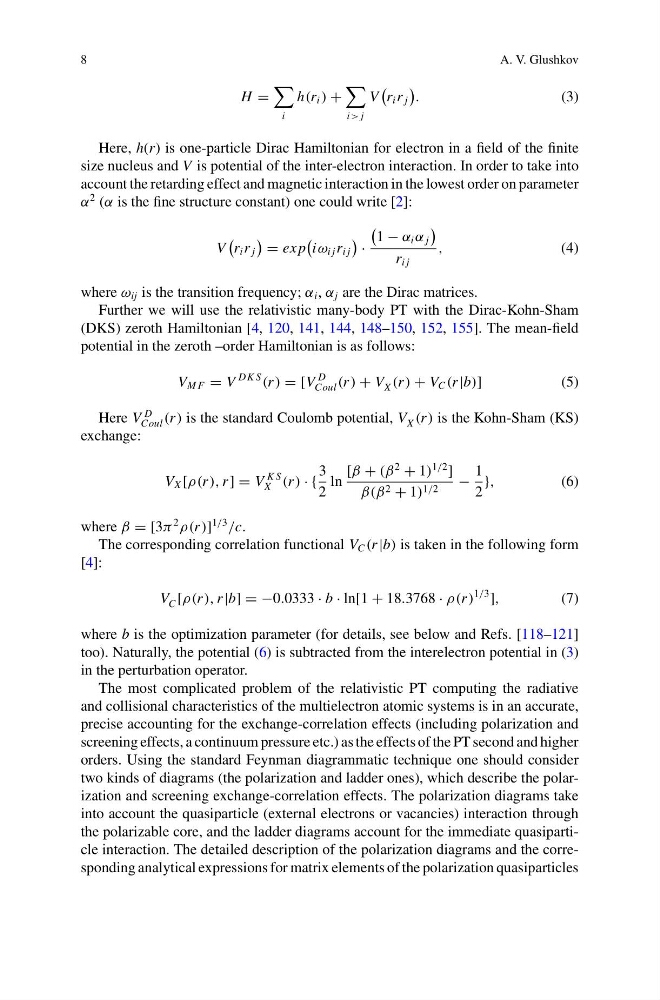
Here, h(r) is one-particle Dirac Hamiltonian for electron in a field of the finite
size nucleus and V is potential of the inter-electron interaction. In order to take into
account the retarding effect and magnetic interaction in the lowest order on parameter
α
2 (α is the fine structure constant) one could write [2]:
V
r i r j
= ex p
iω i j r i j
·
1 − α i α j
r i j
,
(4)
where ω ij is the transition frequency; α i , α j are the Dirac matrices.
Further we will use the relativistic many-body PT with the Dirac-Kohn-Sham
(DKS) zeroth Hamiltonian [4, 120, 141, 144, 148–150, 152, 155]. The mean-field
potential in the zeroth –order Hamiltonian is as follows:
V M F = V
DK S
(r ) = [V
D
Coul (r ) + V X (r ) + V C (r |b)]
(5)
Here V
D
Coul (r ) is the standard Coulomb potential, V X (r ) is the Kohn-Sham (KS)
exchange:
V X [ρ(r ), r ] = V
K S
X (r ) · {
3
2
ln
[β + (β
2
+ 1)
1/2
]
β(β 2 + 1) 1/2 −
1
2
},
(6)
where β = [3π
2
ρ(r )]
1/3
/c.
The corresponding correlation functional V C (r |b) is taken in the following form
[4]:
V C [ρ(r ), r |b] = −0.0333 · b · ln[1 + 18.3768 · ρ(r )
1/3
],
(7)
where b is the optimization parameter (for details, see below and Refs. [118–121]
too). Naturally, the potential (6) is subtracted from the interelectron potential in (3)
in the perturbation operator.
The most complicated problem of the relativistic PT computing the radiative
and collisional characteristics of the multielectron atomic systems is in an accurate,
precise accounting for the exchange-correlation effects (including polarization and
screening effects, a continuum pressure etc.) as the effects of the PT second and higher
orders. Using the standard Feynman diagrammatic technique one should consider
two kinds of diagrams (the polarization and ladder ones), which describe the polarization and screening exchange-correlation effects. The polarization diagrams take
into account the quasiparticle (external electrons or vacancies) interaction through
the polarizable core, and the ladder diagrams account for the immediate quasiparticle interaction. The detailed description of the polarization diagrams and the corresponding analytical expressions for matrix elements of the polarization quasiparticles
A. V. Glushkov
H =
i
h(r i ) +
i> j
V
r i r j
.
(3)
Here, h(r) is one-particle Dirac Hamiltonian for electron in a field of the finite
size nucleus and V is potential of the inter-electron interaction. In order to take into
account the retarding effect and magnetic interaction in the lowest order on parameter
α
2 (α is the fine structure constant) one could write [2]:
V
r i r j
= ex p
iω i j r i j
·
1 − α i α j
r i j
,
(4)
where ω ij is the transition frequency; α i , α j are the Dirac matrices.
Further we will use the relativistic many-body PT with the Dirac-Kohn-Sham
(DKS) zeroth Hamiltonian [4, 120, 141, 144, 148–150, 152, 155]. The mean-field
potential in the zeroth –order Hamiltonian is as follows:
V M F = V
DK S
(r ) = [V
D
Coul (r ) + V X (r ) + V C (r |b)]
(5)
Here V
D
Coul (r ) is the standard Coulomb potential, V X (r ) is the Kohn-Sham (KS)
exchange:
V X [ρ(r ), r ] = V
K S
X (r ) · {
3
2
ln
[β + (β
2
+ 1)
1/2
]
β(β 2 + 1) 1/2 −
1
2
},
(6)
where β = [3π
2
ρ(r )]
1/3
/c.
The corresponding correlation functional V C (r |b) is taken in the following form
[4]:
V C [ρ(r ), r |b] = −0.0333 · b · ln[1 + 18.3768 · ρ(r )
1/3
],
(7)
where b is the optimization parameter (for details, see below and Refs. [118–121]
too). Naturally, the potential (6) is subtracted from the interelectron potential in (3)
in the perturbation operator.
The most complicated problem of the relativistic PT computing the radiative
and collisional characteristics of the multielectron atomic systems is in an accurate,
precise accounting for the exchange-correlation effects (including polarization and
screening effects, a continuum pressure etc.) as the effects of the PT second and higher
orders. Using the standard Feynman diagrammatic technique one should consider
two kinds of diagrams (the polarization and ladder ones), which describe the polarization and screening exchange-correlation effects. The polarization diagrams take
into account the quasiparticle (external electrons or vacancies) interaction through
the polarizable core, and the ladder diagrams account for the immediate quasiparticle interaction. The detailed description of the polarization diagrams and the corresponding analytical expressions for matrix elements of the polarization quasiparticles