

Advanced Relativistic Energy Approach in Spectroscopy …
13
energy shift δ E (1). An expansion of an energy shift into the PT series allows to
construct a regular method for computing the autoionizing states width. It is worth
to remind that the autoionization width firstly appears in the QED PT fourth (second
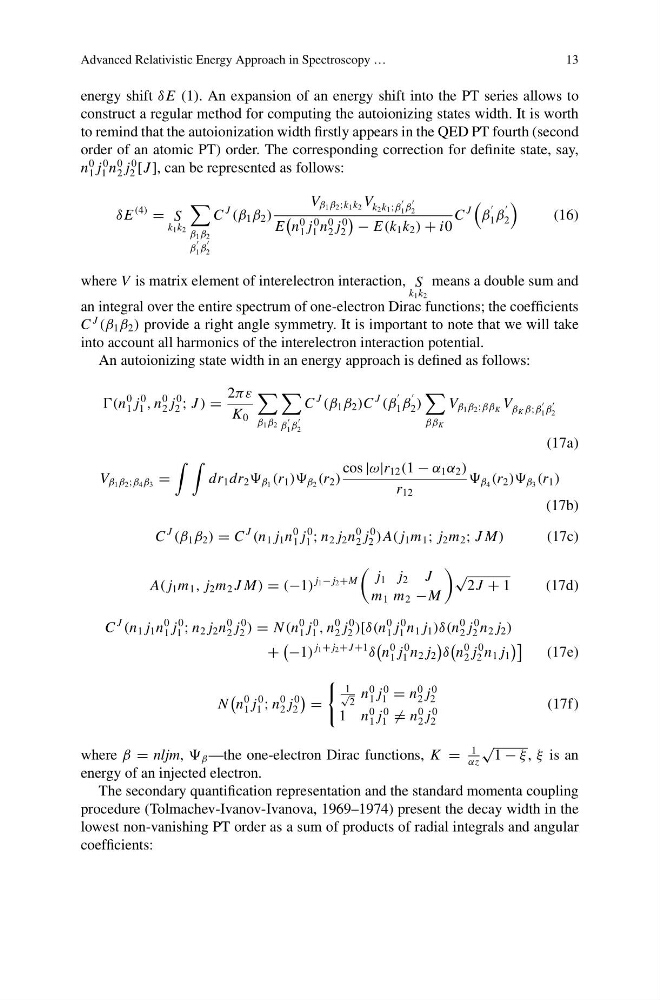
order of an atomic PT) order. The corresponding correction for definite state, say,
n
0
1 j
0
1 n
0
2 j
0
2 [J ], can be represented as follows:
δ E
(4)
= S
k 1 k 2
β 1 β 2
β
1 β
2
C
J
(β 1 β 2 )
V β 1 β 2 ;k 1 k 2 V k 2 k 1 ;β
1 β
2
E
n
0
1 j
0
1 n
0
2 j
0
2
− E(k 1 k 2 ) + i0
C
J
β
1 β
2
(16)
where V is matrix element of interelectron interaction, S
k 1 k 2
means a double sum and
an integral over the entire spectrum of one-electron Dirac functions; the coefficients
C
J
(β 1 β 2 ) provide a right angle symmetry. It is important to note that we will take
into account all harmonics of the interelectron interaction potential.
An autoionizing state width in an energy approach is defined as follows:
(n
0
1 j
0
1 , n
0
2 j
0
2 ; J ) =
2πε
K 0
β 1 β 2
β
1 β
2
C
J
(β 1 β 2 )C
J
(β
1 β
2 )
ββ K
V β 1 β 2 ;ββ K V β K β;β
1 β
2
(17a)
V β 1 β 2 ;β 4 β 3 =
dr 1 dr 2 β 1 (r 1 )) β 2 (r 2 )
cos |ω|r 12 (1 − α 1 α 2 )
r 12
β 4 (r 2 )) β 3 (r 1 )
(17b)
C
J
(β 1 β 2 ) = C
J
(n 1 j 1 n
0
1 j
0
1 ; n 2 j 2 n
0
2 j
0
2 )A( j 1 m 1 ; j 2 m 2 ; J M)
(17c)
A( j 1 m 1 , j 2 m 2 J M) = (−1)
j 1 − j 2 +M
j 1
m 1
j 2
m 2
J
−M
√
2J + 1
(17d)
C
J
(n 1 j 1 n
0
1 j
0
1 ; n 2 j 2 n
0
2 j
0
2 ) = N (n
0
1 j
0
1 , n
0
2 j
0
2 )[δ(n
0
1 j
0
1 n 1 j 1 )δ(n
0
2 j
0
2 n 2 j 2 )
+
−1)
j 1 + j 2 +J +1
δ
n
0
1 j
0
1 n 2 j 2
δ
n
0
2 j
0
2 n 1 j 1
(17e)
N
n
0
1 j
0
1 ; n
0
2 j
0
2
=
1
√
2
n
0
1 j
0
1 = n
0
2 j
0
2
1 n
0
1 j
0
1 = n
0
2 j
0
2
(17f)
where β = nljm, β —the one-electron Dirac functions, K =
1
αz
√
1 − ξ , ξ is an
energy of an injected electron.
The secondary quantification representation and the standard momenta coupling
procedure (Tolmachev-Ivanov-Ivanova, 1969–1974) present the decay width in the
lowest non-vanishing PT order as a sum of products of radial integrals and angular
coefficients:
13
energy shift δ E (1). An expansion of an energy shift into the PT series allows to
construct a regular method for computing the autoionizing states width. It is worth
to remind that the autoionization width firstly appears in the QED PT fourth (second
order of an atomic PT) order. The corresponding correction for definite state, say,
n
0
1 j
0
1 n
0
2 j
0
2 [J ], can be represented as follows:
δ E
(4)
= S
k 1 k 2
β 1 β 2
β
1 β
2
C
J
(β 1 β 2 )
V β 1 β 2 ;k 1 k 2 V k 2 k 1 ;β
1 β
2
E
n
0
1 j
0
1 n
0
2 j
0
2
− E(k 1 k 2 ) + i0
C
J
β
1 β
2
(16)
where V is matrix element of interelectron interaction, S
k 1 k 2
means a double sum and
an integral over the entire spectrum of one-electron Dirac functions; the coefficients
C
J
(β 1 β 2 ) provide a right angle symmetry. It is important to note that we will take
into account all harmonics of the interelectron interaction potential.
An autoionizing state width in an energy approach is defined as follows:
(n
0
1 j
0
1 , n
0
2 j
0
2 ; J ) =
2πε
K 0
β 1 β 2
β
1 β
2
C
J
(β 1 β 2 )C
J
(β
1 β
2 )
ββ K
V β 1 β 2 ;ββ K V β K β;β
1 β
2
(17a)
V β 1 β 2 ;β 4 β 3 =
dr 1 dr 2 β 1 (r 1 )) β 2 (r 2 )
cos |ω|r 12 (1 − α 1 α 2 )
r 12
β 4 (r 2 )) β 3 (r 1 )
(17b)
C
J
(β 1 β 2 ) = C
J
(n 1 j 1 n
0
1 j
0
1 ; n 2 j 2 n
0
2 j
0
2 )A( j 1 m 1 ; j 2 m 2 ; J M)
(17c)
A( j 1 m 1 , j 2 m 2 J M) = (−1)
j 1 − j 2 +M
j 1
m 1
j 2
m 2
J
−M
√
2J + 1
(17d)
C
J
(n 1 j 1 n
0
1 j
0
1 ; n 2 j 2 n
0
2 j
0
2 ) = N (n
0
1 j
0
1 , n
0
2 j
0
2 )[δ(n
0
1 j
0
1 n 1 j 1 )δ(n
0
2 j
0
2 n 2 j 2 )
+
−1)
j 1 + j 2 +J +1
δ
n
0
1 j
0
1 n 2 j 2
δ
n
0
2 j
0
2 n 1 j 1
(17e)
N
n
0
1 j
0
1 ; n
0
2 j
0
2
=
1
√
2
n
0
1 j
0
1 = n
0
2 j
0
2
1 n
0
1 j
0
1 = n
0
2 j
0
2
(17f)
where β = nljm, β —the one-electron Dirac functions, K =
1
αz
√
1 − ξ , ξ is an
energy of an injected electron.
The secondary quantification representation and the standard momenta coupling
procedure (Tolmachev-Ivanov-Ivanova, 1969–1974) present the decay width in the
lowest non-vanishing PT order as a sum of products of radial integrals and angular
coefficients: