

242
V. Poltev et al.
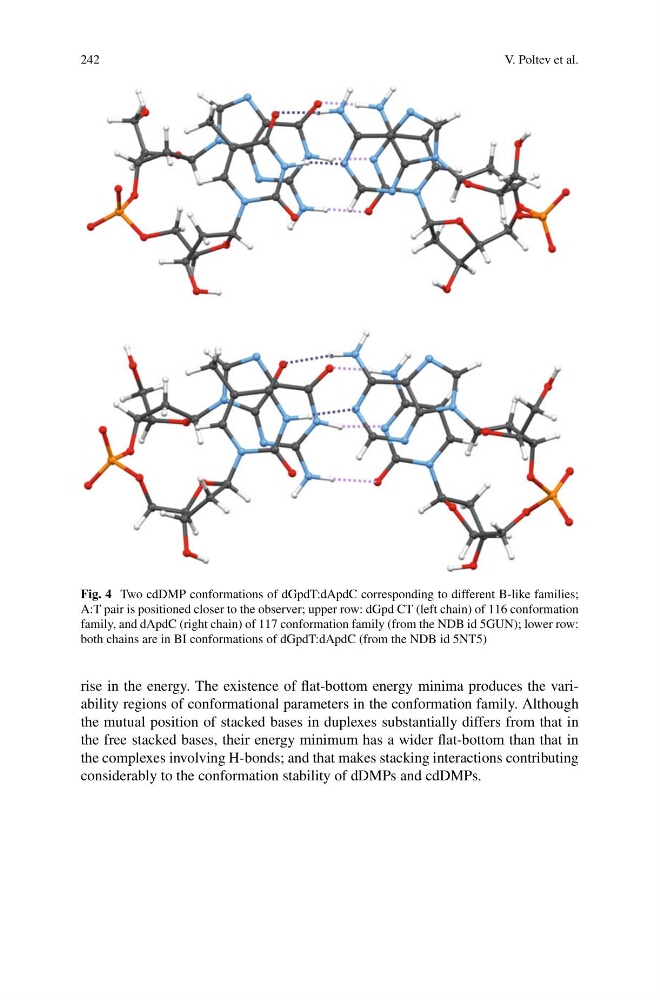
Fig. 4 Two cdDMP conformations of dGpdT:dApdC corresponding to different B-like families;
A:T pair is positioned closer to the observer; upper row: dGpd CT (left chain) of 116 conformation
family, and dApdC (right chain) of 117 conformation family (from the NDB id 5GUN); lower row:
both chains are in BI conformations of dGpdT:dApdC (from the NDB id 5NT5)
rise in the energy. The existence of flat-bottom energy minima produces the variability regions of conformational parameters in the conformation family. Although
the mutual position of stacked bases in duplexes substantially differs from that in
the free stacked bases, their energy minimum has a wider flat-bottom than that in
the complexes involving H-bonds; and that makes stacking interactions contributing
considerably to the conformation stability of dDMPs and cdDMPs.
V. Poltev et al.
Fig. 4 Two cdDMP conformations of dGpdT:dApdC corresponding to different B-like families;
A:T pair is positioned closer to the observer; upper row: dGpd CT (left chain) of 116 conformation
family, and dApdC (right chain) of 117 conformation family (from the NDB id 5GUN); lower row:
both chains are in BI conformations of dGpdT:dApdC (from the NDB id 5NT5)
rise in the energy. The existence of flat-bottom energy minima produces the variability regions of conformational parameters in the conformation family. Although
the mutual position of stacked bases in duplexes substantially differs from that in
the free stacked bases, their energy minimum has a wider flat-bottom than that in
the complexes involving H-bonds; and that makes stacking interactions contributing
considerably to the conformation stability of dDMPs and cdDMPs.