

Current Problems in Computer Simulation of Variability …
241
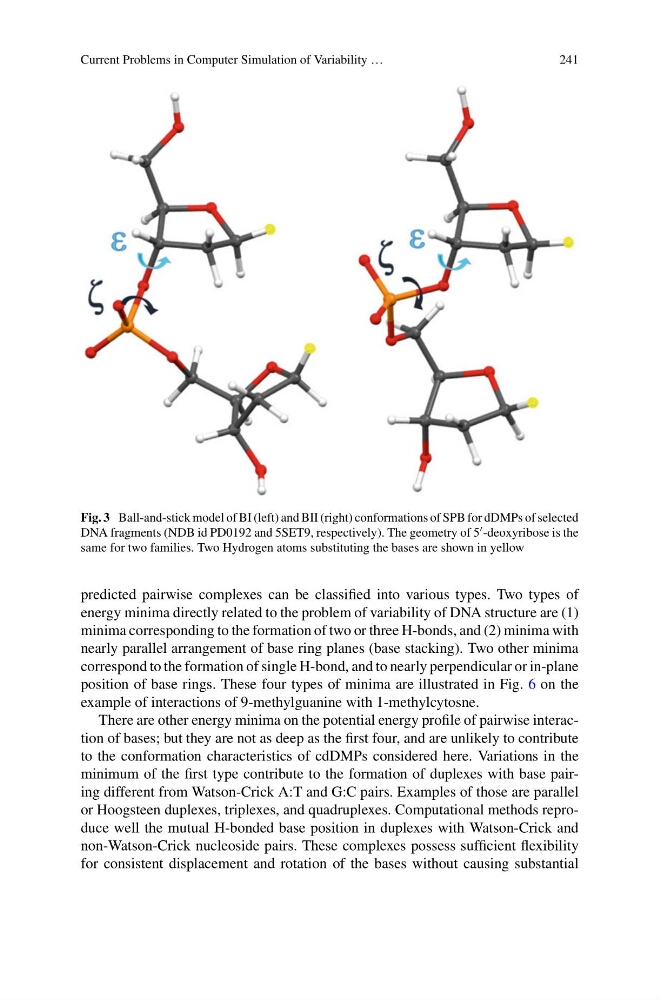
Fig. 3 Ball-and-stick model of BI (left) and BII (right) conformations of SPB for dDMPs of selected
DNA fragments (NDB id PD0192 and 5SET9, respectively). The geometry of 5 -deoxyribose is the
same for two families. Two Hydrogen atoms substituting the bases are shown in yellow
predicted pairwise complexes can be classified into various types. Two types of
energy minima directly related to the problem of variability of DNA structure are (1)
minima corresponding to the formation of two or three H-bonds, and (2) minima with
nearly parallel arrangement of base ring planes (base stacking). Two other minima
correspond to the formation of single H-bond, and to nearly perpendicular or in-plane
position of base rings. These four types of minima are illustrated in Fig. 6 on the
example of interactions of 9-methylguanine with 1-methylcytosne.
There are other energy minima on the potential energy profile of pairwise interaction of bases; but they are not as deep as the first four, and are unlikely to contribute
to the conformation characteristics of cdDMPs considered here. Variations in the
minimum of the first type contribute to the formation of duplexes with base pairing different from Watson-Crick A:T and G:C pairs. Examples of those are parallel
or Hoogsteen duplexes, triplexes, and quadruplexes. Computational methods reproduce well the mutual H-bonded base position in duplexes with Watson-Crick and
non-Watson-Crick nucleoside pairs. These complexes possess sufficient flexibility
for consistent displacement and rotation of the bases without causing substantial
241
Fig. 3 Ball-and-stick model of BI (left) and BII (right) conformations of SPB for dDMPs of selected
DNA fragments (NDB id PD0192 and 5SET9, respectively). The geometry of 5 -deoxyribose is the
same for two families. Two Hydrogen atoms substituting the bases are shown in yellow
predicted pairwise complexes can be classified into various types. Two types of
energy minima directly related to the problem of variability of DNA structure are (1)
minima corresponding to the formation of two or three H-bonds, and (2) minima with
nearly parallel arrangement of base ring planes (base stacking). Two other minima
correspond to the formation of single H-bond, and to nearly perpendicular or in-plane
position of base rings. These four types of minima are illustrated in Fig. 6 on the
example of interactions of 9-methylguanine with 1-methylcytosne.
There are other energy minima on the potential energy profile of pairwise interaction of bases; but they are not as deep as the first four, and are unlikely to contribute
to the conformation characteristics of cdDMPs considered here. Variations in the
minimum of the first type contribute to the formation of duplexes with base pairing different from Watson-Crick A:T and G:C pairs. Examples of those are parallel
or Hoogsteen duplexes, triplexes, and quadruplexes. Computational methods reproduce well the mutual H-bonded base position in duplexes with Watson-Crick and
non-Watson-Crick nucleoside pairs. These complexes possess sufficient flexibility
for consistent displacement and rotation of the bases without causing substantial