

Ab Initio and DFT Computational Study …
213
d
s
r
w
non-u
u
position of the first IHB
orientation of O10−H16
orientation of the OH ortho to CRO
and not engaged in the first IHB
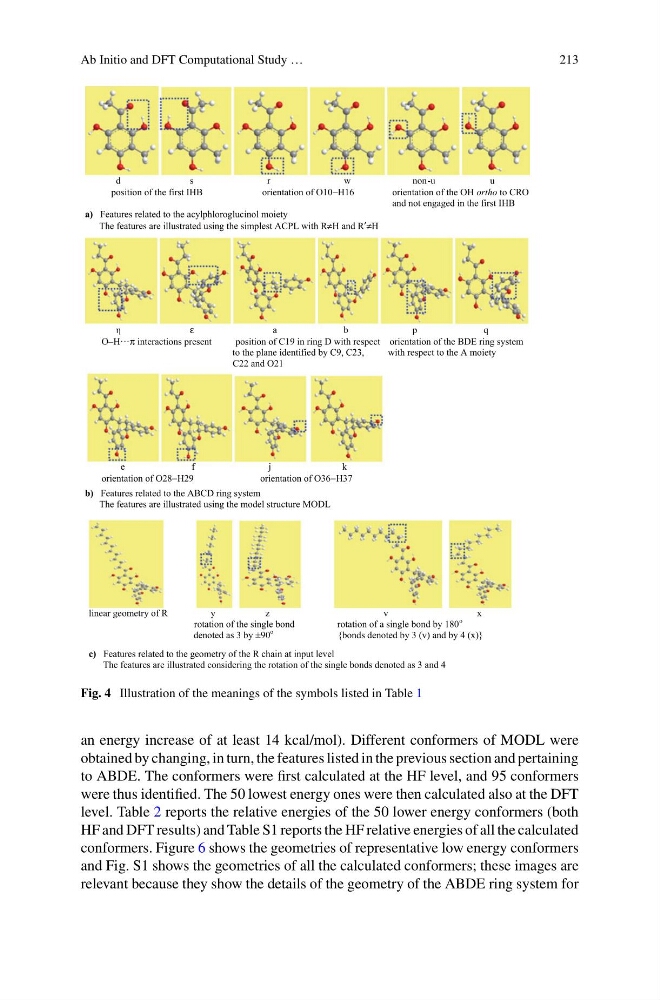
a) Features related to the acylphloroglucinol moiety
The features are illustrated using the simplest ACPL with R≠H and R′≠H
η
ε
a
b
p
q
O–H···π interactions present
position of C19 in ring D with respect orientation of the BDE ring system
to the plane identified by C9, C23,
with respect to the A moiety
C22 and O21
e
f
j
k
orientation of O28−H29
orientation of O36−H37
b) Features related to the ABCD ring system
The features are illustrated using the model structure MODL
linear geometry of R
y
z
v
x
rotation of the single bond
rotation of a single bond by 180
o
denoted as 3 by ±90
o
{bonds denoted by 3 (v) and by 4 (x)}
c) Features related to the geometry of the R chain at input level
The features are illustrated considering the rotation of the single bonds denoted as 3 and 4
Fig. 4 Illustration of the meanings of the symbols listed in Table 1
an energy increase of at least 14 kcal/mol). Different conformers of MODL were
obtained by changing, in turn, the features listed in the previous section and pertaining
to ABDE. The conformers were first calculated at the HF level, and 95 conformers
were thus identified. The 50 lowest energy ones were then calculated also at the DFT
level. Table 2 reports the relative energies of the 50 lower energy conformers (both
HF and DFT results) and Table S1 reports the HF relative energies of all the calculated
conformers. Figure 6 shows the geometries of representative low energy conformers
and Fig. S1 shows the geometries of all the calculated conformers; these images are
relevant because they show the details of the geometry of the ABDE ring system for
213
d
s
r
w
non-u
u
position of the first IHB
orientation of O10−H16
orientation of the OH ortho to CRO
and not engaged in the first IHB
a) Features related to the acylphloroglucinol moiety
The features are illustrated using the simplest ACPL with R≠H and R′≠H
η
ε
a
b
p
q
O–H···π interactions present
position of C19 in ring D with respect orientation of the BDE ring system
to the plane identified by C9, C23,
with respect to the A moiety
C22 and O21
e
f
j
k
orientation of O28−H29
orientation of O36−H37
b) Features related to the ABCD ring system
The features are illustrated using the model structure MODL
linear geometry of R
y
z
v
x
rotation of the single bond
rotation of a single bond by 180
o
denoted as 3 by ±90
o
{bonds denoted by 3 (v) and by 4 (x)}
c) Features related to the geometry of the R chain at input level
The features are illustrated considering the rotation of the single bonds denoted as 3 and 4
Fig. 4 Illustration of the meanings of the symbols listed in Table 1
an energy increase of at least 14 kcal/mol). Different conformers of MODL were
obtained by changing, in turn, the features listed in the previous section and pertaining
to ABDE. The conformers were first calculated at the HF level, and 95 conformers
were thus identified. The 50 lowest energy ones were then calculated also at the DFT
level. Table 2 reports the relative energies of the 50 lower energy conformers (both
HF and DFT results) and Table S1 reports the HF relative energies of all the calculated
conformers. Figure 6 shows the geometries of representative low energy conformers
and Fig. S1 shows the geometries of all the calculated conformers; these images are
relevant because they show the details of the geometry of the ABDE ring system for