

212
N. Tshilande and L. Mammino
O
O
O
O
O
O
O
H
H
H
H
H
H
1
2
3
4
5
6
7
8
9
10
CH3
O
O
O
O
O
O
H
H
H
H
H
H
H3C
1
2
3
4
5
6
7
8
9
10
11
12
13
Number Corresponding
bond
Number Corresponding
bond
Number Corresponding
bond
Number Corresponding
bond
1
C7–C13
4
C38–C39
7
C41–C42
10
C44–C45
2
C13–C18
5
C39–C40
8
C42–C43
3
C18–C38
6
C40–C41
9
C43–C44
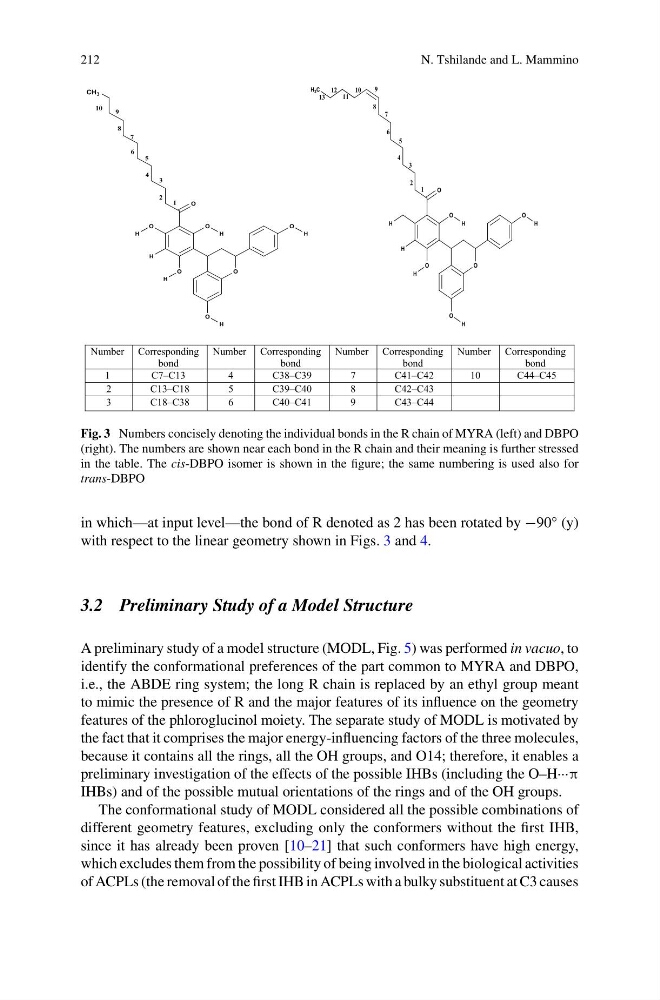
Fig. 3 Numbers concisely denoting the individual bonds in the R chain of MYRA (left) and DBPO
(right). The numbers are shown near each bond in the R chain and their meaning is further stressed
in the table. The cis-DBPO isomer is shown in the figure; the same numbering is used also for
trans-DBPO
in which—at input level—the bond of R denoted as 2 has been rotated by −90° (y)
with respect to the linear geometry shown in Figs. 3 and 4.
3.2 Preliminary Study of a Model Structure
A preliminary study of a model structure (MODL, Fig. 5) was performed in vacuo, to
identify the conformational preferences of the part common to MYRA and DBPO,
i.e., the ABDE ring system; the long R chain is replaced by an ethyl group meant
to mimic the presence of R and the major features of its influence on the geometry
features of the phloroglucinol moiety. The separate study of MODL is motivated by
the fact that it comprises the major energy-influencing factors of the three molecules,
because it contains all the rings, all the OH groups, and O14; therefore, it enables a
preliminary investigation of the effects of the possible IHBs (including the O–H···π
IHBs) and of the possible mutual orientations of the rings and of the OH groups.
The conformational study of MODL considered all the possible combinations of
different geometry features, excluding only the conformers without the first IHB,
since it has already been proven [10–21] that such conformers have high energy,
which excludes them from the possibility of being involved in the biological activities
of ACPLs (the removal of the first IHB in ACPLs with a bulky substituent at C3 causes
N. Tshilande and L. Mammino
O
O
O
O
O
O
O
H
H
H
H
H
H
1
2
3
4
5
6
7
8
9
10
CH3
O
O
O
O
O
O
H
H
H
H
H
H
H3C
1
2
3
4
5
6
7
8
9
10
11
12
13
Number Corresponding
bond
Number Corresponding
bond
Number Corresponding
bond
Number Corresponding
bond
1
C7–C13
4
C38–C39
7
C41–C42
10
C44–C45
2
C13–C18
5
C39–C40
8
C42–C43
3
C18–C38
6
C40–C41
9
C43–C44
Fig. 3 Numbers concisely denoting the individual bonds in the R chain of MYRA (left) and DBPO
(right). The numbers are shown near each bond in the R chain and their meaning is further stressed
in the table. The cis-DBPO isomer is shown in the figure; the same numbering is used also for
trans-DBPO
in which—at input level—the bond of R denoted as 2 has been rotated by −90° (y)
with respect to the linear geometry shown in Figs. 3 and 4.
3.2 Preliminary Study of a Model Structure
A preliminary study of a model structure (MODL, Fig. 5) was performed in vacuo, to
identify the conformational preferences of the part common to MYRA and DBPO,
i.e., the ABDE ring system; the long R chain is replaced by an ethyl group meant
to mimic the presence of R and the major features of its influence on the geometry
features of the phloroglucinol moiety. The separate study of MODL is motivated by
the fact that it comprises the major energy-influencing factors of the three molecules,
because it contains all the rings, all the OH groups, and O14; therefore, it enables a
preliminary investigation of the effects of the possible IHBs (including the O–H···π
IHBs) and of the possible mutual orientations of the rings and of the OH groups.
The conformational study of MODL considered all the possible combinations of
different geometry features, excluding only the conformers without the first IHB,
since it has already been proven [10–21] that such conformers have high energy,
which excludes them from the possibility of being involved in the biological activities
of ACPLs (the removal of the first IHB in ACPLs with a bulky substituent at C3 causes