

Complexes of Furonewguinone B with a Cu 2+ Ion. A DFT Study
167
d-β-γ-ε-b
0.000
d-α-ε-δ-b
0.513
d-α-ε-η-e
0.716
d-β-γ-ε-η-e
0.923
d-α-ε-δ-c
1.168
d-β-γ-ε-c
1.560
d-β-γ-ε-b′
2.109
d-β-ε-δ-a
2.473
d-β-ε-δ-c
2.762
d-β-ε-δ-c′
2.814
d-α-ε-δ-b′
2.881
d-β-γ-a
3.375
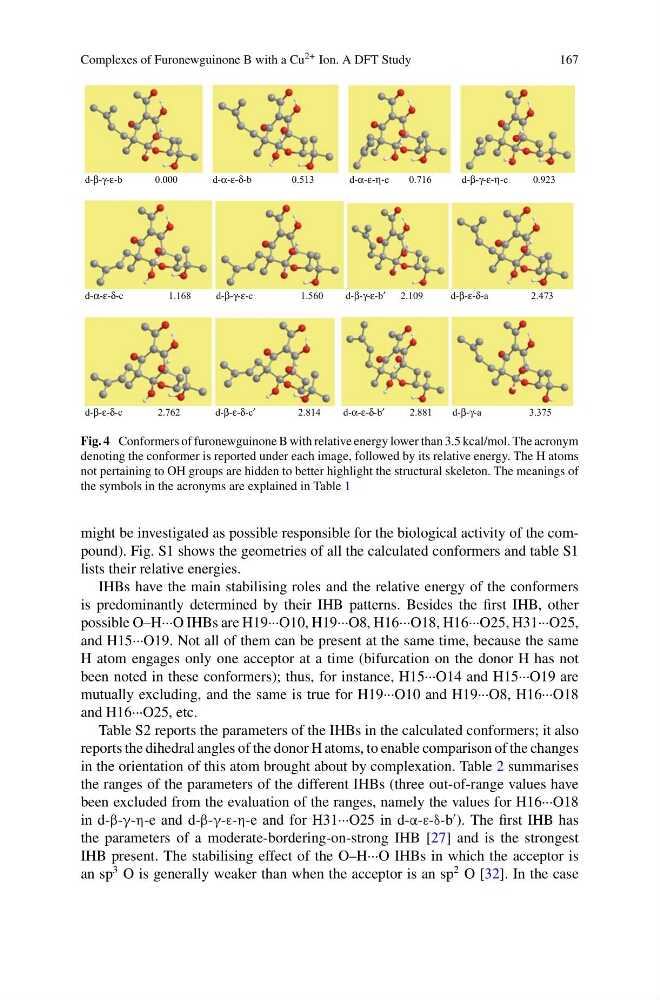
Fig. 4 Conformers of furonewguinone B with relative energy lower than 3.5 kcal/mol. The acronym
denoting the conformer is reported under each image, followed by its relative energy. The H atoms
not pertaining to OH groups are hidden to better highlight the structural skeleton. The meanings of
the symbols in the acronyms are explained in Table 1
might be investigated as possible responsible for the biological activity of the compound). Fig. S1 shows the geometries of all the calculated conformers and table S1
lists their relative energies.
IHBs have the main stabilising roles and the relative energy of the conformers
is predominantly determined by their IHB patterns. Besides the first IHB, other
possible O–H···O IHBs are H19···O10, H19···O8, H16···O18, H16···O25, H31···O25,
and H15···O19. Not all of them can be present at the same time, because the same
H atom engages only one acceptor at a time (bifurcation on the donor H has not
been noted in these conformers); thus, for instance, H15···O14 and H15···O19 are
mutually excluding, and the same is true for H19···O10 and H19···O8, H16···O18
and H16···O25, etc.
Table S2 reports the parameters of the IHBs in the calculated conformers; it also
reports the dihedral angles of the donor H atoms, to enable comparison of the changes
in the orientation of this atom brought about by complexation. Table 2 summarises
the ranges of the parameters of the different IHBs (three out-of-range values have
been excluded from the evaluation of the ranges, namely the values for H16···O18
in d-β-γ-η-e and d-β-γ-ε-η-e and for H31···O25 in d-α-ε-δ-b
). The first IHB has
the parameters of a moderate-bordering-on-strong IHB [27] and is the strongest
IHB present. The stabilising effect of the O–H···O IHBs in which the acceptor is
an sp
3 O is generally weaker than when the acceptor is an sp
2 O [32]. In the case
167
d-β-γ-ε-b
0.000
d-α-ε-δ-b
0.513
d-α-ε-η-e
0.716
d-β-γ-ε-η-e
0.923
d-α-ε-δ-c
1.168
d-β-γ-ε-c
1.560
d-β-γ-ε-b′
2.109
d-β-ε-δ-a
2.473
d-β-ε-δ-c
2.762
d-β-ε-δ-c′
2.814
d-α-ε-δ-b′
2.881
d-β-γ-a
3.375
Fig. 4 Conformers of furonewguinone B with relative energy lower than 3.5 kcal/mol. The acronym
denoting the conformer is reported under each image, followed by its relative energy. The H atoms
not pertaining to OH groups are hidden to better highlight the structural skeleton. The meanings of
the symbols in the acronyms are explained in Table 1
might be investigated as possible responsible for the biological activity of the compound). Fig. S1 shows the geometries of all the calculated conformers and table S1
lists their relative energies.
IHBs have the main stabilising roles and the relative energy of the conformers
is predominantly determined by their IHB patterns. Besides the first IHB, other
possible O–H···O IHBs are H19···O10, H19···O8, H16···O18, H16···O25, H31···O25,
and H15···O19. Not all of them can be present at the same time, because the same
H atom engages only one acceptor at a time (bifurcation on the donor H has not
been noted in these conformers); thus, for instance, H15···O14 and H15···O19 are
mutually excluding, and the same is true for H19···O10 and H19···O8, H16···O18
and H16···O25, etc.
Table S2 reports the parameters of the IHBs in the calculated conformers; it also
reports the dihedral angles of the donor H atoms, to enable comparison of the changes
in the orientation of this atom brought about by complexation. Table 2 summarises
the ranges of the parameters of the different IHBs (three out-of-range values have
been excluded from the evaluation of the ranges, namely the values for H16···O18
in d-β-γ-η-e and d-β-γ-ε-η-e and for H31···O25 in d-α-ε-δ-b
). The first IHB has
the parameters of a moderate-bordering-on-strong IHB [27] and is the strongest
IHB present. The stabilising effect of the O–H···O IHBs in which the acceptor is
an sp
3 O is generally weaker than when the acceptor is an sp
2 O [32]. In the case