

166
L. Mammino
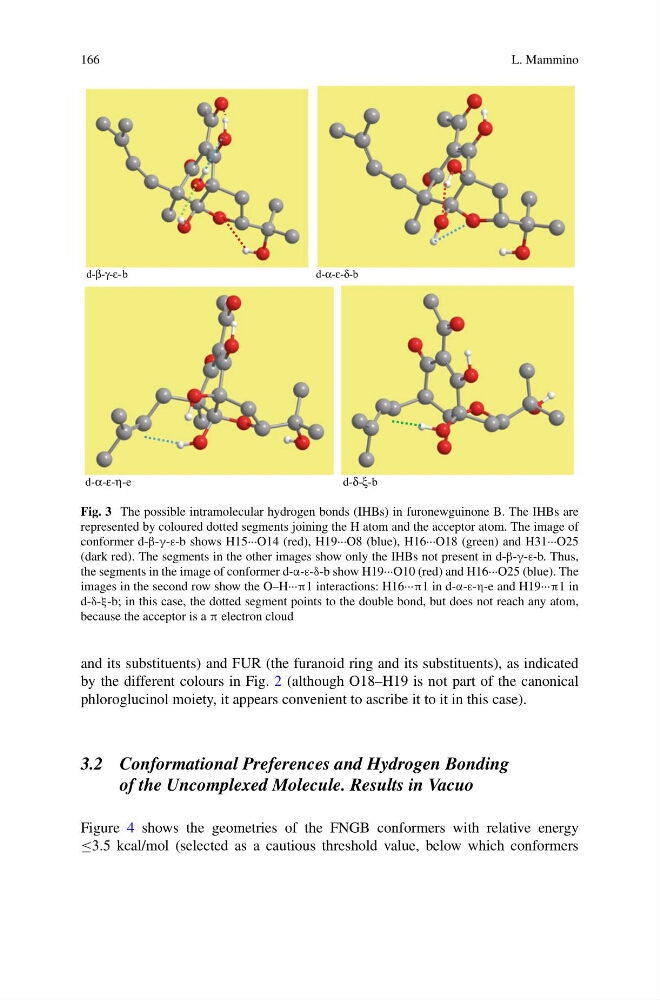
d-β-γ-ε-b
d-α-ε-δ-b
d-α-ε-η-e
d-δ-ξ-b
Fig. 3 The possible intramolecular hydrogen bonds (IHBs) in furonewguinone B. The IHBs are
represented by coloured dotted segments joining the H atom and the acceptor atom. The image of
conformer d-β-γ-ε-b shows H15···O14 (red), H19···O8 (blue), H16···O18 (green) and H31···O25
(dark red). The segments in the other images show only the IHBs not present in d-β-γ-ε-b. Thus,
the segments in the image of conformer d-α-ε-δ-b show H19···O10 (red) and H16···O25 (blue). The
images in the second row show the O–H···π1 interactions: H16···π1 in d-α-ε-η-e and H19···π1 in
d-δ-ξ-b; in this case, the dotted segment points to the double bond, but does not reach any atom,
because the acceptor is a π electron cloud
and its substituents) and FUR (the furanoid ring and its substituents), as indicated
by the different colours in Fig. 2 (although O18–H19 is not part of the canonical
phloroglucinol moiety, it appears convenient to ascribe it to it in this case).
3.2 Conformational Preferences and Hydrogen Bonding
of the Uncomplexed Molecule. Results in Vacuo
Figure 4 shows the geometries of the FNGB conformers with relative energy
≤3.5 kcal/mol (selected as a cautious threshold value, below which conformers
L. Mammino
d-β-γ-ε-b
d-α-ε-δ-b
d-α-ε-η-e
d-δ-ξ-b
Fig. 3 The possible intramolecular hydrogen bonds (IHBs) in furonewguinone B. The IHBs are
represented by coloured dotted segments joining the H atom and the acceptor atom. The image of
conformer d-β-γ-ε-b shows H15···O14 (red), H19···O8 (blue), H16···O18 (green) and H31···O25
(dark red). The segments in the other images show only the IHBs not present in d-β-γ-ε-b. Thus,
the segments in the image of conformer d-α-ε-δ-b show H19···O10 (red) and H16···O25 (blue). The
images in the second row show the O–H···π1 interactions: H16···π1 in d-α-ε-η-e and H19···π1 in
d-δ-ξ-b; in this case, the dotted segment points to the double bond, but does not reach any atom,
because the acceptor is a π electron cloud
and its substituents) and FUR (the furanoid ring and its substituents), as indicated
by the different colours in Fig. 2 (although O18–H19 is not part of the canonical
phloroglucinol moiety, it appears convenient to ascribe it to it in this case).
3.2 Conformational Preferences and Hydrogen Bonding
of the Uncomplexed Molecule. Results in Vacuo
Figure 4 shows the geometries of the FNGB conformers with relative energy
≤3.5 kcal/mol (selected as a cautious threshold value, below which conformers