

168
L. Mammino
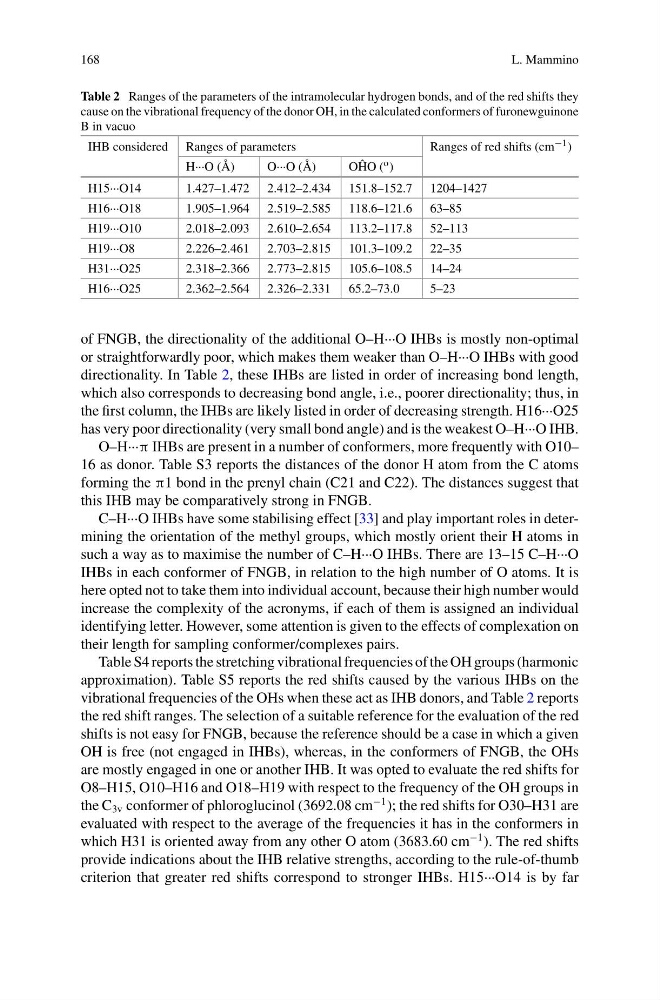
Table 2 Ranges of the parameters of the intramolecular hydrogen bonds, and of the red shifts they
cause on the vibrational frequency of the donor OH, in the calculated conformers of furonewguinone
B in vacuo
IHB considered Ranges of parameters
Ranges of red shifts (cm −1 )
H···O (Å)
O···O (Å)
O ˆ
HO ( o )
H15···O14
1.427–1.472 2.412–2.434 151.8–152.7 1204–1427
H16···O18
1.905–1.964 2.519–2.585 118.6–121.6 63–85
H19···O10
2.018–2.093 2.610–2.654 113.2–117.8 52–113
H19···O8
2.226–2.461 2.703–2.815 101.3–109.2 22–35
H31···O25
2.318–2.366 2.773–2.815 105.6–108.5 14–24
H16···O25
2.362–2.564 2.326–2.331 65.2–73.0
5–23
of FNGB, the directionality of the additional O–H···O IHBs is mostly non-optimal
or straightforwardly poor, which makes them weaker than O–H···O IHBs with good
directionality. In Table 2, these IHBs are listed in order of increasing bond length,
which also corresponds to decreasing bond angle, i.e., poorer directionality; thus, in
the first column, the IHBs are likely listed in order of decreasing strength. H16···O25
has very poor directionality (very small bond angle) and is the weakest O–H···O IHB.
O–H···π IHBs are present in a number of conformers, more frequently with O10–
16 as donor. Table S3 reports the distances of the donor H atom from the C atoms
forming the π1 bond in the prenyl chain (C21 and C22). The distances suggest that
this IHB may be comparatively strong in FNGB.
C–H···O IHBs have some stabilising effect [33] and play important roles in determining the orientation of the methyl groups, which mostly orient their H atoms in
such a way as to maximise the number of C–H···O IHBs. There are 13–15 C–H···O
IHBs in each conformer of FNGB, in relation to the high number of O atoms. It is
here opted not to take them into individual account, because their high number would
increase the complexity of the acronyms, if each of them is assigned an individual
identifying letter. However, some attention is given to the effects of complexation on
their length for sampling conformer/complexes pairs.
Table S4 reports the stretching vibrational frequencies of the OH groups (harmonic
approximation). Table S5 reports the red shifts caused by the various IHBs on the
vibrational frequencies of the OHs when these act as IHB donors, and Table 2 reports
the red shift ranges. The selection of a suitable reference for the evaluation of the red
shifts is not easy for FNGB, because the reference should be a case in which a given
OH is free (not engaged in IHBs), whereas, in the conformers of FNGB, the OHs
are mostly engaged in one or another IHB. It was opted to evaluate the red shifts for
O8–H15, O10–H16 and O18–H19 with respect to the frequency of the OH groups in
the C 3v conformer of phloroglucinol (3692.08 cm
−1 ); the red shifts for O30–H31 are
evaluated with respect to the average of the frequencies it has in the conformers in
which H31 is oriented away from any other O atom (3683.60 cm
−1 ). The red shifts
provide indications about the IHB relative strengths, according to the rule-of-thumb
criterion that greater red shifts correspond to stronger IHBs. H15···O14 is by far
L. Mammino
Table 2 Ranges of the parameters of the intramolecular hydrogen bonds, and of the red shifts they
cause on the vibrational frequency of the donor OH, in the calculated conformers of furonewguinone
B in vacuo
IHB considered Ranges of parameters
Ranges of red shifts (cm −1 )
H···O (Å)
O···O (Å)
O ˆ
HO ( o )
H15···O14
1.427–1.472 2.412–2.434 151.8–152.7 1204–1427
H16···O18
1.905–1.964 2.519–2.585 118.6–121.6 63–85
H19···O10
2.018–2.093 2.610–2.654 113.2–117.8 52–113
H19···O8
2.226–2.461 2.703–2.815 101.3–109.2 22–35
H31···O25
2.318–2.366 2.773–2.815 105.6–108.5 14–24
H16···O25
2.362–2.564 2.326–2.331 65.2–73.0
5–23
of FNGB, the directionality of the additional O–H···O IHBs is mostly non-optimal
or straightforwardly poor, which makes them weaker than O–H···O IHBs with good
directionality. In Table 2, these IHBs are listed in order of increasing bond length,
which also corresponds to decreasing bond angle, i.e., poorer directionality; thus, in
the first column, the IHBs are likely listed in order of decreasing strength. H16···O25
has very poor directionality (very small bond angle) and is the weakest O–H···O IHB.
O–H···π IHBs are present in a number of conformers, more frequently with O10–
16 as donor. Table S3 reports the distances of the donor H atom from the C atoms
forming the π1 bond in the prenyl chain (C21 and C22). The distances suggest that
this IHB may be comparatively strong in FNGB.
C–H···O IHBs have some stabilising effect [33] and play important roles in determining the orientation of the methyl groups, which mostly orient their H atoms in
such a way as to maximise the number of C–H···O IHBs. There are 13–15 C–H···O
IHBs in each conformer of FNGB, in relation to the high number of O atoms. It is
here opted not to take them into individual account, because their high number would
increase the complexity of the acronyms, if each of them is assigned an individual
identifying letter. However, some attention is given to the effects of complexation on
their length for sampling conformer/complexes pairs.
Table S4 reports the stretching vibrational frequencies of the OH groups (harmonic
approximation). Table S5 reports the red shifts caused by the various IHBs on the
vibrational frequencies of the OHs when these act as IHB donors, and Table 2 reports
the red shift ranges. The selection of a suitable reference for the evaluation of the red
shifts is not easy for FNGB, because the reference should be a case in which a given
OH is free (not engaged in IHBs), whereas, in the conformers of FNGB, the OHs
are mostly engaged in one or another IHB. It was opted to evaluate the red shifts for
O8–H15, O10–H16 and O18–H19 with respect to the frequency of the OH groups in
the C 3v conformer of phloroglucinol (3692.08 cm
−1 ); the red shifts for O30–H31 are
evaluated with respect to the average of the frequencies it has in the conformers in
which H31 is oriented away from any other O atom (3683.60 cm
−1 ). The red shifts
provide indications about the IHB relative strengths, according to the rule-of-thumb
criterion that greater red shifts correspond to stronger IHBs. H15···O14 is by far