

100
D. Dell’Angelo
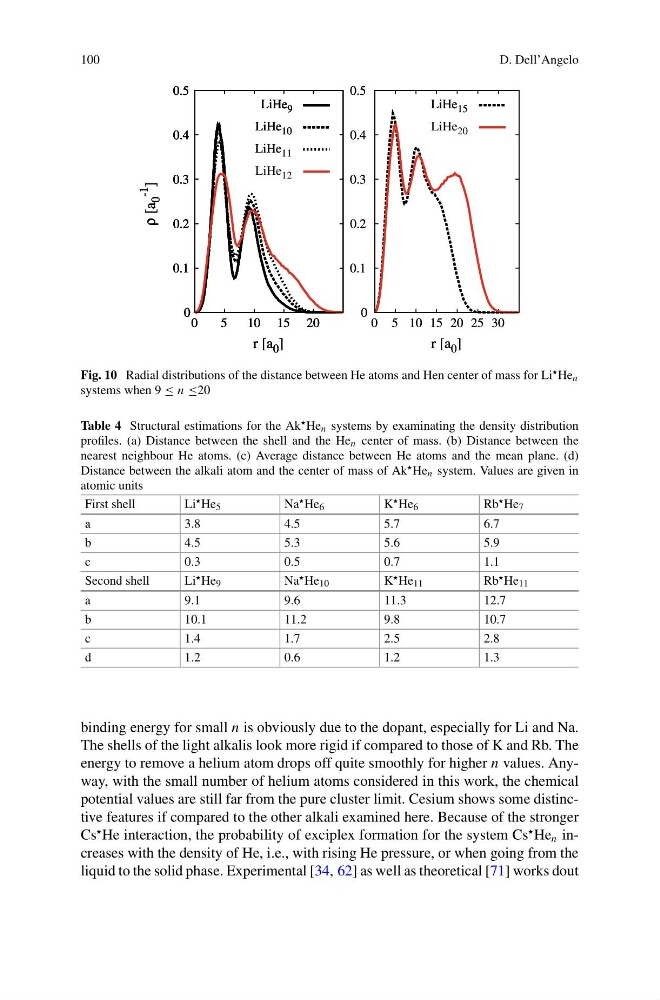
Fig. 10 Radial distributions of the distance between He atoms and Hen center of mass for Li He n
systems when 9 ≤ n ≤20
Table 4 Structural estimations for the Ak He n systems by examinating the density distribution
profiles. (a) Distance between the shell and the He n center of mass. (b) Distance between the
nearest neighbour He atoms. (c) Average distance between He atoms and the mean plane. (d)
Distance between the alkali atom and the center of mass of Ak He n system. Values are given in
atomic units
First shell
Li He 5
Na He 6
K He 6
Rb He 7
a
3.8
4.5
5.7
6.7
b
4.5
5.3
5.6
5.9
c
0.3
0.5
0.7
1.1
Second shell
Li He 9
Na He 10
K He 11
Rb He 11
a
9.1
9.6
11.3
12.7
b
10.1
11.2
9.8
10.7
c
1.4
1.7
2.5
2.8
d
1.2
0.6
1.2
1.3
binding energy for small n is obviously due to the dopant, especially for Li and Na.
The shells of the light alkalis look more rigid if compared to those of K and Rb. The
energy to remove a helium atom drops off quite smoothly for higher n values. Anyway, with the small number of helium atoms considered in this work, the chemical
potential values are still far from the pure cluster limit. Cesium shows some distinctive features if compared to the other alkali examined here. Because of the stronger
Cs
He interaction, the probability of exciplex formation for the system Cs
He n increases with the density of He, i.e., with rising He pressure, or when going from the
liquid to the solid phase. Experimental [34, 62] as well as theoretical [71] works dout
D. Dell’Angelo
Fig. 10 Radial distributions of the distance between He atoms and Hen center of mass for Li He n
systems when 9 ≤ n ≤20
Table 4 Structural estimations for the Ak He n systems by examinating the density distribution
profiles. (a) Distance between the shell and the He n center of mass. (b) Distance between the
nearest neighbour He atoms. (c) Average distance between He atoms and the mean plane. (d)
Distance between the alkali atom and the center of mass of Ak He n system. Values are given in
atomic units
First shell
Li He 5
Na He 6
K He 6
Rb He 7
a
3.8
4.5
5.7
6.7
b
4.5
5.3
5.6
5.9
c
0.3
0.5
0.7
1.1
Second shell
Li He 9
Na He 10
K He 11
Rb He 11
a
9.1
9.6
11.3
12.7
b
10.1
11.2
9.8
10.7
c
1.4
1.7
2.5
2.8
d
1.2
0.6
1.2
1.3
binding energy for small n is obviously due to the dopant, especially for Li and Na.
The shells of the light alkalis look more rigid if compared to those of K and Rb. The
energy to remove a helium atom drops off quite smoothly for higher n values. Anyway, with the small number of helium atoms considered in this work, the chemical
potential values are still far from the pure cluster limit. Cesium shows some distinctive features if compared to the other alkali examined here. Because of the stronger
Cs
He interaction, the probability of exciplex formation for the system Cs
He n increases with the density of He, i.e., with rising He pressure, or when going from the
liquid to the solid phase. Experimental [34, 62] as well as theoretical [71] works dout