

Quantum Study of Helium Clusters Doped with Electronically Excited …
99
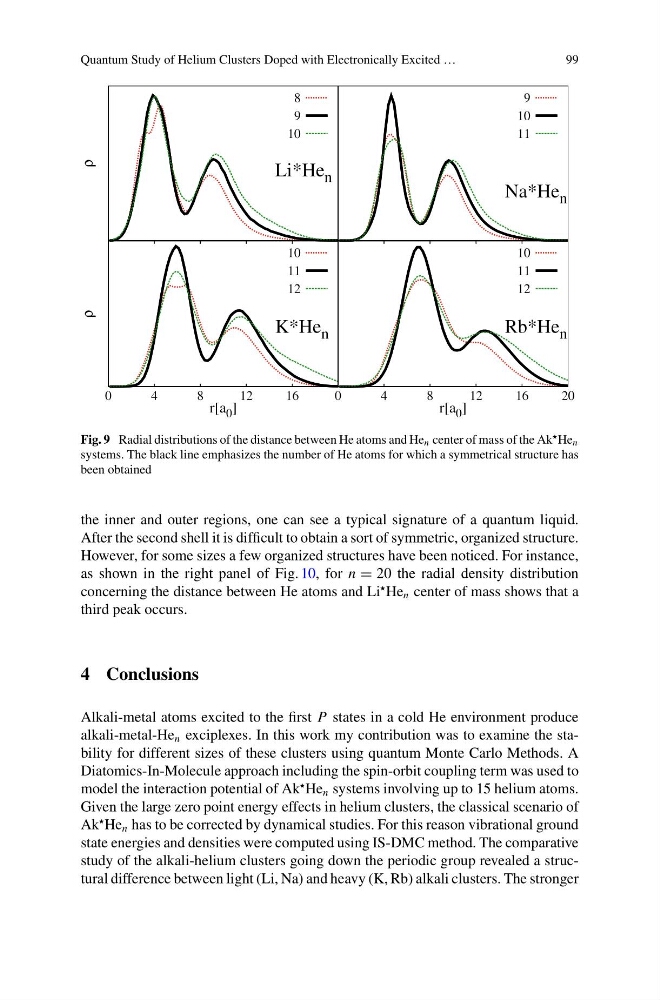
Fig. 9 Radial distributions of the distance between He atoms and He n center of mass of the Ak He n
systems. The black line emphasizes the number of He atoms for which a symmetrical structure has
been obtained
the inner and outer regions, one can see a typical signature of a quantum liquid.
After the second shell it is difficult to obtain a sort of symmetric, organized structure.
However, for some sizes a few organized structures have been noticed. For instance,
as shown in the right panel of Fig. 10, for n = 20 the radial density distribution
concerning the distance between He atoms and Li
He n center of mass shows that a
third peak occurs.
4 Conclusions
Alkali-metal atoms excited to the first P states in a cold He environment produce
alkali-metal-He n exciplexes. In this work my contribution was to examine the stability for different sizes of these clusters using quantum Monte Carlo Methods. A
Diatomics-In-Molecule approach including the spin-orbit coupling term was used to
model the interaction potential of Ak
He n systems involving up to 15 helium atoms.
Given the large zero point energy effects in helium clusters, the classical scenario of
Ak
He n has to be corrected by dynamical studies. For this reason vibrational ground
state energies and densities were computed using IS-DMC method. The comparative
study of the alkali-helium clusters going down the periodic group revealed a structural difference between light (Li, Na) and heavy (K, Rb) alkali clusters. The stronger
99
Fig. 9 Radial distributions of the distance between He atoms and He n center of mass of the Ak He n
systems. The black line emphasizes the number of He atoms for which a symmetrical structure has
been obtained
the inner and outer regions, one can see a typical signature of a quantum liquid.
After the second shell it is difficult to obtain a sort of symmetric, organized structure.
However, for some sizes a few organized structures have been noticed. For instance,
as shown in the right panel of Fig. 10, for n = 20 the radial density distribution
concerning the distance between He atoms and Li
He n center of mass shows that a
third peak occurs.
4 Conclusions
Alkali-metal atoms excited to the first P states in a cold He environment produce
alkali-metal-He n exciplexes. In this work my contribution was to examine the stability for different sizes of these clusters using quantum Monte Carlo Methods. A
Diatomics-In-Molecule approach including the spin-orbit coupling term was used to
model the interaction potential of Ak
He n systems involving up to 15 helium atoms.
Given the large zero point energy effects in helium clusters, the classical scenario of
Ak
He n has to be corrected by dynamical studies. For this reason vibrational ground
state energies and densities were computed using IS-DMC method. The comparative
study of the alkali-helium clusters going down the periodic group revealed a structural difference between light (Li, Na) and heavy (K, Rb) alkali clusters. The stronger