

Quantum Study of Helium Clusters Doped with Electronically Excited …
93
3.2 Energetics
Given the large zero point energy effects in helium clusters, the classical analysis
obtained for Ak
He n needs to be corrected by dynamical studies. In particular, the
ring structure at the quantum level is expected to be affected as it was previously
found for Rb
He n [51].
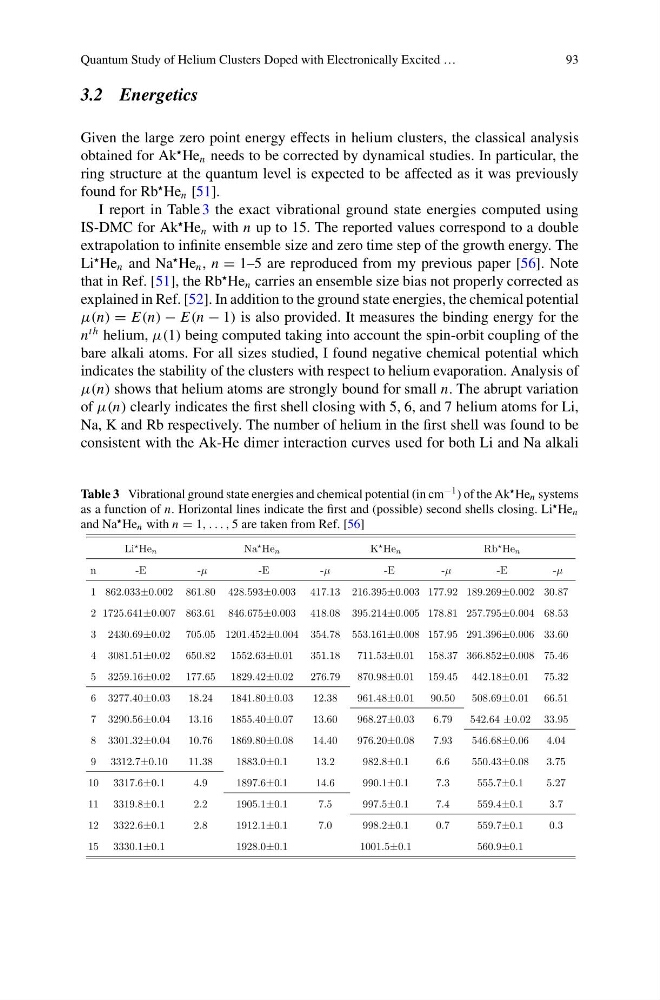
I report in Table 3 the exact vibrational ground state energies computed using
IS-DMC for Ak
He n with n up to 15. The reported values correspond to a double
extrapolation to infinite ensemble size and zero time step of the growth energy. The
Li
He n and Na
He n , n = 1–5 are reproduced from my previous paper [56]. Note
that in Ref. [51], the Rb
He n carries an ensemble size bias not properly corrected as
explained in Ref. [52]. In addition to the ground state energies, the chemical potential
μ(n) = E(n) − E(n − 1) is also provided. It measures the binding energy for the
n
th helium, μ(1) being computed taking into account the spin-orbit coupling of the
bare alkali atoms. For all sizes studied, I found negative chemical potential which
indicates the stability of the clusters with respect to helium evaporation. Analysis of
μ(n) shows that helium atoms are strongly bound for small n. The abrupt variation
of μ(n) clearly indicates the first shell closing with 5, 6, and 7 helium atoms for Li,
Na, K and Rb respectively. The number of helium in the first shell was found to be
consistent with the Ak-He dimer interaction curves used for both Li and Na alkali
Table 3 Vibrational ground state energies and chemical potential (in cm −1 ) of the Ak He n systems
as a function of n. Horizontal lines indicate the first and (possible) second shells closing. Li He n
and Na He n with n = 1, . . . , 5 are taken from Ref. [56]
Li He n
Na He n
K He n
Rb He n
n
- E
- µ
-E
-µ
-E
-µ
-E
-µ
1 862.033±0.002 861.80 428.593±0.003 417.13 216.395±0.003 177.92 189.269±0.002 30.87
2 1725.641±0.007 863.61 846.675±0.003 418.08 395.214±0.005 178.81 257.795±0.004 68.53
3 2430.69±0.02 705.05 1201.452±0.004 354.78 553.161±0.008 157.95 291.396±0.006 33.60
4 3081.51±0.02 650.82 1552.63±0.01
351.18
711.53±0.01 158.37 366.852±0.008 75.46
5 3259.16±0.02 177.65 1829.42±0.02
276.79
870.98±0.01 159.45 442.18±0.01 75.32
6 3277.40±0.03
18.24
1841.80±0.03
12.38
961.48±0.01
90.50
508.69±0.01 66.51
7 3290.56±0.04
13.16
1855.40±0.07
13.60
968.27±0.03
6.79
542.64 ±0.02 33.95
8 3301.32±0.04
10.76
1869.80±0.08
14.40
976.20±0.08
7.93
546.68±0.06
4.04
9 3312.7±0.10
11.38
1883.0±0.1
13.2
982.8±0.1
6.6
550.43±0.08
3.75
10 3317.6±0.1
4.9
1897.6±0.1
14.6
990.1±0.1
7.3
555.7±0.1
5.27
11 3319.8±0.1
2.2
1905.1±0.1
7.5
997.5±0.1
7.4
559.4±0.1
3.7
12 3322.6±0.1
2.8
1912.1±0.1
7.0
998.2±0.1
0.7
559.7±0.1
0.3
15 3330.1±0.1
1928.0±0.1
1001.5±0.1
560.9±0.1
93
3.2 Energetics
Given the large zero point energy effects in helium clusters, the classical analysis
obtained for Ak
He n needs to be corrected by dynamical studies. In particular, the
ring structure at the quantum level is expected to be affected as it was previously
found for Rb
He n [51].
I report in Table 3 the exact vibrational ground state energies computed using
IS-DMC for Ak
He n with n up to 15. The reported values correspond to a double
extrapolation to infinite ensemble size and zero time step of the growth energy. The
Li
He n and Na
He n , n = 1–5 are reproduced from my previous paper [56]. Note
that in Ref. [51], the Rb
He n carries an ensemble size bias not properly corrected as
explained in Ref. [52]. In addition to the ground state energies, the chemical potential
μ(n) = E(n) − E(n − 1) is also provided. It measures the binding energy for the
n
th helium, μ(1) being computed taking into account the spin-orbit coupling of the
bare alkali atoms. For all sizes studied, I found negative chemical potential which
indicates the stability of the clusters with respect to helium evaporation. Analysis of
μ(n) shows that helium atoms are strongly bound for small n. The abrupt variation
of μ(n) clearly indicates the first shell closing with 5, 6, and 7 helium atoms for Li,
Na, K and Rb respectively. The number of helium in the first shell was found to be
consistent with the Ak-He dimer interaction curves used for both Li and Na alkali
Table 3 Vibrational ground state energies and chemical potential (in cm −1 ) of the Ak He n systems
as a function of n. Horizontal lines indicate the first and (possible) second shells closing. Li He n
and Na He n with n = 1, . . . , 5 are taken from Ref. [56]
Li He n
Na He n
K He n
Rb He n
n
- E
- µ
-E
-µ
-E
-µ
-E
-µ
1 862.033±0.002 861.80 428.593±0.003 417.13 216.395±0.003 177.92 189.269±0.002 30.87
2 1725.641±0.007 863.61 846.675±0.003 418.08 395.214±0.005 178.81 257.795±0.004 68.53
3 2430.69±0.02 705.05 1201.452±0.004 354.78 553.161±0.008 157.95 291.396±0.006 33.60
4 3081.51±0.02 650.82 1552.63±0.01
351.18
711.53±0.01 158.37 366.852±0.008 75.46
5 3259.16±0.02 177.65 1829.42±0.02
276.79
870.98±0.01 159.45 442.18±0.01 75.32
6 3277.40±0.03
18.24
1841.80±0.03
12.38
961.48±0.01
90.50
508.69±0.01 66.51
7 3290.56±0.04
13.16
1855.40±0.07
13.60
968.27±0.03
6.79
542.64 ±0.02 33.95
8 3301.32±0.04
10.76
1869.80±0.08
14.40
976.20±0.08
7.93
546.68±0.06
4.04
9 3312.7±0.10
11.38
1883.0±0.1
13.2
982.8±0.1
6.6
550.43±0.08
3.75
10 3317.6±0.1
4.9
1897.6±0.1
14.6
990.1±0.1
7.3
555.7±0.1
5.27
11 3319.8±0.1
2.2
1905.1±0.1
7.5
997.5±0.1
7.4
559.4±0.1
3.7
12 3322.6±0.1
2.8
1912.1±0.1
7.0
998.2±0.1
0.7
559.7±0.1
0.3
15 3330.1±0.1
1928.0±0.1
1001.5±0.1
560.9±0.1