

92
D. Dell’Angelo
T =
i∈He
χ
He
(r i A )
He Ak
(r i A )
i, j∈He
HeHe
r i j
(1)
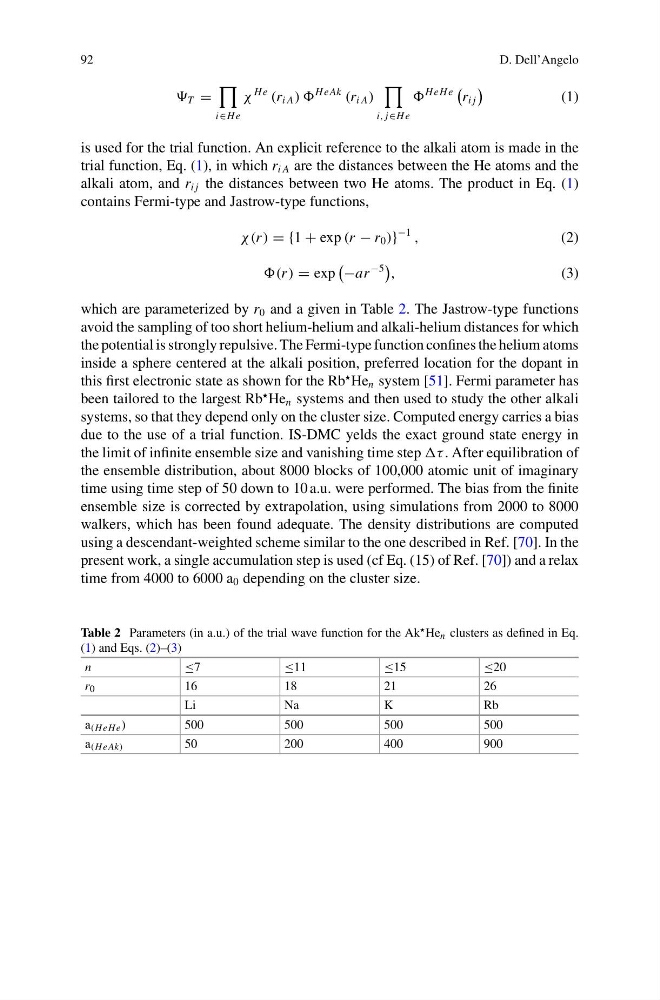
is used for the trial function. An explicit reference to the alkali atom is made in the
trial function, Eq. (1), in which r i A are the distances between the He atoms and the
alkali atom, and r i j the distances between two He atoms. The product in Eq. (1)
contains Fermi-type and Jastrow-type functions,
χ(r ) = {1 + exp (r − r 0 )}
−1
,
(2)
(r ) = exp
−ar
−5
,
(3)
which are parameterized by r 0 and a given in Table 2. The Jastrow-type functions
avoid the sampling of too short helium-helium and alkali-helium distances for which
the potential is strongly repulsive. The Fermi-type function confines the helium atoms
inside a sphere centered at the alkali position, preferred location for the dopant in
this first electronic state as shown for the Rb
He n system [51]. Fermi parameter has
been tailored to the largest Rb
He n systems and then used to study the other alkali
systems, so that they depend only on the cluster size. Computed energy carries a bias
due to the use of a trial function. IS-DMC yelds the exact ground state energy in
the limit of infinite ensemble size and vanishing time step τ . After equilibration of
the ensemble distribution, about 8000 blocks of 100,000 atomic unit of imaginary
time using time step of 50 down to 10 a.u. were performed. The bias from the finite
ensemble size is corrected by extrapolation, using simulations from 2000 to 8000
walkers, which has been found adequate. The density distributions are computed
using a descendant-weighted scheme similar to the one described in Ref. [70]. In the
present work, a single accumulation step is used (cf Eq. (15) of Ref. [70]) and a relax
time from 4000 to 6000 a 0 depending on the cluster size.
Table 2 Parameters (in a.u.) of the trial wave function for the Ak He n clusters as defined in Eq.
(1) and Eqs. (2)–(3)
n
≤7
≤11
≤15
≤20
r 0
16
18
21
26
Li
Na
K
Rb
a (HeHe )
500
500
500
500
a (He Ak)
50
200
400
900
D. Dell’Angelo
T =
i∈He
χ
He
(r i A )
He Ak
(r i A )
i, j∈He
HeHe
r i j
(1)
is used for the trial function. An explicit reference to the alkali atom is made in the
trial function, Eq. (1), in which r i A are the distances between the He atoms and the
alkali atom, and r i j the distances between two He atoms. The product in Eq. (1)
contains Fermi-type and Jastrow-type functions,
χ(r ) = {1 + exp (r − r 0 )}
−1
,
(2)
(r ) = exp
−ar
−5
,
(3)
which are parameterized by r 0 and a given in Table 2. The Jastrow-type functions
avoid the sampling of too short helium-helium and alkali-helium distances for which
the potential is strongly repulsive. The Fermi-type function confines the helium atoms
inside a sphere centered at the alkali position, preferred location for the dopant in
this first electronic state as shown for the Rb
He n system [51]. Fermi parameter has
been tailored to the largest Rb
He n systems and then used to study the other alkali
systems, so that they depend only on the cluster size. Computed energy carries a bias
due to the use of a trial function. IS-DMC yelds the exact ground state energy in
the limit of infinite ensemble size and vanishing time step τ . After equilibration of
the ensemble distribution, about 8000 blocks of 100,000 atomic unit of imaginary
time using time step of 50 down to 10 a.u. were performed. The bias from the finite
ensemble size is corrected by extrapolation, using simulations from 2000 to 8000
walkers, which has been found adequate. The density distributions are computed
using a descendant-weighted scheme similar to the one described in Ref. [70]. In the
present work, a single accumulation step is used (cf Eq. (15) of Ref. [70]) and a relax
time from 4000 to 6000 a 0 depending on the cluster size.
Table 2 Parameters (in a.u.) of the trial wave function for the Ak He n clusters as defined in Eq.
(1) and Eqs. (2)–(3)
n
≤7
≤11
≤15
≤20
r 0
16
18
21
26
Li
Na
K
Rb
a (HeHe )
500
500
500
500
a (He Ak)
50
200
400
900