

Quantum Study of Helium Clusters Doped with Electronically Excited …
91
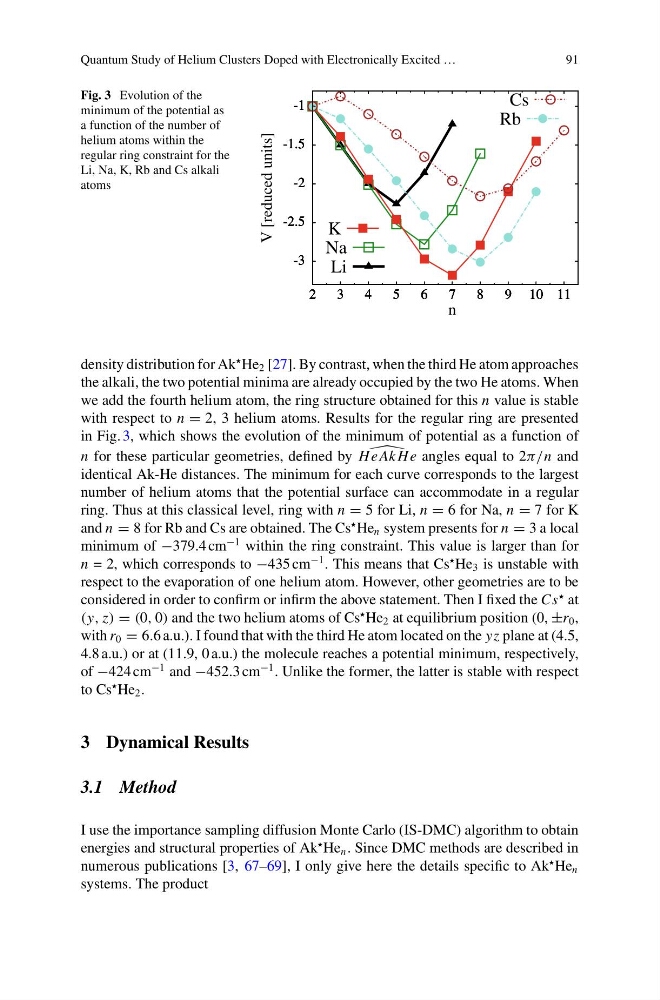
Fig. 3 Evolution of the
minimum of the potential as
a function of the number of
helium atoms within the
regular ring constraint for the
Li, Na, K, Rb and Cs alkali
atoms
-3
-2.5
-2
-1.5
-1
2
3
4
5
6
7
8
9 10 11
V [reduced units]
n
Li
-3
-2.5
-2
-1.5
-1
2
3
4
5
6
7
8
9 10 11
Na
-3
-2.5
-2
-1.5
-1
2
3
4
5
6
7
8
9 10 11
K
-3
-2.5
-2
-1.5
-1
2
3
4
5
6
7
8
9 10 11
Rb
-3
-2.5
-2
-1.5
-1
2
3
4
5
6
7
8
9 10 11
Cs
density distribution for Ak
He 2 [27]. By contrast, when the third He atom approaches
the alkali, the two potential minima are already occupied by the two He atoms. When
we add the fourth helium atom, the ring structure obtained for this n value is stable
with respect to n = 2, 3 helium atoms. Results for the regular ring are presented
in Fig. 3, which shows the evolution of the minimum of potential as a function of
n for these particular geometries, defined by
He Ak He angles equal to 2π/n and
identical Ak-He distances. The minimum for each curve corresponds to the largest
number of helium atoms that the potential surface can accommodate in a regular
ring. Thus at this classical level, ring with n = 5 for Li, n = 6 for Na, n = 7 for K
and n = 8 for Rb and Cs are obtained. The Cs
He n system presents for n = 3 a local
minimum of −379.4 cm
−1 within the ring constraint. This value is larger than for
n = 2, which corresponds to −435 cm
−1 . This means that Cs
He 3 is unstable with
respect to the evaporation of one helium atom. However, other geometries are to be
considered in order to confirm or infirm the above statement. Then I fixed the Cs
at
(y, z) = (0, 0) and the two helium atoms of Cs
He 2 at equilibrium position (0, ±r 0 ,
with r 0 = 6.6 a.u.). I found that with the third He atom located on the yz plane at (4.5,
4.8 a.u.) or at (11.9, 0 a.u.) the molecule reaches a potential minimum, respectively,
of −424 cm
−1 and −452.3 cm
−1 . Unlike the former, the latter is stable with respect
to Cs
He 2 .
3 Dynamical Results
3.1 Method
I use the importance sampling diffusion Monte Carlo (IS-DMC) algorithm to obtain
energies and structural properties of Ak
He n . Since DMC methods are described in
numerous publications [3, 67–69], I only give here the details specific to Ak
He n
systems. The product
91
Fig. 3 Evolution of the
minimum of the potential as
a function of the number of
helium atoms within the
regular ring constraint for the
Li, Na, K, Rb and Cs alkali
atoms
-3
-2.5
-2
-1.5
-1
2
3
4
5
6
7
8
9 10 11
V [reduced units]
n
Li
-3
-2.5
-2
-1.5
-1
2
3
4
5
6
7
8
9 10 11
Na
-3
-2.5
-2
-1.5
-1
2
3
4
5
6
7
8
9 10 11
K
-3
-2.5
-2
-1.5
-1
2
3
4
5
6
7
8
9 10 11
Rb
-3
-2.5
-2
-1.5
-1
2
3
4
5
6
7
8
9 10 11
Cs
density distribution for Ak
He 2 [27]. By contrast, when the third He atom approaches
the alkali, the two potential minima are already occupied by the two He atoms. When
we add the fourth helium atom, the ring structure obtained for this n value is stable
with respect to n = 2, 3 helium atoms. Results for the regular ring are presented
in Fig. 3, which shows the evolution of the minimum of potential as a function of
n for these particular geometries, defined by
He Ak He angles equal to 2π/n and
identical Ak-He distances. The minimum for each curve corresponds to the largest
number of helium atoms that the potential surface can accommodate in a regular
ring. Thus at this classical level, ring with n = 5 for Li, n = 6 for Na, n = 7 for K
and n = 8 for Rb and Cs are obtained. The Cs
He n system presents for n = 3 a local
minimum of −379.4 cm
−1 within the ring constraint. This value is larger than for
n = 2, which corresponds to −435 cm
−1 . This means that Cs
He 3 is unstable with
respect to the evaporation of one helium atom. However, other geometries are to be
considered in order to confirm or infirm the above statement. Then I fixed the Cs
at
(y, z) = (0, 0) and the two helium atoms of Cs
He 2 at equilibrium position (0, ±r 0 ,
with r 0 = 6.6 a.u.). I found that with the third He atom located on the yz plane at (4.5,
4.8 a.u.) or at (11.9, 0 a.u.) the molecule reaches a potential minimum, respectively,
of −424 cm
−1 and −452.3 cm
−1 . Unlike the former, the latter is stable with respect
to Cs
He 2 .
3 Dynamical Results
3.1 Method
I use the importance sampling diffusion Monte Carlo (IS-DMC) algorithm to obtain
energies and structural properties of Ak
He n . Since DMC methods are described in
numerous publications [3, 67–69], I only give here the details specific to Ak
He n
systems. The product