

90
D. Dell’Angelo
2.2 Larger Clusters
Given the complexity of the systems as n increases, I considered first the geometries
corresponding to rings, expected structures for the exciplex. Theoretical works dealing with excited alkali atoms in liquid helium [47, 49], in solid helium [62–65], in
4 He cold gas [28, 66] as well as in clusters [50] agree on considering larger Ak
He n≥3
structures made up of a ring of n He atoms around the p-like electron density of the
excited alkali atom. I studied these particular ring geometries as a function of the
number n of helium atoms for Li, Na, K and Rb. The PES of Ak
He 2 presents in the
lowest 1/2 excited state a global and a local minimum, at least for reasonable Ak-He
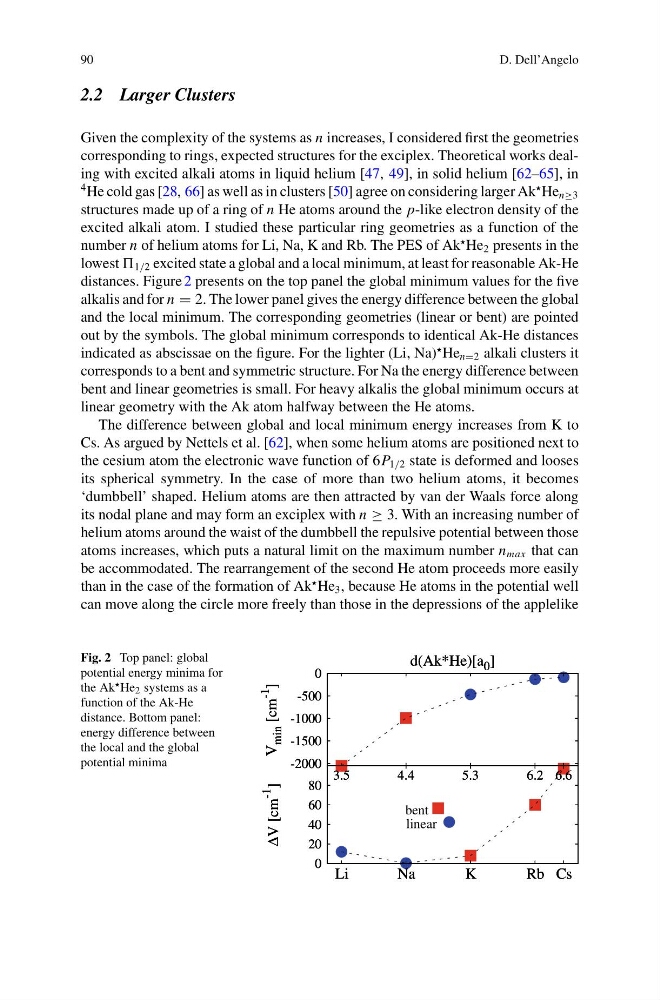
distances. Figure 2 presents on the top panel the global minimum values for the five
alkalis and for n = 2. The lower panel gives the energy difference between the global
and the local minimum. The corresponding geometries (linear or bent) are pointed
out by the symbols. The global minimum corresponds to identical Ak-He distances
indicated as abscissae on the figure. For the lighter (Li, Na)
He n=2 alkali clusters it
corresponds to a bent and symmetric structure. For Na the energy difference between
bent and linear geometries is small. For heavy alkalis the global minimum occurs at
linear geometry with the Ak atom halfway between the He atoms.
The difference between global and local minimum energy increases from K to
Cs. As argued by Nettels et al. [62], when some helium atoms are positioned next to
the cesium atom the electronic wave function of 6P 1/2 state is deformed and looses
its spherical symmetry. In the case of more than two helium atoms, it becomes
‘dumbbell’ shaped. Helium atoms are then attracted by van der Waals force along
its nodal plane and may form an exciplex with n ≥ 3. With an increasing number of
helium atoms around the waist of the dumbbell the repulsive potential between those
atoms increases, which puts a natural limit on the maximum number n max that can
be accommodated. The rearrangement of the second He atom proceeds more easily
than in the case of the formation of Ak
He 3 , because He atoms in the potential well
can move along the circle more freely than those in the depressions of the applelike
Fig. 2 Top panel: global
potential energy minima for
the Ak He 2 systems as a
function of the Ak-He
distance. Bottom panel:
energy difference between
the local and the global
potential minima
0
20
40
60
80
Li
Na
K
Rb Cs
ΔV [cm
-1
]
bent
0
20
40
60
80
Li
Na
K
Rb Cs
ΔV [cm
-1
]
linear
0
20
40
60
80
Li
Na
K
Rb Cs
ΔV [cm
-1
]
-2000
-1500
-1000
-500
0
3.5
4.4
5.3
6.2 6.6
V
min [cm
-1
]
d(Ak*He)[a 0 ]
-2000
-1500
-1000
-500
0
3.5
4.4
5.3
6.2 6.6
V
min [cm
-1
]
d(Ak*He)[a 0 ]
-2000
-1500
-1000
-500
0
3.5
4.4
5.3
6.2 6.6
V
min [cm
-1
]
d(Ak*He)[a 0 ]
D. Dell’Angelo
2.2 Larger Clusters
Given the complexity of the systems as n increases, I considered first the geometries
corresponding to rings, expected structures for the exciplex. Theoretical works dealing with excited alkali atoms in liquid helium [47, 49], in solid helium [62–65], in
4 He cold gas [28, 66] as well as in clusters [50] agree on considering larger Ak
He n≥3
structures made up of a ring of n He atoms around the p-like electron density of the
excited alkali atom. I studied these particular ring geometries as a function of the
number n of helium atoms for Li, Na, K and Rb. The PES of Ak
He 2 presents in the
lowest 1/2 excited state a global and a local minimum, at least for reasonable Ak-He
distances. Figure 2 presents on the top panel the global minimum values for the five
alkalis and for n = 2. The lower panel gives the energy difference between the global
and the local minimum. The corresponding geometries (linear or bent) are pointed
out by the symbols. The global minimum corresponds to identical Ak-He distances
indicated as abscissae on the figure. For the lighter (Li, Na)
He n=2 alkali clusters it
corresponds to a bent and symmetric structure. For Na the energy difference between
bent and linear geometries is small. For heavy alkalis the global minimum occurs at
linear geometry with the Ak atom halfway between the He atoms.
The difference between global and local minimum energy increases from K to
Cs. As argued by Nettels et al. [62], when some helium atoms are positioned next to
the cesium atom the electronic wave function of 6P 1/2 state is deformed and looses
its spherical symmetry. In the case of more than two helium atoms, it becomes
‘dumbbell’ shaped. Helium atoms are then attracted by van der Waals force along
its nodal plane and may form an exciplex with n ≥ 3. With an increasing number of
helium atoms around the waist of the dumbbell the repulsive potential between those
atoms increases, which puts a natural limit on the maximum number n max that can
be accommodated. The rearrangement of the second He atom proceeds more easily
than in the case of the formation of Ak
He 3 , because He atoms in the potential well
can move along the circle more freely than those in the depressions of the applelike
Fig. 2 Top panel: global
potential energy minima for
the Ak He 2 systems as a
function of the Ak-He
distance. Bottom panel:
energy difference between
the local and the global
potential minima
0
20
40
60
80
Li
Na
K
Rb Cs
ΔV [cm
-1
]
bent
0
20
40
60
80
Li
Na
K
Rb Cs
ΔV [cm
-1
]
linear
0
20
40
60
80
Li
Na
K
Rb Cs
ΔV [cm
-1
]
-2000
-1500
-1000
-500
0
3.5
4.4
5.3
6.2 6.6
V
min [cm
-1
]
d(Ak*He)[a 0 ]
-2000
-1500
-1000
-500
0
3.5
4.4
5.3
6.2 6.6
V
min [cm
-1
]
d(Ak*He)[a 0 ]
-2000
-1500
-1000
-500
0
3.5
4.4
5.3
6.2 6.6
V
min [cm
-1
]
d(Ak*He)[a 0 ]