

Quantum Study of Helium Clusters Doped with Electronically Excited …
89
-1000
-800
-600
-400
-200
0
200
2
4
6
8
10 12 14 16 18 20
V-V
∞ [cm
-1
]
r [a 0 ]
Li
-1000
-800
-600
-400
-200
0
200
2
4
6
8
10 12 14 16 18 20
V-V
∞ [cm
-1
]
r [a 0 ]
Li
Na
-1000
-800
-600
-400
-200
0
200
2
4
6
8
10 12 14 16 18 20
V-V
∞ [cm
-1
]
r [a 0 ]
Li
Na
K
-1000
-800
-600
-400
-200
0
200
2
4
6
8
10 12 14 16 18 20
V-V
∞ [cm
-1
]
r [a 0 ]
Li
Na
K
Rb
-1000
-800
-600
-400
-200
0
200
2
4
6
8
10 12 14 16 18 20
V-V
∞ [cm
-1
]
r [a 0 ]
Li
Na
K
Rb
Cs
0
20
40
60
80
6 9 12 15 18
0
20
40
60
80
6 9 12 15 18
0
20
40
60
80
6 9 12 15 18
0
20
40
60
80
6 9 12 15 18
0
20
40
60
80
6 9 12 15 18
-0.6
-0.4
-0.2
0
16 20 24 28
-0.6
-0.4
-0.2
0
16 20 24 28
-0.6
-0.4
-0.2
0
16 20 24 28
-0.6
-0.4
-0.2
0
16 20 24 28
-0.6
-0.4
-0.2
0
16 20 24 28
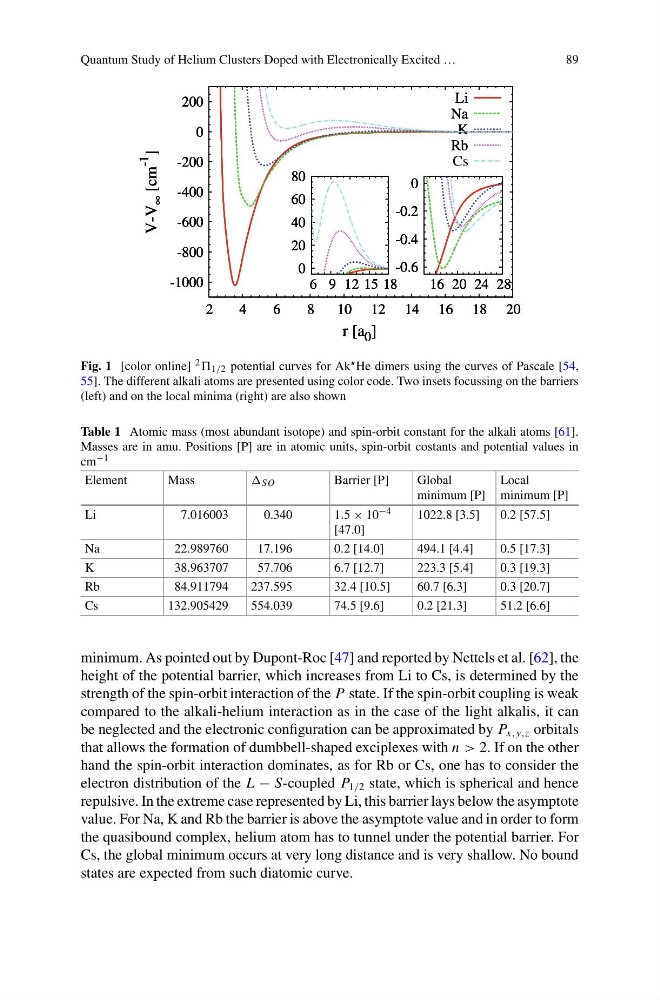
Fig. 1 [color online] 2 1/2 potential curves for Ak He dimers using the curves of Pascale [54,
55]. The different alkali atoms are presented using color code. Two insets focussing on the barriers
(left) and on the local minima (right) are also shown
Table 1 Atomic mass (most abundant isotope) and spin-orbit constant for the alkali atoms [61].
Masses are in amu. Positions [P] are in atomic units, spin-orbit costants and potential values in
cm −1
Element
Mass
SO
Barrier [P]
Global
minimum [P]
Local
minimum [P]
Li
7.016003
0.340
1.5 × 10 −4
[47.0]
1022.8 [3.5]
0.2 [57.5]
Na
22.989760
17.196
0.2 [14.0]
494.1 [4.4]
0.5 [17.3]
K
38.963707
57.706
6.7 [12.7]
223.3 [5.4]
0.3 [19.3]
Rb
84.911794
237.595
32.4 [10.5]
60.7 [6.3]
0.3 [20.7]
Cs
132.905429
554.039
74.5 [9.6]
0.2 [21.3]
51.2 [6.6]
minimum. As pointed out by Dupont-Roc [47] and reported by Nettels et al. [62], the
height of the potential barrier, which increases from Li to Cs, is determined by the
strength of the spin-orbit interaction of the P state. If the spin-orbit coupling is weak
compared to the alkali-helium interaction as in the case of the light alkalis, it can
be neglected and the electronic configuration can be approximated by P x,y,z orbitals
that allows the formation of dumbbell-shaped exciplexes with n > 2. If on the other
hand the spin-orbit interaction dominates, as for Rb or Cs, one has to consider the
electron distribution of the L − S-coupled P 1/2 state, which is spherical and hence
repulsive. In the extreme case represented by Li, this barrier lays below the asymptote
value. For Na, K and Rb the barrier is above the asymptote value and in order to form
the quasibound complex, helium atom has to tunnel under the potential barrier. For
Cs, the global minimum occurs at very long distance and is very shallow. No bound
states are expected from such diatomic curve.
89
-1000
-800
-600
-400
-200
0
200
2
4
6
8
10 12 14 16 18 20
V-V
∞ [cm
-1
]
r [a 0 ]
Li
-1000
-800
-600
-400
-200
0
200
2
4
6
8
10 12 14 16 18 20
V-V
∞ [cm
-1
]
r [a 0 ]
Li
Na
-1000
-800
-600
-400
-200
0
200
2
4
6
8
10 12 14 16 18 20
V-V
∞ [cm
-1
]
r [a 0 ]
Li
Na
K
-1000
-800
-600
-400
-200
0
200
2
4
6
8
10 12 14 16 18 20
V-V
∞ [cm
-1
]
r [a 0 ]
Li
Na
K
Rb
-1000
-800
-600
-400
-200
0
200
2
4
6
8
10 12 14 16 18 20
V-V
∞ [cm
-1
]
r [a 0 ]
Li
Na
K
Rb
Cs
0
20
40
60
80
6 9 12 15 18
0
20
40
60
80
6 9 12 15 18
0
20
40
60
80
6 9 12 15 18
0
20
40
60
80
6 9 12 15 18
0
20
40
60
80
6 9 12 15 18
-0.6
-0.4
-0.2
0
16 20 24 28
-0.6
-0.4
-0.2
0
16 20 24 28
-0.6
-0.4
-0.2
0
16 20 24 28
-0.6
-0.4
-0.2
0
16 20 24 28
-0.6
-0.4
-0.2
0
16 20 24 28
Fig. 1 [color online] 2 1/2 potential curves for Ak He dimers using the curves of Pascale [54,
55]. The different alkali atoms are presented using color code. Two insets focussing on the barriers
(left) and on the local minima (right) are also shown
Table 1 Atomic mass (most abundant isotope) and spin-orbit constant for the alkali atoms [61].
Masses are in amu. Positions [P] are in atomic units, spin-orbit costants and potential values in
cm −1
Element
Mass
SO
Barrier [P]
Global
minimum [P]
Local
minimum [P]
Li
7.016003
0.340
1.5 × 10 −4
[47.0]
1022.8 [3.5]
0.2 [57.5]
Na
22.989760
17.196
0.2 [14.0]
494.1 [4.4]
0.5 [17.3]
K
38.963707
57.706
6.7 [12.7]
223.3 [5.4]
0.3 [19.3]
Rb
84.911794
237.595
32.4 [10.5]
60.7 [6.3]
0.3 [20.7]
Cs
132.905429
554.039
74.5 [9.6]
0.2 [21.3]
51.2 [6.6]
minimum. As pointed out by Dupont-Roc [47] and reported by Nettels et al. [62], the
height of the potential barrier, which increases from Li to Cs, is determined by the
strength of the spin-orbit interaction of the P state. If the spin-orbit coupling is weak
compared to the alkali-helium interaction as in the case of the light alkalis, it can
be neglected and the electronic configuration can be approximated by P x,y,z orbitals
that allows the formation of dumbbell-shaped exciplexes with n > 2. If on the other
hand the spin-orbit interaction dominates, as for Rb or Cs, one has to consider the
electron distribution of the L − S-coupled P 1/2 state, which is spherical and hence
repulsive. In the extreme case represented by Li, this barrier lays below the asymptote
value. For Na, K and Rb the barrier is above the asymptote value and in order to form
the quasibound complex, helium atom has to tunnel under the potential barrier. For
Cs, the global minimum occurs at very long distance and is very shallow. No bound
states are expected from such diatomic curve.