

66
1.4.11 Cyclodextrins: Trends and Outlook
Although an important number of works, patents, and products have been realized,
the sector of cyclodextrin-based pharmacy continues to interest the scientific community. Cyclodextrins are still regarded as “novel” excipients, active ingredients,
drug delivery vehicles, and anti-aggregation agents (Conceição et al. 2018). New
formulations continue to be reported, generating new interests in medicine and biomedicine (Higashi et al. 2018; Higashi 2019; Menezes et al. 2019; Pawar and
Shende 2019). The 18 ongoing clinical trials in 2019 give the promise of new marketed formulations (Cyclodextrin News, CycloLab Ltd., Hungary).
The recent research has clearly revealed that cyclodextrins cannot be considered
inactive excipients any more (Arima et al. 2017). Hydroxypropyl-β-cyclodextrin was
found by serendipity to be useful for slowing down the progression of Niemann- Pick
type C disease, the fatal genetic disorder. Based on the promising results of the clinical
trials, this cyclodextrin received orphan drug status both from Food and Drug
Administration and European Drug Agency. The mechanism of action which was
thought first to be based on cholesterol complexation is still under debate.
Yokoo et al. (2015) demonstrated that hydroxypropyl-β-cyclodextrin was a
potential anticancer agent in leukemia. This derivative was found effective in inhibition of leukemic cell proliferation at various leukemic cell lines. It was proved to
influence autophagy, a catabolic process with an essential function in the maintenance of cellular and tissue homeostasis. As solubilizing agent to increase cholesterol solubility, hydroxypropyl-β-cyclodextrin is used for prevention and treatment
of atherosclerosis, a chronic inflammatory disease driven primarily by a continuous
retention of cholesterol within the subendothelial space to hinder its precipitation in
the form of cholesterol crystals (Zimmer et al. 2016).
Several research groups are developing special cyclodextrin derivatives with various functions, for instance, for targeted drug delivery. Folate-appended cyclodextrins
are recognized by folate-receptor-expressing tumor cells; therefore they can be utilized as potent anticancer agents (Motoyama et al. 2015). Lactosyl-β- cyclodextrin
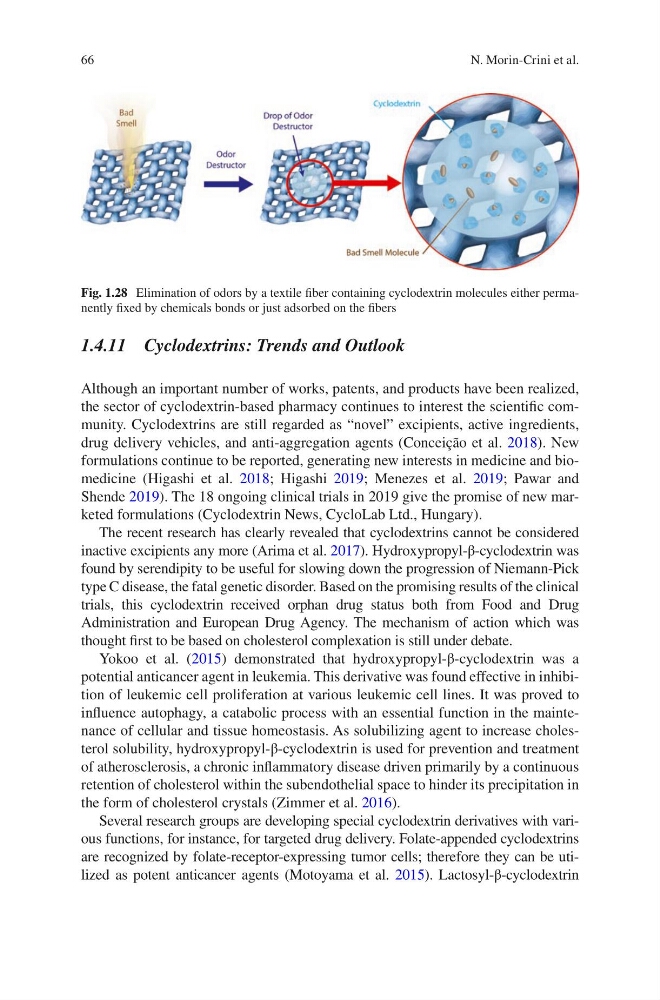
Fig. 1.28 Elimination of odors by a textile fiber containing cyclodextrin molecules either permanently fixed by chemicals bonds or just adsorbed on the fibers
N. Morin-Crini et al.
1.4.11 Cyclodextrins: Trends and Outlook
Although an important number of works, patents, and products have been realized,
the sector of cyclodextrin-based pharmacy continues to interest the scientific community. Cyclodextrins are still regarded as “novel” excipients, active ingredients,
drug delivery vehicles, and anti-aggregation agents (Conceição et al. 2018). New
formulations continue to be reported, generating new interests in medicine and biomedicine (Higashi et al. 2018; Higashi 2019; Menezes et al. 2019; Pawar and
Shende 2019). The 18 ongoing clinical trials in 2019 give the promise of new marketed formulations (Cyclodextrin News, CycloLab Ltd., Hungary).
The recent research has clearly revealed that cyclodextrins cannot be considered
inactive excipients any more (Arima et al. 2017). Hydroxypropyl-β-cyclodextrin was
found by serendipity to be useful for slowing down the progression of Niemann- Pick
type C disease, the fatal genetic disorder. Based on the promising results of the clinical
trials, this cyclodextrin received orphan drug status both from Food and Drug
Administration and European Drug Agency. The mechanism of action which was
thought first to be based on cholesterol complexation is still under debate.
Yokoo et al. (2015) demonstrated that hydroxypropyl-β-cyclodextrin was a
potential anticancer agent in leukemia. This derivative was found effective in inhibition of leukemic cell proliferation at various leukemic cell lines. It was proved to
influence autophagy, a catabolic process with an essential function in the maintenance of cellular and tissue homeostasis. As solubilizing agent to increase cholesterol solubility, hydroxypropyl-β-cyclodextrin is used for prevention and treatment
of atherosclerosis, a chronic inflammatory disease driven primarily by a continuous
retention of cholesterol within the subendothelial space to hinder its precipitation in
the form of cholesterol crystals (Zimmer et al. 2016).
Several research groups are developing special cyclodextrin derivatives with various functions, for instance, for targeted drug delivery. Folate-appended cyclodextrins
are recognized by folate-receptor-expressing tumor cells; therefore they can be utilized as potent anticancer agents (Motoyama et al. 2015). Lactosyl-β- cyclodextrin
Fig. 1.28 Elimination of odors by a textile fiber containing cyclodextrin molecules either permanently fixed by chemicals bonds or just adsorbed on the fibers
N. Morin-Crini et al.