

65
During the period from 1980 to 1990, manufactured products using cyclodextrins
have emerged such as pesticide formulations, reproduction processes, e.g., photography and inks, tobaccos, corrosion inhibitors, industrial detergents, sterilizing agents,
anti-foam agents, glues, wood treatment, etc. (Szejtli 1982a, 1984, 1988; Vaution
et al. 1987). In the agricultural sector, the use of complexation by cyclodextrins has
facilitated the formulation of pesticides in many ways, e.g., by enhancing water solubility and biological activity, through stabilization of labile substances, by enabling
easier handling of hazardous substance, and also through the formation of crystalline
substances from volatile liquids. An important feature of the cyclodextrin-formulated
pesticides is the water-triggered release of the active compounds. A large number of
patents concerning the use of cyclodextrins in agrochemistry were filled (Szejtli
1982a, 1984; Szente and Szejtli 1996; Morillo 2006).
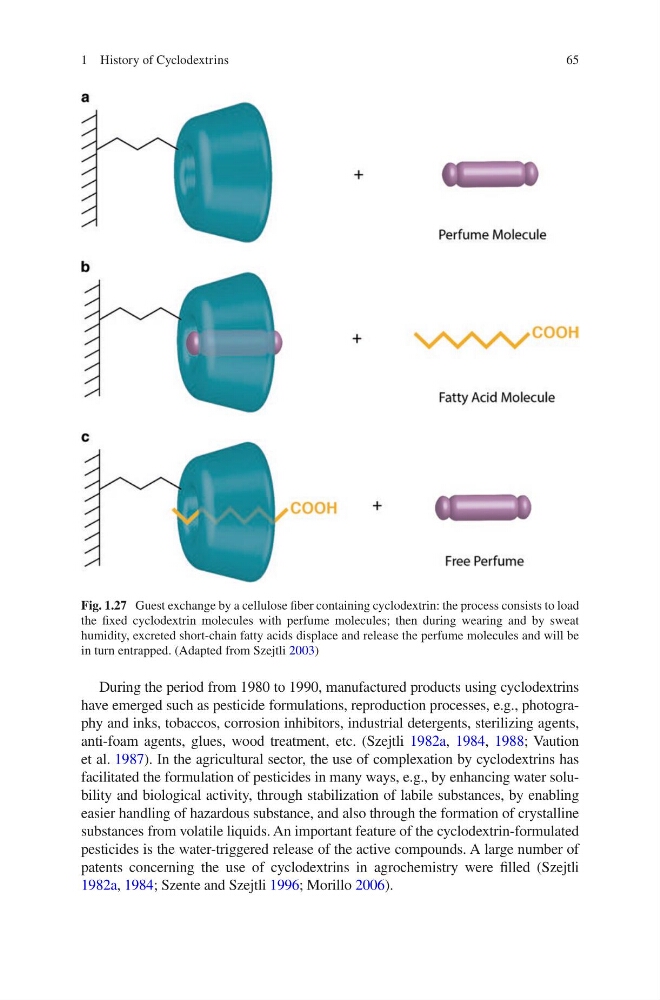
Fig. 1.27 Guest exchange by a cellulose fiber containing cyclodextrin: the process consists to load
the fixed cyclodextrin molecules with perfume molecules; then during wearing and by sweat
humidity, excreted short-chain fatty acids displace and release the perfume molecules and will be
in turn entrapped. (Adapted from Szejtli 2003)
1 History of Cyclodextrins
During the period from 1980 to 1990, manufactured products using cyclodextrins
have emerged such as pesticide formulations, reproduction processes, e.g., photography and inks, tobaccos, corrosion inhibitors, industrial detergents, sterilizing agents,
anti-foam agents, glues, wood treatment, etc. (Szejtli 1982a, 1984, 1988; Vaution
et al. 1987). In the agricultural sector, the use of complexation by cyclodextrins has
facilitated the formulation of pesticides in many ways, e.g., by enhancing water solubility and biological activity, through stabilization of labile substances, by enabling
easier handling of hazardous substance, and also through the formation of crystalline
substances from volatile liquids. An important feature of the cyclodextrin-formulated
pesticides is the water-triggered release of the active compounds. A large number of
patents concerning the use of cyclodextrins in agrochemistry were filled (Szejtli
1982a, 1984; Szente and Szejtli 1996; Morillo 2006).
Fig. 1.27 Guest exchange by a cellulose fiber containing cyclodextrin: the process consists to load
the fixed cyclodextrin molecules with perfume molecules; then during wearing and by sweat
humidity, excreted short-chain fatty acids displace and release the perfume molecules and will be
in turn entrapped. (Adapted from Szejtli 2003)
1 History of Cyclodextrins