

58
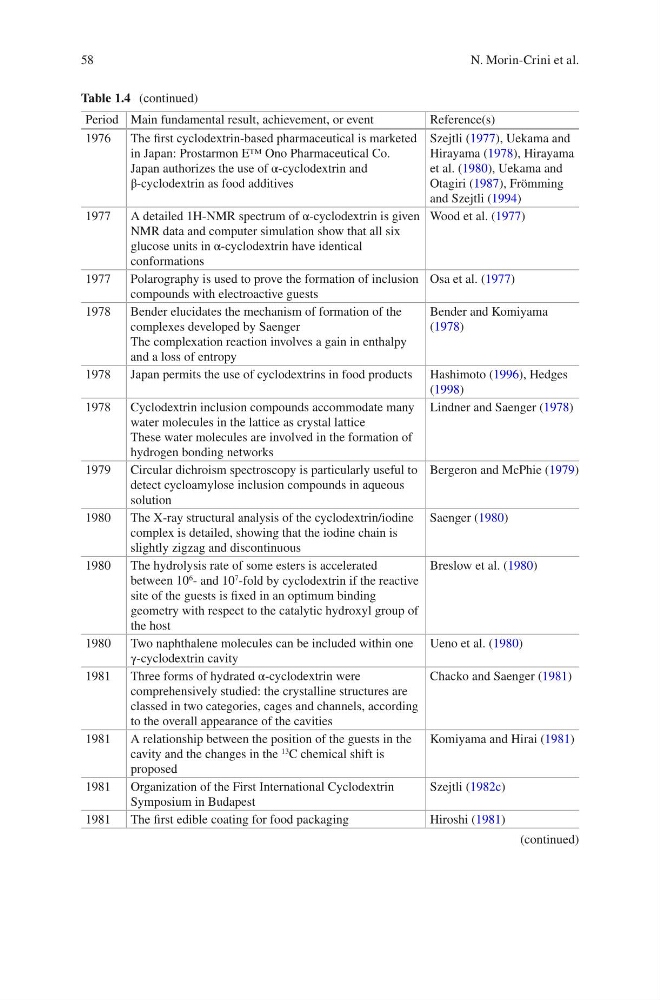
Table 1.4 (continued)
Period Main fundamental result, achievement, or event
Reference(s)
1976
The first cyclodextrin-based pharmaceutical is marketed
in Japan: Prostarmon E™ Ono Pharmaceutical Co.
Japan authorizes the use of α-cyclodextrin and
β-cyclodextrin as food additives
Szejtli (1977), Uekama and
Hirayama (1978), Hirayama
et al. (1980), Uekama and
Otagiri (1987), Frömming
and Szejtli (1994)
1977
A detailed 1H-NMR spectrum of α-cyclodextrin is given
NMR data and computer simulation show that all six
glucose units in α-cyclodextrin have identical
conformations
Wood et al. (1977)
1977
Polarography is used to prove the formation of inclusion
compounds with electroactive guests
Osa et al. (1977)
1978
Bender elucidates the mechanism of formation of the
complexes developed by Saenger
The complexation reaction involves a gain in enthalpy
and a loss of entropy
Bender and Komiyama
(1978)
1978
Japan permits the use of cyclodextrins in food products Hashimoto (1996), Hedges
(1998)
1978
Cyclodextrin inclusion compounds accommodate many
water molecules in the lattice as crystal lattice
These water molecules are involved in the formation of
hydrogen bonding networks
Lindner and Saenger (1978)
1979
Circular dichroism spectroscopy is particularly useful to
detect cycloamylose inclusion compounds in aqueous
solution
Bergeron and McPhie (1979)
1980
The X-ray structural analysis of the cyclodextrin/iodine
complex is detailed, showing that the iodine chain is
slightly zigzag and discontinuous
Saenger (1980)
1980
The hydrolysis rate of some esters is accelerated
between 10
6
- and 10
7 -fold by cyclodextrin if the reactive
site of the guests is fixed in an optimum binding
geometry with respect to the catalytic hydroxyl group of
the host
Breslow et al. (1980)
1980
Two naphthalene molecules can be included within one
γ-cyclodextrin cavity
Ueno et al. (1980)
1981
Three forms of hydrated α-cyclodextrin were
comprehensively studied: the crystalline structures are
classed in two categories, cages and channels, according
to the overall appearance of the cavities
Chacko and Saenger (1981)
1981
A relationship between the position of the guests in the
cavity and the changes in the
13 C chemical shift is
proposed
Komiyama and Hirai (1981)
1981
Organization of the First International Cyclodextrin
Symposium in Budapest
Szejtli (1982c)
1981
The first edible coating for food packaging
Hiroshi (1981)
(continued)
N. Morin-Crini et al.
Table 1.4 (continued)
Period Main fundamental result, achievement, or event
Reference(s)
1976
The first cyclodextrin-based pharmaceutical is marketed
in Japan: Prostarmon E™ Ono Pharmaceutical Co.
Japan authorizes the use of α-cyclodextrin and
β-cyclodextrin as food additives
Szejtli (1977), Uekama and
Hirayama (1978), Hirayama
et al. (1980), Uekama and
Otagiri (1987), Frömming
and Szejtli (1994)
1977
A detailed 1H-NMR spectrum of α-cyclodextrin is given
NMR data and computer simulation show that all six
glucose units in α-cyclodextrin have identical
conformations
Wood et al. (1977)
1977
Polarography is used to prove the formation of inclusion
compounds with electroactive guests
Osa et al. (1977)
1978
Bender elucidates the mechanism of formation of the
complexes developed by Saenger
The complexation reaction involves a gain in enthalpy
and a loss of entropy
Bender and Komiyama
(1978)
1978
Japan permits the use of cyclodextrins in food products Hashimoto (1996), Hedges
(1998)
1978
Cyclodextrin inclusion compounds accommodate many
water molecules in the lattice as crystal lattice
These water molecules are involved in the formation of
hydrogen bonding networks
Lindner and Saenger (1978)
1979
Circular dichroism spectroscopy is particularly useful to
detect cycloamylose inclusion compounds in aqueous
solution
Bergeron and McPhie (1979)
1980
The X-ray structural analysis of the cyclodextrin/iodine
complex is detailed, showing that the iodine chain is
slightly zigzag and discontinuous
Saenger (1980)
1980
The hydrolysis rate of some esters is accelerated
between 10
6
- and 10
7 -fold by cyclodextrin if the reactive
site of the guests is fixed in an optimum binding
geometry with respect to the catalytic hydroxyl group of
the host
Breslow et al. (1980)
1980
Two naphthalene molecules can be included within one
γ-cyclodextrin cavity
Ueno et al. (1980)
1981
Three forms of hydrated α-cyclodextrin were
comprehensively studied: the crystalline structures are
classed in two categories, cages and channels, according
to the overall appearance of the cavities
Chacko and Saenger (1981)
1981
A relationship between the position of the guests in the
cavity and the changes in the
13 C chemical shift is
proposed
Komiyama and Hirai (1981)
1981
Organization of the First International Cyclodextrin
Symposium in Budapest
Szejtli (1982c)
1981
The first edible coating for food packaging
Hiroshi (1981)
(continued)
N. Morin-Crini et al.