

57
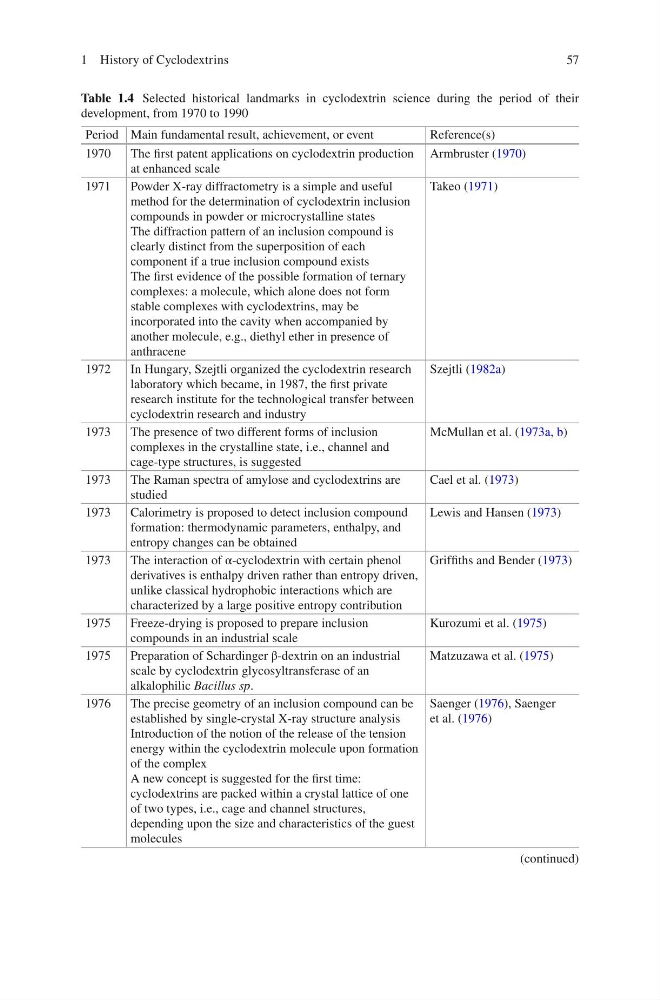
Table 1.4 Selected historical landmarks in cyclodextrin science during the period of their
development, from 1970 to 1990
Period Main fundamental result, achievement, or event
Reference(s)
1970
The first patent applications on cyclodextrin production
at enhanced scale
Armbruster (1970)
1971
Powder X-ray diffractometry is a simple and useful
method for the determination of cyclodextrin inclusion
compounds in powder or microcrystalline states
The diffraction pattern of an inclusion compound is
clearly distinct from the superposition of each
component if a true inclusion compound exists
The first evidence of the possible formation of ternary
complexes: a molecule, which alone does not form
stable complexes with cyclodextrins, may be
incorporated into the cavity when accompanied by
another molecule, e.g., diethyl ether in presence of
anthracene
Takeo (1971)
1972
In Hungary, Szejtli organized the cyclodextrin research
laboratory which became, in 1987, the first private
research institute for the technological transfer between
cyclodextrin research and industry
Szejtli (1982a)
1973
The presence of two different forms of inclusion
complexes in the crystalline state, i.e., channel and
cage-type structures, is suggested
McMullan et al. (1973a, b)
1973
The Raman spectra of amylose and cyclodextrins are
studied
Cael et al. (1973)
1973
Calorimetry is proposed to detect inclusion compound
formation: thermodynamic parameters, enthalpy, and
entropy changes can be obtained
Lewis and Hansen (1973)
1973
The interaction of α-cyclodextrin with certain phenol
derivatives is enthalpy driven rather than entropy driven,
unlike classical hydrophobic interactions which are
characterized by a large positive entropy contribution
Griffiths and Bender (1973)
1975
Freeze-drying is proposed to prepare inclusion
compounds in an industrial scale
Kurozumi et al. (1975)
1975
Preparation of Schardinger β-dextrin on an industrial
scale by cyclodextrin glycosyltransferase of an
alkalophilic Bacillus sp.
Matzuzawa et al. (1975)
1976
The precise geometry of an inclusion compound can be
established by single-crystal X-ray structure analysis
Introduction of the notion of the release of the tension
energy within the cyclodextrin molecule upon formation
of the complex
A new concept is suggested for the first time:
cyclodextrins are packed within a crystal lattice of one
of two types, i.e., cage and channel structures,
depending upon the size and characteristics of the guest
molecules
Saenger (1976), Saenger
et al. (1976)
(continued)
1 History of Cyclodextrins
Table 1.4 Selected historical landmarks in cyclodextrin science during the period of their
development, from 1970 to 1990
Period Main fundamental result, achievement, or event
Reference(s)
1970
The first patent applications on cyclodextrin production
at enhanced scale
Armbruster (1970)
1971
Powder X-ray diffractometry is a simple and useful
method for the determination of cyclodextrin inclusion
compounds in powder or microcrystalline states
The diffraction pattern of an inclusion compound is
clearly distinct from the superposition of each
component if a true inclusion compound exists
The first evidence of the possible formation of ternary
complexes: a molecule, which alone does not form
stable complexes with cyclodextrins, may be
incorporated into the cavity when accompanied by
another molecule, e.g., diethyl ether in presence of
anthracene
Takeo (1971)
1972
In Hungary, Szejtli organized the cyclodextrin research
laboratory which became, in 1987, the first private
research institute for the technological transfer between
cyclodextrin research and industry
Szejtli (1982a)
1973
The presence of two different forms of inclusion
complexes in the crystalline state, i.e., channel and
cage-type structures, is suggested
McMullan et al. (1973a, b)
1973
The Raman spectra of amylose and cyclodextrins are
studied
Cael et al. (1973)
1973
Calorimetry is proposed to detect inclusion compound
formation: thermodynamic parameters, enthalpy, and
entropy changes can be obtained
Lewis and Hansen (1973)
1973
The interaction of α-cyclodextrin with certain phenol
derivatives is enthalpy driven rather than entropy driven,
unlike classical hydrophobic interactions which are
characterized by a large positive entropy contribution
Griffiths and Bender (1973)
1975
Freeze-drying is proposed to prepare inclusion
compounds in an industrial scale
Kurozumi et al. (1975)
1975
Preparation of Schardinger β-dextrin on an industrial
scale by cyclodextrin glycosyltransferase of an
alkalophilic Bacillus sp.
Matzuzawa et al. (1975)
1976
The precise geometry of an inclusion compound can be
established by single-crystal X-ray structure analysis
Introduction of the notion of the release of the tension
energy within the cyclodextrin molecule upon formation
of the complex
A new concept is suggested for the first time:
cyclodextrins are packed within a crystal lattice of one
of two types, i.e., cage and channel structures,
depending upon the size and characteristics of the guest
molecules
Saenger (1976), Saenger
et al. (1976)
(continued)
1 History of Cyclodextrins