

59
practically all the aspects of cyclodextrins, so many that it would not be feasible to cite
them all. In this section, we chose to highlight selected works on the first applications
of cyclodextrins. A recent review on this topic can be found in the review by Crini
et al. (2018) who summarized the literature published in the last four decades. Readers
interested in cyclodextrin applications should also refer to the library database
“Cyclodextrin News” from CycloLab Ltd., Hungary.
Cyclodextrins have been used in pharmaceutical industry since the 1970s (Szejtli
1977; Uekama and Hirayama 1978; Uekama and Otagiri 1987; Frömming and
Szejtli 1994). With a more accurate picture of their toxicity and better
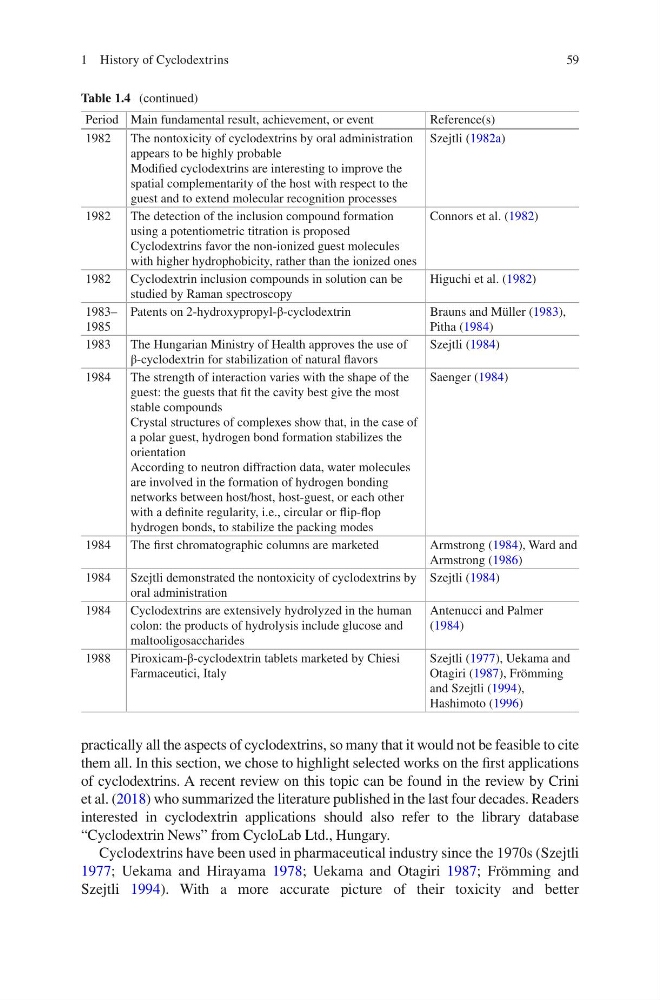
Table 1.4 (continued)
Period Main fundamental result, achievement, or event
Reference(s)
1982
The nontoxicity of cyclodextrins by oral administration
appears to be highly probable
Modified cyclodextrins are interesting to improve the
spatial complementarity of the host with respect to the
guest and to extend molecular recognition processes
Szejtli (1982a)
1982
The detection of the inclusion compound formation
using a potentiometric titration is proposed
Cyclodextrins favor the non-ionized guest molecules
with higher hydrophobicity, rather than the ionized ones
Connors et al. (1982)
1982
Cyclodextrin inclusion compounds in solution can be
studied by Raman spectroscopy
Higuchi et al. (1982)
1983–
1985
Patents on 2-hydroxypropyl-β-cyclodextrin
Brauns and Müller (1983),
Pitha (1984)
1983
The Hungarian Ministry of Health approves the use of
β-cyclodextrin for stabilization of natural flavors
Szejtli (1984)
1984
The strength of interaction varies with the shape of the
guest: the guests that fit the cavity best give the most
stable compounds
Crystal structures of complexes show that, in the case of
a polar guest, hydrogen bond formation stabilizes the
orientation
According to neutron diffraction data, water molecules
are involved in the formation of hydrogen bonding
networks between host/host, host-guest, or each other
with a definite regularity, i.e., circular or flip-flop
hydrogen bonds, to stabilize the packing modes
Saenger (1984)
1984
The first chromatographic columns are marketed
Armstrong (1984), Ward and
Armstrong (1986)
1984
Szejtli demonstrated the nontoxicity of cyclodextrins by
oral administration
Szejtli (1984)
1984
Cyclodextrins are extensively hydrolyzed in the human
colon: the products of hydrolysis include glucose and
maltooligosaccharides
Antenucci and Palmer
(1984)
1988
Piroxicam-β-cyclodextrin tablets marketed by Chiesi
Farmaceutici, Italy
Szejtli (1977), Uekama and
Otagiri (1987), Frömming
and Szejtli (1994),
Hashimoto (1996)
1 History of Cyclodextrins
practically all the aspects of cyclodextrins, so many that it would not be feasible to cite
them all. In this section, we chose to highlight selected works on the first applications
of cyclodextrins. A recent review on this topic can be found in the review by Crini
et al. (2018) who summarized the literature published in the last four decades. Readers
interested in cyclodextrin applications should also refer to the library database
“Cyclodextrin News” from CycloLab Ltd., Hungary.
Cyclodextrins have been used in pharmaceutical industry since the 1970s (Szejtli
1977; Uekama and Hirayama 1978; Uekama and Otagiri 1987; Frömming and
Szejtli 1994). With a more accurate picture of their toxicity and better
Table 1.4 (continued)
Period Main fundamental result, achievement, or event
Reference(s)
1982
The nontoxicity of cyclodextrins by oral administration
appears to be highly probable
Modified cyclodextrins are interesting to improve the
spatial complementarity of the host with respect to the
guest and to extend molecular recognition processes
Szejtli (1982a)
1982
The detection of the inclusion compound formation
using a potentiometric titration is proposed
Cyclodextrins favor the non-ionized guest molecules
with higher hydrophobicity, rather than the ionized ones
Connors et al. (1982)
1982
Cyclodextrin inclusion compounds in solution can be
studied by Raman spectroscopy
Higuchi et al. (1982)
1983–
1985
Patents on 2-hydroxypropyl-β-cyclodextrin
Brauns and Müller (1983),
Pitha (1984)
1983
The Hungarian Ministry of Health approves the use of
β-cyclodextrin for stabilization of natural flavors
Szejtli (1984)
1984
The strength of interaction varies with the shape of the
guest: the guests that fit the cavity best give the most
stable compounds
Crystal structures of complexes show that, in the case of
a polar guest, hydrogen bond formation stabilizes the
orientation
According to neutron diffraction data, water molecules
are involved in the formation of hydrogen bonding
networks between host/host, host-guest, or each other
with a definite regularity, i.e., circular or flip-flop
hydrogen bonds, to stabilize the packing modes
Saenger (1984)
1984
The first chromatographic columns are marketed
Armstrong (1984), Ward and
Armstrong (1986)
1984
Szejtli demonstrated the nontoxicity of cyclodextrins by
oral administration
Szejtli (1984)
1984
Cyclodextrins are extensively hydrolyzed in the human
colon: the products of hydrolysis include glucose and
maltooligosaccharides
Antenucci and Palmer
(1984)
1988
Piroxicam-β-cyclodextrin tablets marketed by Chiesi
Farmaceutici, Italy
Szejtli (1977), Uekama and
Otagiri (1987), Frömming
and Szejtli (1994),
Hashimoto (1996)
1 History of Cyclodextrins