

44
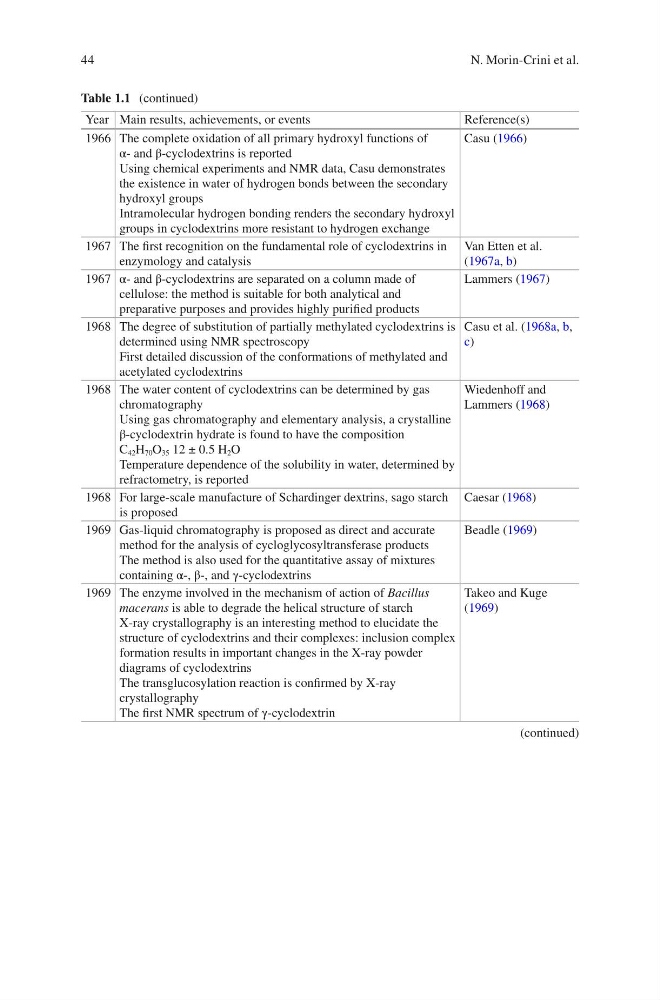
Table 1.1 (continued)
Year Main results, achievements, or events
Reference(s)
1966 The complete oxidation of all primary hydroxyl functions of
α- and β-cyclodextrins is reported
Using chemical experiments and NMR data, Casu demonstrates
the existence in water of hydrogen bonds between the secondary
hydroxyl groups
Intramolecular hydrogen bonding renders the secondary hydroxyl
groups in cyclodextrins more resistant to hydrogen exchange
Casu (1966)
1967 The first recognition on the fundamental role of cyclodextrins in
enzymology and catalysis
Van Etten et al.
(1967a, b)
1967 α- and β-cyclodextrins are separated on a column made of
cellulose: the method is suitable for both analytical and
preparative purposes and provides highly purified products
Lammers (1967)
1968 The degree of substitution of partially methylated cyclodextrins is
determined using NMR spectroscopy
First detailed discussion of the conformations of methylated and
acetylated cyclodextrins
Casu et al. (1968a, b,
c)
1968 The water content of cyclodextrins can be determined by gas
chromatography
Using gas chromatography and elementary analysis, a crystalline
β-cyclodextrin hydrate is found to have the composition
C 42 H 70 O 35 12 ± 0.5 H 2 O
Temperature dependence of the solubility in water, determined by
refractometry, is reported
Wiedenhoff and
Lammers (1968)
1968 For large-scale manufacture of Schardinger dextrins, sago starch
is proposed
Caesar (1968)
1969 Gas-liquid chromatography is proposed as direct and accurate
method for the analysis of cycloglycosyltransferase products
The method is also used for the quantitative assay of mixtures
containing α-, β-, and γ-cyclodextrins
Beadle (1969)
1969 The enzyme involved in the mechanism of action of Bacillus
macerans is able to degrade the helical structure of starch
X-ray crystallography is an interesting method to elucidate the
structure of cyclodextrins and their complexes: inclusion complex
formation results in important changes in the X-ray powder
diagrams of cyclodextrins
The transglucosylation reaction is confirmed by X-ray
crystallography
The first NMR spectrum of γ-cyclodextrin
Takeo and Kuge
(1969)
(continued)
N. Morin-Crini et al.
Table 1.1 (continued)
Year Main results, achievements, or events
Reference(s)
1966 The complete oxidation of all primary hydroxyl functions of
α- and β-cyclodextrins is reported
Using chemical experiments and NMR data, Casu demonstrates
the existence in water of hydrogen bonds between the secondary
hydroxyl groups
Intramolecular hydrogen bonding renders the secondary hydroxyl
groups in cyclodextrins more resistant to hydrogen exchange
Casu (1966)
1967 The first recognition on the fundamental role of cyclodextrins in
enzymology and catalysis
Van Etten et al.
(1967a, b)
1967 α- and β-cyclodextrins are separated on a column made of
cellulose: the method is suitable for both analytical and
preparative purposes and provides highly purified products
Lammers (1967)
1968 The degree of substitution of partially methylated cyclodextrins is
determined using NMR spectroscopy
First detailed discussion of the conformations of methylated and
acetylated cyclodextrins
Casu et al. (1968a, b,
c)
1968 The water content of cyclodextrins can be determined by gas
chromatography
Using gas chromatography and elementary analysis, a crystalline
β-cyclodextrin hydrate is found to have the composition
C 42 H 70 O 35 12 ± 0.5 H 2 O
Temperature dependence of the solubility in water, determined by
refractometry, is reported
Wiedenhoff and
Lammers (1968)
1968 For large-scale manufacture of Schardinger dextrins, sago starch
is proposed
Caesar (1968)
1969 Gas-liquid chromatography is proposed as direct and accurate
method for the analysis of cycloglycosyltransferase products
The method is also used for the quantitative assay of mixtures
containing α-, β-, and γ-cyclodextrins
Beadle (1969)
1969 The enzyme involved in the mechanism of action of Bacillus
macerans is able to degrade the helical structure of starch
X-ray crystallography is an interesting method to elucidate the
structure of cyclodextrins and their complexes: inclusion complex
formation results in important changes in the X-ray powder
diagrams of cyclodextrins
The transglucosylation reaction is confirmed by X-ray
crystallography
The first NMR spectrum of γ-cyclodextrin
Takeo and Kuge
(1969)
(continued)
N. Morin-Crini et al.