

43
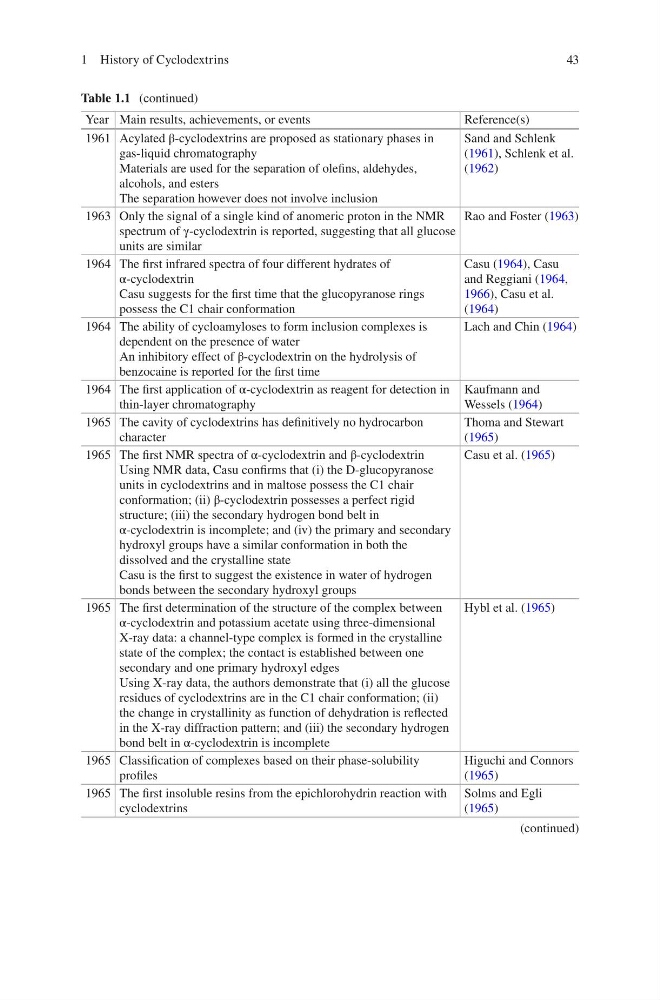
Table 1.1 (continued)
Year Main results, achievements, or events
Reference(s)
1961 Acylated β-cyclodextrins are proposed as stationary phases in
gas-liquid chromatography
Materials are used for the separation of olefins, aldehydes,
alcohols, and esters
The separation however does not involve inclusion
Sand and Schlenk
(1961), Schlenk et al.
(1962)
1963 Only the signal of a single kind of anomeric proton in the NMR
spectrum of γ-cyclodextrin is reported, suggesting that all glucose
units are similar
Rao and Foster (1963)
1964 The first infrared spectra of four different hydrates of
α-cyclodextrin
Casu suggests for the first time that the glucopyranose rings
possess the C1 chair conformation
Casu (1964), Casu
and Reggiani (1964,
1966), Casu et al.
(1964)
1964 The ability of cycloamyloses to form inclusion complexes is
dependent on the presence of water
An inhibitory effect of β-cyclodextrin on the hydrolysis of
benzocaine is reported for the first time
Lach and Chin (1964)
1964 The first application of α-cyclodextrin as reagent for detection in
thin-layer chromatography
Kaufmann and
Wessels (1964)
1965 The cavity of cyclodextrins has definitively no hydrocarbon
character
Thoma and Stewart
(1965)
1965 The first NMR spectra of α-cyclodextrin and β-cyclodextrin
Using NMR data, Casu confirms that (i) the D-glucopyranose
units in cyclodextrins and in maltose possess the C1 chair
conformation; (ii) β-cyclodextrin possesses a perfect rigid
structure; (iii) the secondary hydrogen bond belt in
α-cyclodextrin is incomplete; and (iv) the primary and secondary
hydroxyl groups have a similar conformation in both the
dissolved and the crystalline state
Casu is the first to suggest the existence in water of hydrogen
bonds between the secondary hydroxyl groups
Casu et al. (1965)
1965 The first determination of the structure of the complex between
α-cyclodextrin and potassium acetate using three-dimensional
X-ray data: a channel-type complex is formed in the crystalline
state of the complex; the contact is established between one
secondary and one primary hydroxyl edges
Using X-ray data, the authors demonstrate that (i) all the glucose
residues of cyclodextrins are in the C1 chair conformation; (ii)
the change in crystallinity as function of dehydration is reflected
in the X-ray diffraction pattern; and (iii) the secondary hydrogen
bond belt in α-cyclodextrin is incomplete
Hybl et al. (1965)
1965 Classification of complexes based on their phase-solubility
profiles
Higuchi and Connors
(1965)
1965 The first insoluble resins from the epichlorohydrin reaction with
cyclodextrins
Solms and Egli
(1965)
(continued)
1 History of Cyclodextrins
Table 1.1 (continued)
Year Main results, achievements, or events
Reference(s)
1961 Acylated β-cyclodextrins are proposed as stationary phases in
gas-liquid chromatography
Materials are used for the separation of olefins, aldehydes,
alcohols, and esters
The separation however does not involve inclusion
Sand and Schlenk
(1961), Schlenk et al.
(1962)
1963 Only the signal of a single kind of anomeric proton in the NMR
spectrum of γ-cyclodextrin is reported, suggesting that all glucose
units are similar
Rao and Foster (1963)
1964 The first infrared spectra of four different hydrates of
α-cyclodextrin
Casu suggests for the first time that the glucopyranose rings
possess the C1 chair conformation
Casu (1964), Casu
and Reggiani (1964,
1966), Casu et al.
(1964)
1964 The ability of cycloamyloses to form inclusion complexes is
dependent on the presence of water
An inhibitory effect of β-cyclodextrin on the hydrolysis of
benzocaine is reported for the first time
Lach and Chin (1964)
1964 The first application of α-cyclodextrin as reagent for detection in
thin-layer chromatography
Kaufmann and
Wessels (1964)
1965 The cavity of cyclodextrins has definitively no hydrocarbon
character
Thoma and Stewart
(1965)
1965 The first NMR spectra of α-cyclodextrin and β-cyclodextrin
Using NMR data, Casu confirms that (i) the D-glucopyranose
units in cyclodextrins and in maltose possess the C1 chair
conformation; (ii) β-cyclodextrin possesses a perfect rigid
structure; (iii) the secondary hydrogen bond belt in
α-cyclodextrin is incomplete; and (iv) the primary and secondary
hydroxyl groups have a similar conformation in both the
dissolved and the crystalline state
Casu is the first to suggest the existence in water of hydrogen
bonds between the secondary hydroxyl groups
Casu et al. (1965)
1965 The first determination of the structure of the complex between
α-cyclodextrin and potassium acetate using three-dimensional
X-ray data: a channel-type complex is formed in the crystalline
state of the complex; the contact is established between one
secondary and one primary hydroxyl edges
Using X-ray data, the authors demonstrate that (i) all the glucose
residues of cyclodextrins are in the C1 chair conformation; (ii)
the change in crystallinity as function of dehydration is reflected
in the X-ray diffraction pattern; and (iii) the secondary hydrogen
bond belt in α-cyclodextrin is incomplete
Hybl et al. (1965)
1965 Classification of complexes based on their phase-solubility
profiles
Higuchi and Connors
(1965)
1965 The first insoluble resins from the epichlorohydrin reaction with
cyclodextrins
Solms and Egli
(1965)
(continued)
1 History of Cyclodextrins