

42
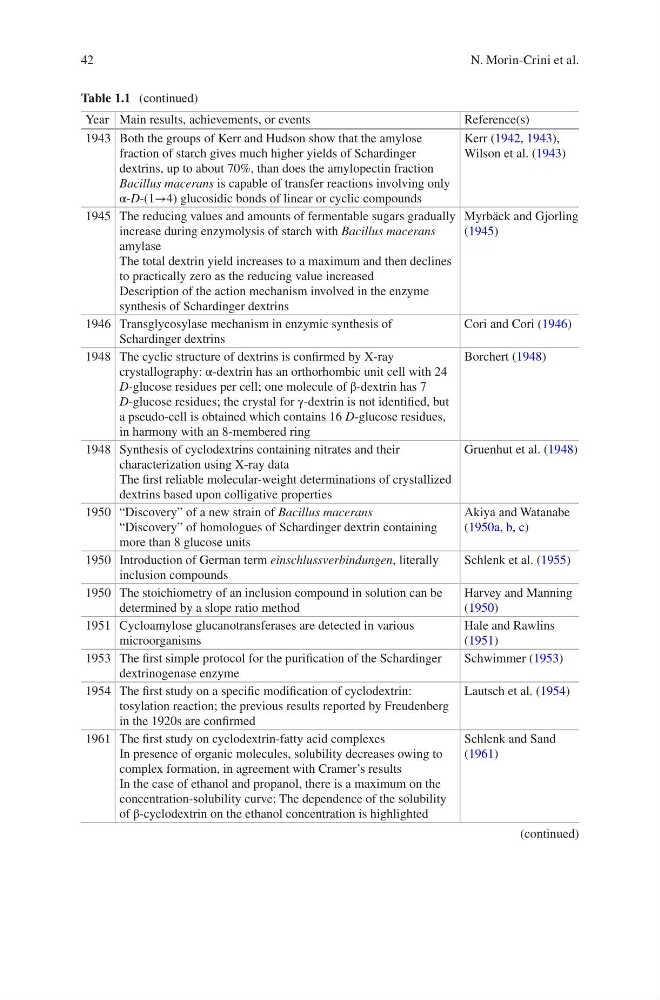
Table 1.1 (continued)
Year Main results, achievements, or events
Reference(s)
1943 Both the groups of Kerr and Hudson show that the amylose
fraction of starch gives much higher yields of Schardinger
dextrins, up to about 70%, than does the amylopectin fraction
Bacillus macerans is capable of transfer reactions involving only
α-D-(1→4) glucosidic bonds of linear or cyclic compounds
Kerr (1942, 1943),
Wilson et al. (1943)
1945 The reducing values and amounts of fermentable sugars gradually
increase during enzymolysis of starch with Bacillus macerans
amylase
The total dextrin yield increases to a maximum and then declines
to practically zero as the reducing value increased
Description of the action mechanism involved in the enzyme
synthesis of Schardinger dextrins
Myrbäck and Gjorling
(1945)
1946 Transglycosylase mechanism in enzymic synthesis of
Schardinger dextrins
Cori and Cori (1946)
1948 The cyclic structure of dextrins is confirmed by X-ray
crystallography: α-dextrin has an orthorhombic unit cell with 24
D-glucose residues per cell; one molecule of β-dextrin has 7
D-glucose residues; the crystal for γ-dextrin is not identified, but
a pseudo-cell is obtained which contains 16 D-glucose residues,
in harmony with an 8-membered ring
Borchert (1948)
1948 Synthesis of cyclodextrins containing nitrates and their
characterization using X-ray data
The first reliable molecular-weight determinations of crystallized
dextrins based upon colligative properties
Gruenhut et al. (1948)
1950 “Discovery” of a new strain of Bacillus macerans
“Discovery” of homologues of Schardinger dextrin containing
more than 8 glucose units
Akiya and Watanabe
(1950a, b, c)
1950 Introduction of German term einschlussverbindungen, literally
inclusion compounds
Schlenk et al. (1955)
1950 The stoichiometry of an inclusion compound in solution can be
determined by a slope ratio method
Harvey and Manning
(1950)
1951 Cycloamylose glucanotransferases are detected in various
microorganisms
Hale and Rawlins
(1951)
1953 The first simple protocol for the purification of the Schardinger
dextrinogenase enzyme
Schwimmer (1953)
1954 The first study on a specific modification of cyclodextrin:
tosylation reaction; the previous results reported by Freudenberg
in the 1920s are confirmed
Lautsch et al. (1954)
1961 The first study on cyclodextrin-fatty acid complexes
In presence of organic molecules, solubility decreases owing to
complex formation, in agreement with Cramer’s results
In the case of ethanol and propanol, there is a maximum on the
concentration-solubility curve: The dependence of the solubility
of β-cyclodextrin on the ethanol concentration is highlighted
Schlenk and Sand
(1961)
(continued)
N. Morin-Crini et al.
Table 1.1 (continued)
Year Main results, achievements, or events
Reference(s)
1943 Both the groups of Kerr and Hudson show that the amylose
fraction of starch gives much higher yields of Schardinger
dextrins, up to about 70%, than does the amylopectin fraction
Bacillus macerans is capable of transfer reactions involving only
α-D-(1→4) glucosidic bonds of linear or cyclic compounds
Kerr (1942, 1943),
Wilson et al. (1943)
1945 The reducing values and amounts of fermentable sugars gradually
increase during enzymolysis of starch with Bacillus macerans
amylase
The total dextrin yield increases to a maximum and then declines
to practically zero as the reducing value increased
Description of the action mechanism involved in the enzyme
synthesis of Schardinger dextrins
Myrbäck and Gjorling
(1945)
1946 Transglycosylase mechanism in enzymic synthesis of
Schardinger dextrins
Cori and Cori (1946)
1948 The cyclic structure of dextrins is confirmed by X-ray
crystallography: α-dextrin has an orthorhombic unit cell with 24
D-glucose residues per cell; one molecule of β-dextrin has 7
D-glucose residues; the crystal for γ-dextrin is not identified, but
a pseudo-cell is obtained which contains 16 D-glucose residues,
in harmony with an 8-membered ring
Borchert (1948)
1948 Synthesis of cyclodextrins containing nitrates and their
characterization using X-ray data
The first reliable molecular-weight determinations of crystallized
dextrins based upon colligative properties
Gruenhut et al. (1948)
1950 “Discovery” of a new strain of Bacillus macerans
“Discovery” of homologues of Schardinger dextrin containing
more than 8 glucose units
Akiya and Watanabe
(1950a, b, c)
1950 Introduction of German term einschlussverbindungen, literally
inclusion compounds
Schlenk et al. (1955)
1950 The stoichiometry of an inclusion compound in solution can be
determined by a slope ratio method
Harvey and Manning
(1950)
1951 Cycloamylose glucanotransferases are detected in various
microorganisms
Hale and Rawlins
(1951)
1953 The first simple protocol for the purification of the Schardinger
dextrinogenase enzyme
Schwimmer (1953)
1954 The first study on a specific modification of cyclodextrin:
tosylation reaction; the previous results reported by Freudenberg
in the 1920s are confirmed
Lautsch et al. (1954)
1961 The first study on cyclodextrin-fatty acid complexes
In presence of organic molecules, solubility decreases owing to
complex formation, in agreement with Cramer’s results
In the case of ethanol and propanol, there is a maximum on the
concentration-solubility curve: The dependence of the solubility
of β-cyclodextrin on the ethanol concentration is highlighted
Schlenk and Sand
(1961)
(continued)
N. Morin-Crini et al.