

41
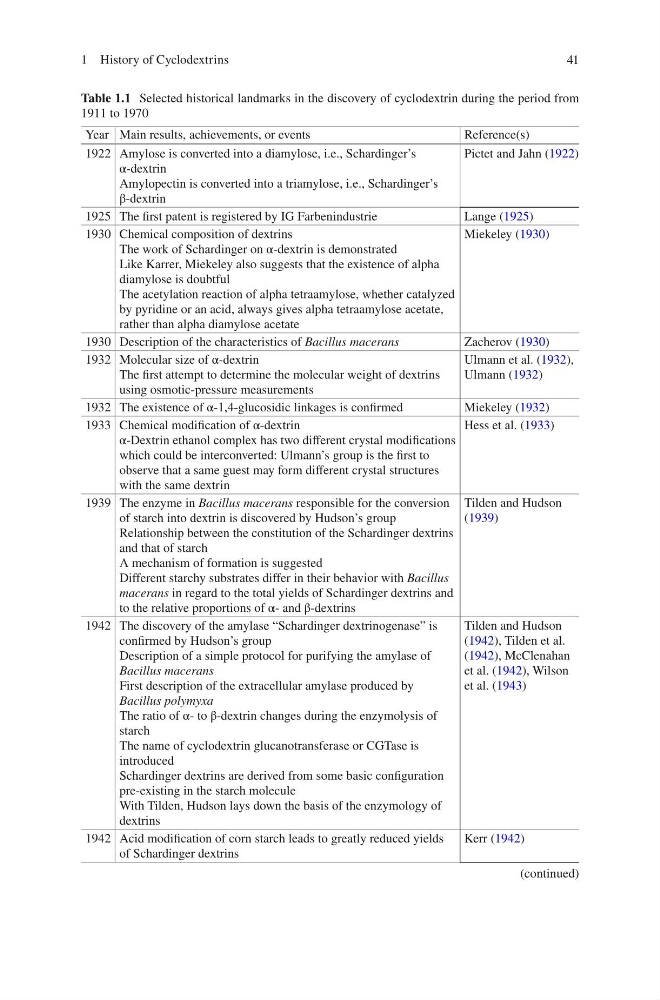
Table 1.1 Selected historical landmarks in the discovery of cyclodextrin during the period from
1911 to 1970
Year Main results, achievements, or events
Reference(s)
1922 Amylose is converted into a diamylose, i.e., Schardinger’s
α-dextrin
Amylopectin is converted into a triamylose, i.e., Schardinger’s
β-dextrin
Pictet and Jahn (1922)
1925 The first patent is registered by IG Farbenindustrie
Lange (1925)
1930 Chemical composition of dextrins
The work of Schardinger on α-dextrin is demonstrated
Like Karrer, Miekeley also suggests that the existence of alpha
diamylose is doubtful
The acetylation reaction of alpha tetraamylose, whether catalyzed
by pyridine or an acid, always gives alpha tetraamylose acetate,
rather than alpha diamylose acetate
Miekeley (1930)
1930 Description of the characteristics of Bacillus macerans
Zacherov (1930)
1932 Molecular size of α-dextrin
The first attempt to determine the molecular weight of dextrins
using osmotic-pressure measurements
Ulmann et al. (1932),
Ulmann (1932)
1932 The existence of α-1,4-glucosidic linkages is confirmed
Miekeley (1932)
1933 Chemical modification of α-dextrin
α-Dextrin ethanol complex has two different crystal modifications
which could be interconverted: Ulmann’s group is the first to
observe that a same guest may form different crystal structures
with the same dextrin
Hess et al. (1933)
1939 The enzyme in Bacillus macerans responsible for the conversion
of starch into dextrin is discovered by Hudson’s group
Relationship between the constitution of the Schardinger dextrins
and that of starch
A mechanism of formation is suggested
Different starchy substrates differ in their behavior with Bacillus
macerans in regard to the total yields of Schardinger dextrins and
to the relative proportions of α- and β-dextrins
Tilden and Hudson
(1939)
1942 The discovery of the amylase “Schardinger dextrinogenase” is
confirmed by Hudson’s group
Description of a simple protocol for purifying the amylase of
Bacillus macerans
First description of the extracellular amylase produced by
Bacillus polymyxa
The ratio of α- to β-dextrin changes during the enzymolysis of
starch
The name of cyclodextrin glucanotransferase or CGTase is
introduced
Schardinger dextrins are derived from some basic configuration
pre-existing in the starch molecule
With Tilden, Hudson lays down the basis of the enzymology of
dextrins
Tilden and Hudson
(1942), Tilden et al.
(1942), McClenahan
et al. (1942), Wilson
et al. (1943)
1942 Acid modification of corn starch leads to greatly reduced yields
of Schardinger dextrins
Kerr (1942)
(continued)
1 History of Cyclodextrins
Table 1.1 Selected historical landmarks in the discovery of cyclodextrin during the period from
1911 to 1970
Year Main results, achievements, or events
Reference(s)
1922 Amylose is converted into a diamylose, i.e., Schardinger’s
α-dextrin
Amylopectin is converted into a triamylose, i.e., Schardinger’s
β-dextrin
Pictet and Jahn (1922)
1925 The first patent is registered by IG Farbenindustrie
Lange (1925)
1930 Chemical composition of dextrins
The work of Schardinger on α-dextrin is demonstrated
Like Karrer, Miekeley also suggests that the existence of alpha
diamylose is doubtful
The acetylation reaction of alpha tetraamylose, whether catalyzed
by pyridine or an acid, always gives alpha tetraamylose acetate,
rather than alpha diamylose acetate
Miekeley (1930)
1930 Description of the characteristics of Bacillus macerans
Zacherov (1930)
1932 Molecular size of α-dextrin
The first attempt to determine the molecular weight of dextrins
using osmotic-pressure measurements
Ulmann et al. (1932),
Ulmann (1932)
1932 The existence of α-1,4-glucosidic linkages is confirmed
Miekeley (1932)
1933 Chemical modification of α-dextrin
α-Dextrin ethanol complex has two different crystal modifications
which could be interconverted: Ulmann’s group is the first to
observe that a same guest may form different crystal structures
with the same dextrin
Hess et al. (1933)
1939 The enzyme in Bacillus macerans responsible for the conversion
of starch into dextrin is discovered by Hudson’s group
Relationship between the constitution of the Schardinger dextrins
and that of starch
A mechanism of formation is suggested
Different starchy substrates differ in their behavior with Bacillus
macerans in regard to the total yields of Schardinger dextrins and
to the relative proportions of α- and β-dextrins
Tilden and Hudson
(1939)
1942 The discovery of the amylase “Schardinger dextrinogenase” is
confirmed by Hudson’s group
Description of a simple protocol for purifying the amylase of
Bacillus macerans
First description of the extracellular amylase produced by
Bacillus polymyxa
The ratio of α- to β-dextrin changes during the enzymolysis of
starch
The name of cyclodextrin glucanotransferase or CGTase is
introduced
Schardinger dextrins are derived from some basic configuration
pre-existing in the starch molecule
With Tilden, Hudson lays down the basis of the enzymology of
dextrins
Tilden and Hudson
(1942), Tilden et al.
(1942), McClenahan
et al. (1942), Wilson
et al. (1943)
1942 Acid modification of corn starch leads to greatly reduced yields
of Schardinger dextrins
Kerr (1942)
(continued)
1 History of Cyclodextrins