

45
1.4 Historical Landmarks in the Development
of Cyclodextrins: From 1970 Until Now
1.4.1 Production of Cyclodextrins
At the mid-1970s, industrial-scale production really started (Horikoshi 1979).
Indeed, several manufacturers started to produce and to market cyclodextrins, e.g.,
Nihon Shokuhin Kako, Japan; Sanraku Ocean Co. Ltd., Japan; Toyo Joso, Japan;
and Chinoin, Hungary. The first pilot plant at Nihon Shokuhin Kako firm, Japan,
started up in 1978 with a production capacity of about 20 tons per year (Sicard and
Saniez 1987). However, cyclodextrins were expensive.
The first to believe in the possibilities of industrial production and the multiple
applications of cyclodextrins was probably Szejtli, a Hungarian carbohydrate chemist who organized the cyclodextrin technology in Hungary in the 1970s (Szejtli
1988, 1998). Among the list of prestigious researchers who have contributed to the
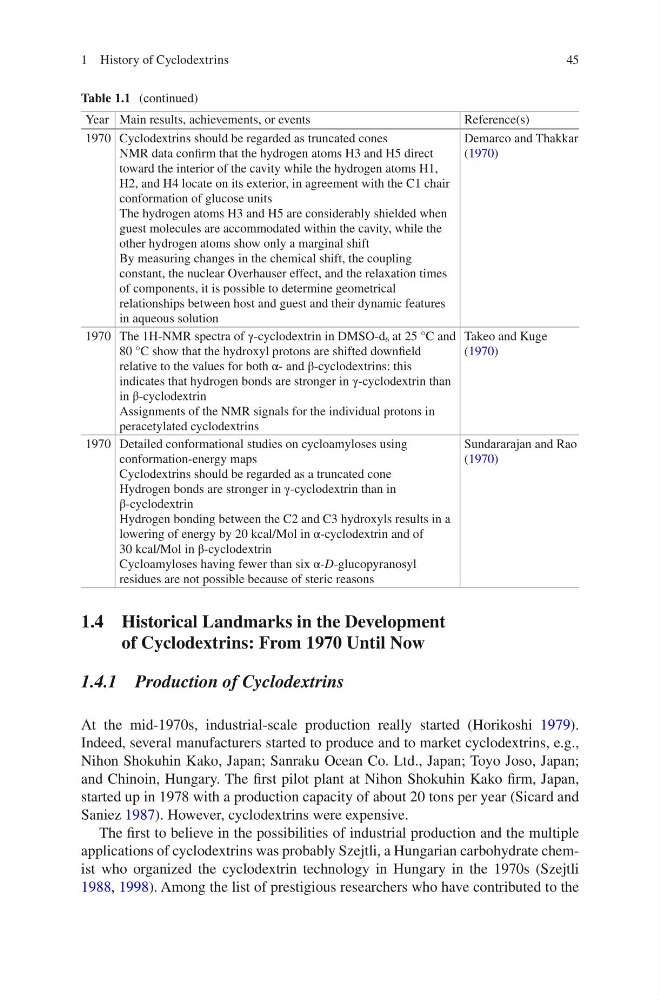
Table 1.1 (continued)
Year Main results, achievements, or events
Reference(s)
1970 Cyclodextrins should be regarded as truncated cones
NMR data confirm that the hydrogen atoms H3 and H5 direct
toward the interior of the cavity while the hydrogen atoms H1,
H2, and H4 locate on its exterior, in agreement with the C1 chair
conformation of glucose units
The hydrogen atoms H3 and H5 are considerably shielded when
guest molecules are accommodated within the cavity, while the
other hydrogen atoms show only a marginal shift
By measuring changes in the chemical shift, the coupling
constant, the nuclear Overhauser effect, and the relaxation times
of components, it is possible to determine geometrical
relationships between host and guest and their dynamic features
in aqueous solution
Demarco and Thakkar
(1970)
1970 The 1H-NMR spectra of γ-cyclodextrin in DMSO-d 6 at 25 °C and
80 °C show that the hydroxyl protons are shifted downfield
relative to the values for both α- and β-cyclodextrins: this
indicates that hydrogen bonds are stronger in γ-cyclodextrin than
in β-cyclodextrin
Assignments of the NMR signals for the individual protons in
peracetylated cyclodextrins
Takeo and Kuge
(1970)
1970 Detailed conformational studies on cycloamyloses using
conformation-energy maps
Cyclodextrins should be regarded as a truncated cone
Hydrogen bonds are stronger in γ-cyclodextrin than in
β-cyclodextrin
Hydrogen bonding between the C2 and C3 hydroxyls results in a
lowering of energy by 20 kcal/Mol in α-cyclodextrin and of
30 kcal/Mol in β-cyclodextrin
Cycloamyloses having fewer than six α-D-glucopyranosyl
residues are not possible because of steric reasons
Sundararajan and Rao
(1970)
1 History of Cyclodextrins
1.4 Historical Landmarks in the Development
of Cyclodextrins: From 1970 Until Now
1.4.1 Production of Cyclodextrins
At the mid-1970s, industrial-scale production really started (Horikoshi 1979).
Indeed, several manufacturers started to produce and to market cyclodextrins, e.g.,
Nihon Shokuhin Kako, Japan; Sanraku Ocean Co. Ltd., Japan; Toyo Joso, Japan;
and Chinoin, Hungary. The first pilot plant at Nihon Shokuhin Kako firm, Japan,
started up in 1978 with a production capacity of about 20 tons per year (Sicard and
Saniez 1987). However, cyclodextrins were expensive.
The first to believe in the possibilities of industrial production and the multiple
applications of cyclodextrins was probably Szejtli, a Hungarian carbohydrate chemist who organized the cyclodextrin technology in Hungary in the 1970s (Szejtli
1988, 1998). Among the list of prestigious researchers who have contributed to the
Table 1.1 (continued)
Year Main results, achievements, or events
Reference(s)
1970 Cyclodextrins should be regarded as truncated cones
NMR data confirm that the hydrogen atoms H3 and H5 direct
toward the interior of the cavity while the hydrogen atoms H1,
H2, and H4 locate on its exterior, in agreement with the C1 chair
conformation of glucose units
The hydrogen atoms H3 and H5 are considerably shielded when
guest molecules are accommodated within the cavity, while the
other hydrogen atoms show only a marginal shift
By measuring changes in the chemical shift, the coupling
constant, the nuclear Overhauser effect, and the relaxation times
of components, it is possible to determine geometrical
relationships between host and guest and their dynamic features
in aqueous solution
Demarco and Thakkar
(1970)
1970 The 1H-NMR spectra of γ-cyclodextrin in DMSO-d 6 at 25 °C and
80 °C show that the hydroxyl protons are shifted downfield
relative to the values for both α- and β-cyclodextrins: this
indicates that hydrogen bonds are stronger in γ-cyclodextrin than
in β-cyclodextrin
Assignments of the NMR signals for the individual protons in
peracetylated cyclodextrins
Takeo and Kuge
(1970)
1970 Detailed conformational studies on cycloamyloses using
conformation-energy maps
Cyclodextrins should be regarded as a truncated cone
Hydrogen bonds are stronger in γ-cyclodextrin than in
β-cyclodextrin
Hydrogen bonding between the C2 and C3 hydroxyls results in a
lowering of energy by 20 kcal/Mol in α-cyclodextrin and of
30 kcal/Mol in β-cyclodextrin
Cycloamyloses having fewer than six α-D-glucopyranosyl
residues are not possible because of steric reasons
Sundararajan and Rao
(1970)
1 History of Cyclodextrins