

36
complementarity between the guest and the cyclodextrin cavity. In solution, two
main components of the driving forces of the process are suggested: the first was the
presence of repulsive forces between the included water molecules and the apolar
cavity, and the second was the presence of repulsive forces between the bulk water
and the apolar organic guest. Cramer also indicated that hydrogen bonding between
the guest and the cyclodextrin was of only minor importance as a driving force for
complex formation (Cramer 1956). The stability of cyclodextrin inclusion complexes was due to a favorable change in enthalpy during the inclusion process.
However, later, Cramer also considered that a complex was stabilized not only by
van der Waals forces but also by hydrogen bonds (Cramer and Kampe 1965; Cramer
et al. 1967).
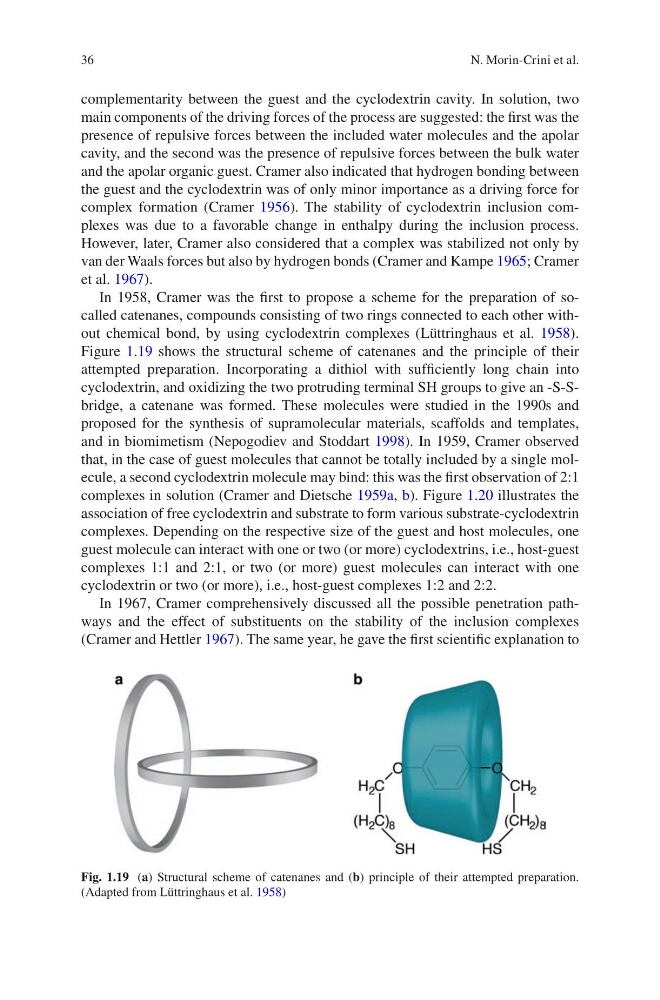
In 1958, Cramer was the first to propose a scheme for the preparation of socalled catenanes, compounds consisting of two rings connected to each other without chemical bond, by using cyclodextrin complexes (Lüttringhaus et al. 1958).
Figure 1.19 shows the structural scheme of catenanes and the principle of their
attempted preparation. Incorporating a dithiol with sufficiently long chain into
cyclodextrin, and oxidizing the two protruding terminal SH groups to give an -S-Sbridge, a catenane was formed. These molecules were studied in the 1990s and
proposed for the synthesis of supramolecular materials, scaffolds and templates,
and in biomimetism (Nepogodiev and Stoddart 1998). In 1959, Cramer observed
that, in the case of guest molecules that cannot be totally included by a single molecule, a second cyclodextrin molecule may bind: this was the first observation of 2:1
complexes in solution (Cramer and Dietsche 1959a, b). Figure 1.20 illustrates the
association of free cyclodextrin and substrate to form various substrate-cyclodextrin
complexes. Depending on the respective size of the guest and host molecules, one
guest molecule can interact with one or two (or more) cyclodextrins, i.e., host-guest
complexes 1:1 and 2:1, or two (or more) guest molecules can interact with one
cyclodextrin or two (or more), i.e., host-guest complexes 1:2 and 2:2.
In 1967, Cramer comprehensively discussed all the possible penetration pathways and the effect of substituents on the stability of the inclusion complexes
(Cramer and Hettler 1967). The same year, he gave the first scientific explanation to
Fig. 1.19 (a) Structural scheme of catenanes and (b) principle of their attempted preparation.
(Adapted from Lüttringhaus et al. 1958)
N. Morin-Crini et al.
complementarity between the guest and the cyclodextrin cavity. In solution, two
main components of the driving forces of the process are suggested: the first was the
presence of repulsive forces between the included water molecules and the apolar
cavity, and the second was the presence of repulsive forces between the bulk water
and the apolar organic guest. Cramer also indicated that hydrogen bonding between
the guest and the cyclodextrin was of only minor importance as a driving force for
complex formation (Cramer 1956). The stability of cyclodextrin inclusion complexes was due to a favorable change in enthalpy during the inclusion process.
However, later, Cramer also considered that a complex was stabilized not only by
van der Waals forces but also by hydrogen bonds (Cramer and Kampe 1965; Cramer
et al. 1967).
In 1958, Cramer was the first to propose a scheme for the preparation of socalled catenanes, compounds consisting of two rings connected to each other without chemical bond, by using cyclodextrin complexes (Lüttringhaus et al. 1958).
Figure 1.19 shows the structural scheme of catenanes and the principle of their
attempted preparation. Incorporating a dithiol with sufficiently long chain into
cyclodextrin, and oxidizing the two protruding terminal SH groups to give an -S-Sbridge, a catenane was formed. These molecules were studied in the 1990s and
proposed for the synthesis of supramolecular materials, scaffolds and templates,
and in biomimetism (Nepogodiev and Stoddart 1998). In 1959, Cramer observed
that, in the case of guest molecules that cannot be totally included by a single molecule, a second cyclodextrin molecule may bind: this was the first observation of 2:1
complexes in solution (Cramer and Dietsche 1959a, b). Figure 1.20 illustrates the
association of free cyclodextrin and substrate to form various substrate-cyclodextrin
complexes. Depending on the respective size of the guest and host molecules, one
guest molecule can interact with one or two (or more) cyclodextrins, i.e., host-guest
complexes 1:1 and 2:1, or two (or more) guest molecules can interact with one
cyclodextrin or two (or more), i.e., host-guest complexes 1:2 and 2:2.
In 1967, Cramer comprehensively discussed all the possible penetration pathways and the effect of substituents on the stability of the inclusion complexes
(Cramer and Hettler 1967). The same year, he gave the first scientific explanation to
Fig. 1.19 (a) Structural scheme of catenanes and (b) principle of their attempted preparation.
(Adapted from Lüttringhaus et al. 1958)
N. Morin-Crini et al.