

35
between several organic substances studied by Cramer and β-cyclodextrin using
NMR spectroscopy.
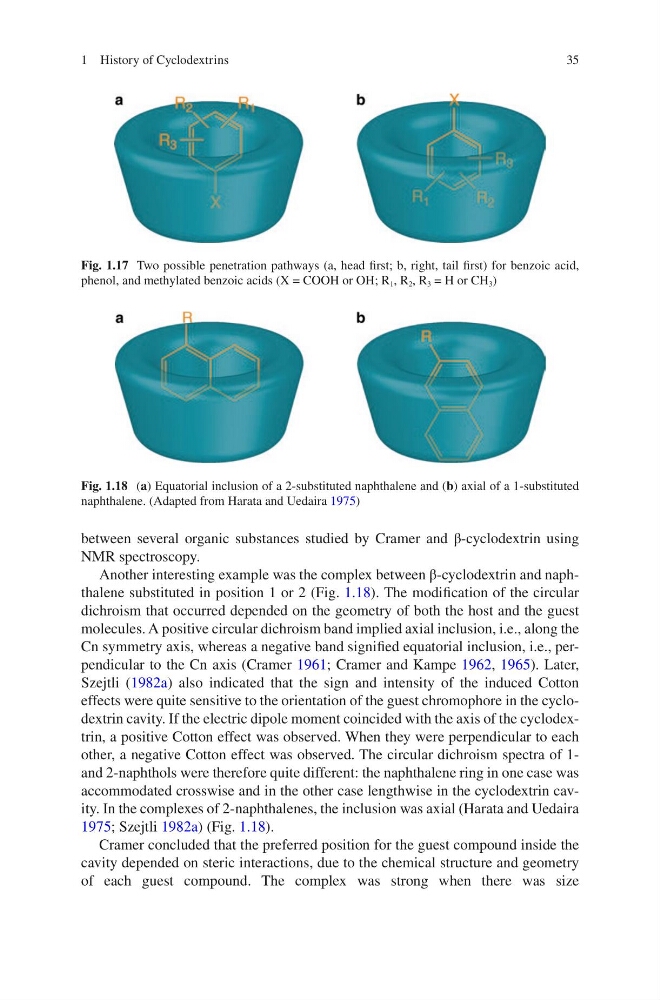
Another interesting example was the complex between β-cyclodextrin and naphthalene substituted in position 1 or 2 (Fig. 1.18). The modification of the circular
dichroism that occurred depended on the geometry of both the host and the guest
molecules. A positive circular dichroism band implied axial inclusion, i.e., along the
Cn symmetry axis, whereas a negative band signified equatorial inclusion, i.e., perpendicular to the Cn axis (Cramer 1961; Cramer and Kampe 1962, 1965). Later,
Szejtli (1982a) also indicated that the sign and intensity of the induced Cotton
effects were quite sensitive to the orientation of the guest chromophore in the cyclodextrin cavity. If the electric dipole moment coincided with the axis of the cyclodextrin, a positive Cotton effect was observed. When they were perpendicular to each
other, a negative Cotton effect was observed. The circular dichroism spectra of 1and 2-naphthols were therefore quite different: the naphthalene ring in one case was
accommodated crosswise and in the other case lengthwise in the cyclodextrin cavity. In the complexes of 2-naphthalenes, the inclusion was axial (Harata and Uedaira
1975; Szejtli 1982a) (Fig. 1.18).
Cramer concluded that the preferred position for the guest compound inside the
cavity depended on steric interactions, due to the chemical structure and geometry
of each guest compound. The complex was strong when there was size
Fig. 1.17 Two possible penetration pathways (a, head first; b, right, tail first) for benzoic acid,
phenol, and methylated benzoic acids (X = COOH or OH; R 1 , R 2 , R 3 = H or CH 3 )
Fig. 1.18 (a) Equatorial inclusion of a 2-substituted naphthalene and (b) axial of a 1-substituted
naphthalene. (Adapted from Harata and Uedaira 1975)
1 History of Cyclodextrins
between several organic substances studied by Cramer and β-cyclodextrin using
NMR spectroscopy.
Another interesting example was the complex between β-cyclodextrin and naphthalene substituted in position 1 or 2 (Fig. 1.18). The modification of the circular
dichroism that occurred depended on the geometry of both the host and the guest
molecules. A positive circular dichroism band implied axial inclusion, i.e., along the
Cn symmetry axis, whereas a negative band signified equatorial inclusion, i.e., perpendicular to the Cn axis (Cramer 1961; Cramer and Kampe 1962, 1965). Later,
Szejtli (1982a) also indicated that the sign and intensity of the induced Cotton
effects were quite sensitive to the orientation of the guest chromophore in the cyclodextrin cavity. If the electric dipole moment coincided with the axis of the cyclodextrin, a positive Cotton effect was observed. When they were perpendicular to each
other, a negative Cotton effect was observed. The circular dichroism spectra of 1and 2-naphthols were therefore quite different: the naphthalene ring in one case was
accommodated crosswise and in the other case lengthwise in the cyclodextrin cavity. In the complexes of 2-naphthalenes, the inclusion was axial (Harata and Uedaira
1975; Szejtli 1982a) (Fig. 1.18).
Cramer concluded that the preferred position for the guest compound inside the
cavity depended on steric interactions, due to the chemical structure and geometry
of each guest compound. The complex was strong when there was size
Fig. 1.17 Two possible penetration pathways (a, head first; b, right, tail first) for benzoic acid,
phenol, and methylated benzoic acids (X = COOH or OH; R 1 , R 2 , R 3 = H or CH 3 )
Fig. 1.18 (a) Equatorial inclusion of a 2-substituted naphthalene and (b) axial of a 1-substituted
naphthalene. (Adapted from Harata and Uedaira 1975)
1 History of Cyclodextrins