

34
2014). The term “inclusion compound” has been coined to describe the positional
relationship of two components which form certain types of crystals. These components were designated as host and guest, again in reference to the solid state (Schlenk
et al. 1955; Schlenk and Sand 1961).
In 1956, Cramer introduced the notion of “inclusion complex” (Cramer 1956).
He considered the interior of the cavity as a lipophilic microenvironment into which
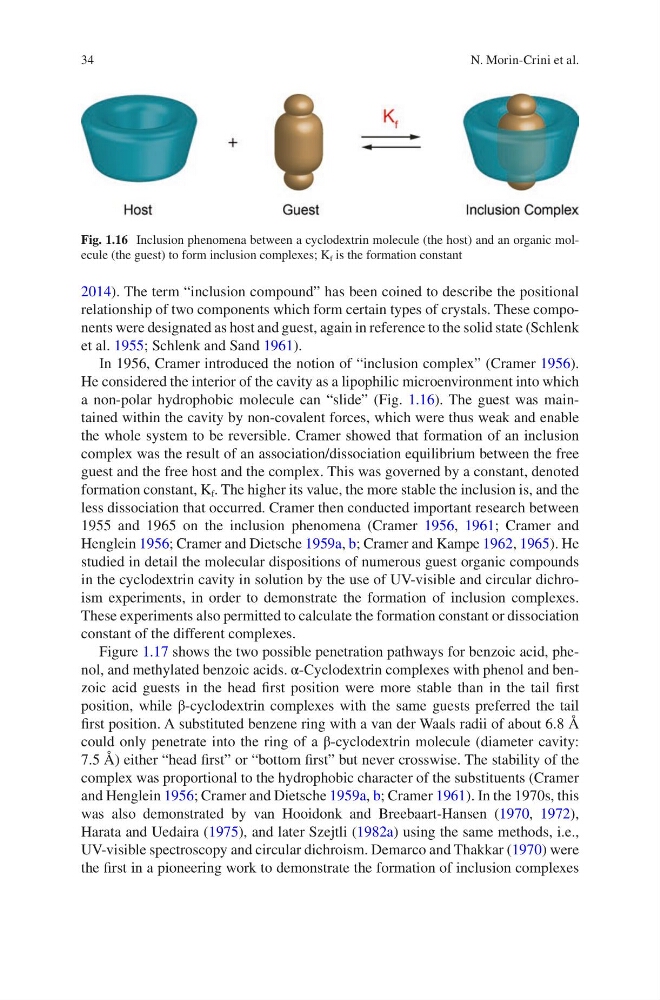
a non-polar hydrophobic molecule can “slide” (Fig. 1.16). The guest was maintained within the cavity by non-covalent forces, which were thus weak and enable
the whole system to be reversible. Cramer showed that formation of an inclusion
complex was the result of an association/dissociation equilibrium between the free
guest and the free host and the complex. This was governed by a constant, denoted
formation constant, K f . The higher its value, the more stable the inclusion is, and the
less dissociation that occurred. Cramer then conducted important research between
1955 and 1965 on the inclusion phenomena (Cramer 1956, 1961; Cramer and
Henglein 1956; Cramer and Dietsche 1959a, b; Cramer and Kampe 1962, 1965). He
studied in detail the molecular dispositions of numerous guest organic compounds
in the cyclodextrin cavity in solution by the use of UV-visible and circular dichroism experiments, in order to demonstrate the formation of inclusion complexes.
These experiments also permitted to calculate the formation constant or dissociation
constant of the different complexes.
Figure 1.17 shows the two possible penetration pathways for benzoic acid, phenol, and methylated benzoic acids. α-Cyclodextrin complexes with phenol and benzoic acid guests in the head first position were more stable than in the tail first
position, while β-cyclodextrin complexes with the same guests preferred the tail
first position. A substituted benzene ring with a van der Waals radii of about 6.8 Å
could only penetrate into the ring of a β-cyclodextrin molecule (diameter cavity:
7.5 Å) either “head first” or “bottom first” but never crosswise. The stability of the
complex was proportional to the hydrophobic character of the substituents (Cramer
and Henglein 1956; Cramer and Dietsche 1959a, b; Cramer 1961). In the 1970s, this
was also demonstrated by van Hooidonk and Breebaart-Hansen (1970, 1972),
Harata and Uedaira (1975), and later Szejtli (1982a) using the same methods, i.e.,
UV-visible spectroscopy and circular dichroism. Demarco and Thakkar (1970) were
the first in a pioneering work to demonstrate the formation of inclusion complexes
Fig. 1.16 Inclusion phenomena between a cyclodextrin molecule (the host) and an organic molecule (the guest) to form inclusion complexes; K f is the formation constant
N. Morin-Crini et al.
2014). The term “inclusion compound” has been coined to describe the positional
relationship of two components which form certain types of crystals. These components were designated as host and guest, again in reference to the solid state (Schlenk
et al. 1955; Schlenk and Sand 1961).
In 1956, Cramer introduced the notion of “inclusion complex” (Cramer 1956).
He considered the interior of the cavity as a lipophilic microenvironment into which
a non-polar hydrophobic molecule can “slide” (Fig. 1.16). The guest was maintained within the cavity by non-covalent forces, which were thus weak and enable
the whole system to be reversible. Cramer showed that formation of an inclusion
complex was the result of an association/dissociation equilibrium between the free
guest and the free host and the complex. This was governed by a constant, denoted
formation constant, K f . The higher its value, the more stable the inclusion is, and the
less dissociation that occurred. Cramer then conducted important research between
1955 and 1965 on the inclusion phenomena (Cramer 1956, 1961; Cramer and
Henglein 1956; Cramer and Dietsche 1959a, b; Cramer and Kampe 1962, 1965). He
studied in detail the molecular dispositions of numerous guest organic compounds
in the cyclodextrin cavity in solution by the use of UV-visible and circular dichroism experiments, in order to demonstrate the formation of inclusion complexes.
These experiments also permitted to calculate the formation constant or dissociation
constant of the different complexes.
Figure 1.17 shows the two possible penetration pathways for benzoic acid, phenol, and methylated benzoic acids. α-Cyclodextrin complexes with phenol and benzoic acid guests in the head first position were more stable than in the tail first
position, while β-cyclodextrin complexes with the same guests preferred the tail
first position. A substituted benzene ring with a van der Waals radii of about 6.8 Å
could only penetrate into the ring of a β-cyclodextrin molecule (diameter cavity:
7.5 Å) either “head first” or “bottom first” but never crosswise. The stability of the
complex was proportional to the hydrophobic character of the substituents (Cramer
and Henglein 1956; Cramer and Dietsche 1959a, b; Cramer 1961). In the 1970s, this
was also demonstrated by van Hooidonk and Breebaart-Hansen (1970, 1972),
Harata and Uedaira (1975), and later Szejtli (1982a) using the same methods, i.e.,
UV-visible spectroscopy and circular dichroism. Demarco and Thakkar (1970) were
the first in a pioneering work to demonstrate the formation of inclusion complexes
Fig. 1.16 Inclusion phenomena between a cyclodextrin molecule (the host) and an organic molecule (the guest) to form inclusion complexes; K f is the formation constant
N. Morin-Crini et al.