

37
explain the mechanism of formation of an inclusion complex between a substrate
and a cyclodextrin molecule both in solution and solid state (Cramer et al. 1967). To
explain the formation of an inclusion complex, Cramer introduced five elementary
steps: (1) the substrate approaches the cyclodextrin molecule; water molecules
escape from the cyclodextrin cavity and acquire a new energy level, corresponding
to that of the gaseous state; the van der Waals interactions and the number of hydrogen bonds decrease, whereas the degrees of freedom of translation and rotation of
the freed water molecules increase; (2) the guest molecule becomes released from
the layer of water that envelops it and also acquires a different state; the layer of
water becomes dispersed and rearranges; (3) the guest molecule, considered to be in
a perfect gas state, enters the cavity, and the complex formed is stabilized by van der
Waals forces and/or hydrogen bonds; (4) the expelled water molecules are rearranged and form hydrogen bonds between each other; and (5) the structure of the
water is restored around the part of the substrate that remains in contact with the
solvent and that is integrated into the hydration shell around the CD. Cramer finally
concluded that the most important property of cyclodextrins was the ability to establish specific interactions, i.e., molecular encapsulation, with various types of molecules through the formation of non-covalently bonded entities such as hydrophobic
interactions, van der Waals forces, and hydrogen bonding (Cramer and Hettler
1967; Cramer et al. 1967). Cramer’s work on inclusion complexes established much
of our modern understanding of the behavior of cyclodextrins during complexation
and remains a commonly cited source to this day.
At the same time as Cramer, French also studied the formation of inclusion complexes and showed that evidence for a guest inclusion into the cycloamylose cavity
may be proved by analytical techniques such as UV-visible absorption spectrophotometry, optical rotatory dispersion, circular dichroism, and X-ray measurements
(Thoma and French 1958, 1959, 1960, 1961; James et al. 1959; Thoma et al. 1959).
The guests studied were the same as that of Cramer such as phenol, benzoic acids,
or iodine. For instance, in 1958, French showed that absorption spectroscopy was an
interesting method to determine the dissociation constant of the inclusion complex
between cycloamylose and iodine (Thoma and French 1958). The values of dissociation constant could be easily obtained from the observed change in absorbance
and the concentration of cycloamylose added according the Benesi-Hildebrand
method. For French, the driving forces for complex formation included solvent
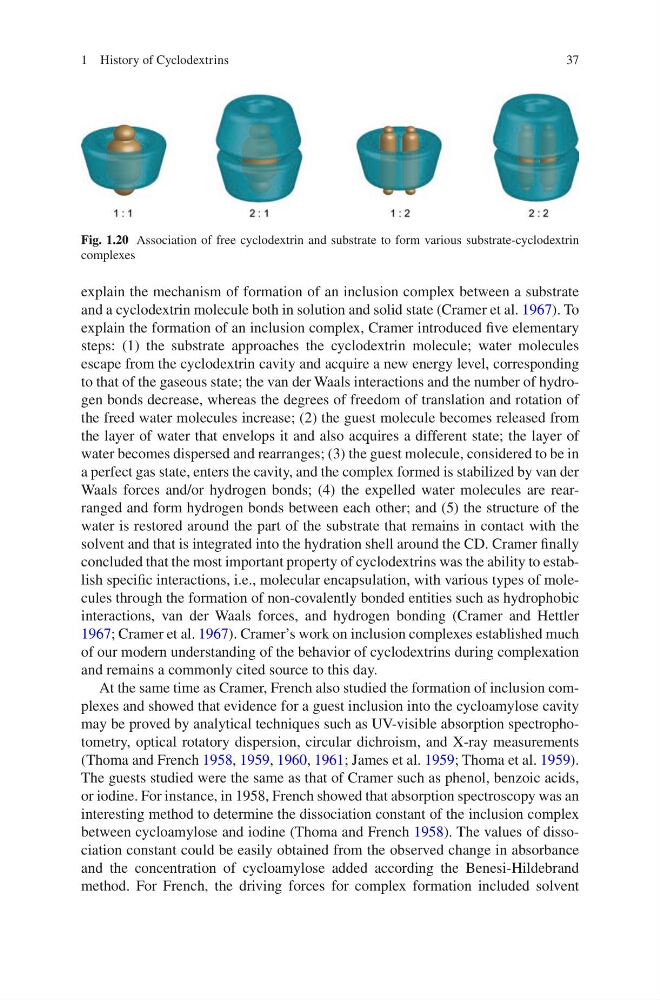
Fig. 1.20 Association of free cyclodextrin and substrate to form various substrate-cyclodextrin
complexes
1 History of Cyclodextrins
explain the mechanism of formation of an inclusion complex between a substrate
and a cyclodextrin molecule both in solution and solid state (Cramer et al. 1967). To
explain the formation of an inclusion complex, Cramer introduced five elementary
steps: (1) the substrate approaches the cyclodextrin molecule; water molecules
escape from the cyclodextrin cavity and acquire a new energy level, corresponding
to that of the gaseous state; the van der Waals interactions and the number of hydrogen bonds decrease, whereas the degrees of freedom of translation and rotation of
the freed water molecules increase; (2) the guest molecule becomes released from
the layer of water that envelops it and also acquires a different state; the layer of
water becomes dispersed and rearranges; (3) the guest molecule, considered to be in
a perfect gas state, enters the cavity, and the complex formed is stabilized by van der
Waals forces and/or hydrogen bonds; (4) the expelled water molecules are rearranged and form hydrogen bonds between each other; and (5) the structure of the
water is restored around the part of the substrate that remains in contact with the
solvent and that is integrated into the hydration shell around the CD. Cramer finally
concluded that the most important property of cyclodextrins was the ability to establish specific interactions, i.e., molecular encapsulation, with various types of molecules through the formation of non-covalently bonded entities such as hydrophobic
interactions, van der Waals forces, and hydrogen bonding (Cramer and Hettler
1967; Cramer et al. 1967). Cramer’s work on inclusion complexes established much
of our modern understanding of the behavior of cyclodextrins during complexation
and remains a commonly cited source to this day.
At the same time as Cramer, French also studied the formation of inclusion complexes and showed that evidence for a guest inclusion into the cycloamylose cavity
may be proved by analytical techniques such as UV-visible absorption spectrophotometry, optical rotatory dispersion, circular dichroism, and X-ray measurements
(Thoma and French 1958, 1959, 1960, 1961; James et al. 1959; Thoma et al. 1959).
The guests studied were the same as that of Cramer such as phenol, benzoic acids,
or iodine. For instance, in 1958, French showed that absorption spectroscopy was an
interesting method to determine the dissociation constant of the inclusion complex
between cycloamylose and iodine (Thoma and French 1958). The values of dissociation constant could be easily obtained from the observed change in absorbance
and the concentration of cycloamylose added according the Benesi-Hildebrand
method. For French, the driving forces for complex formation included solvent
Fig. 1.20 Association of free cyclodextrin and substrate to form various substrate-cyclodextrin
complexes
1 History of Cyclodextrins