

381
Year Result
Reference(s)
2017 Solid-state NMR and X-ray diffraction analysis are interesting techniques to characterize modified ECP materials
Crini et al.
(2017),
Euvrard et al.
(2017), and
Priac et al.
(2017)
The first study on the use of cyclodextrin-based materials to remove a mixture of five fungicides. Significant affinities are found with
the mixture propiconazole + tebuconazole + epoxiconazole + bromuconazole + difenoconazole, five pesticides listed as priority
substances in Europe. Multilayer adsorption due to
π–π bonds and steric effects can be advanced to explain the differences of
adsorption observed
ECP materials can also remove significantly endocrine disruptors such as alkylphenols and alkylphenol polyethoxylates
2018 An updated review on the applications of ECP materials. Non-modified and modified ECP materials have proved to be efficient and
more advantageous than conventional systems in water and wastewater treatment
Crini et al.
(2018a)
2018 The first review on the adsorption mechanisms described during the complexation of contaminants by ECP materials. The
mechanisms are still being debated because they involve various interactions that can occur simultaneously. There is nevertheless a
consensus on the fundamental role of cyclodextrin units
Morin-Crini
et al. (2018a)
2018 Two other books published on cyclodextrins
Fourmentin
et al. (2018a,
b)
2019 The last review on non-conventional sorbents for wastewater treatment
Crini et al.
(2019b)
8 Water-Insoluble Cyclodextrin-Epichlorohydrin Polymers
Year Result
Reference(s)
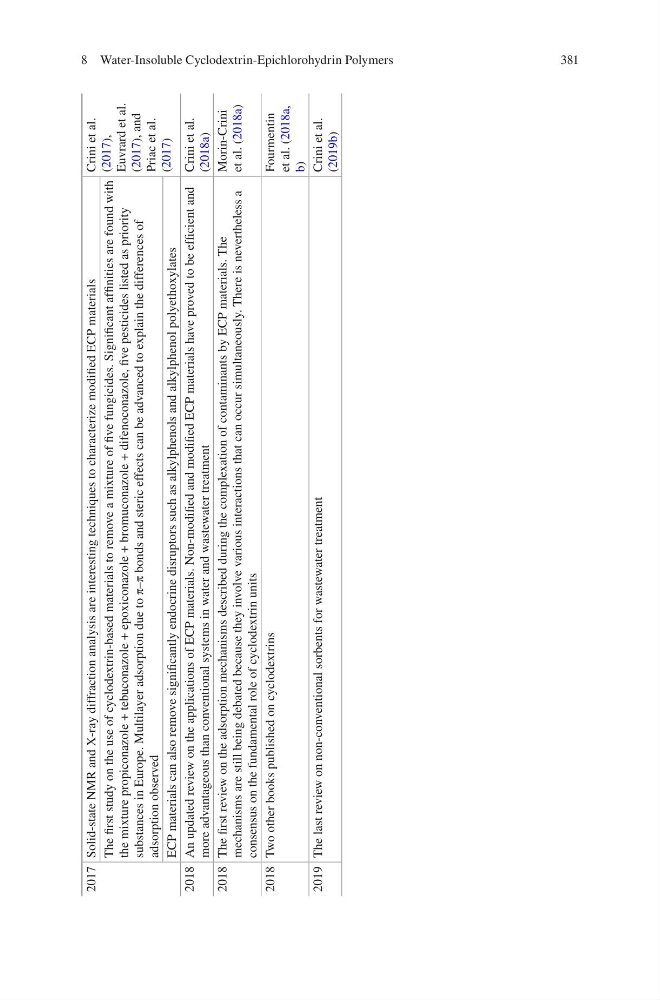
2017 Solid-state NMR and X-ray diffraction analysis are interesting techniques to characterize modified ECP materials
Crini et al.
(2017),
Euvrard et al.
(2017), and
Priac et al.
(2017)
The first study on the use of cyclodextrin-based materials to remove a mixture of five fungicides. Significant affinities are found with
the mixture propiconazole + tebuconazole + epoxiconazole + bromuconazole + difenoconazole, five pesticides listed as priority
substances in Europe. Multilayer adsorption due to
π–π bonds and steric effects can be advanced to explain the differences of
adsorption observed
ECP materials can also remove significantly endocrine disruptors such as alkylphenols and alkylphenol polyethoxylates
2018 An updated review on the applications of ECP materials. Non-modified and modified ECP materials have proved to be efficient and
more advantageous than conventional systems in water and wastewater treatment
Crini et al.
(2018a)
2018 The first review on the adsorption mechanisms described during the complexation of contaminants by ECP materials. The
mechanisms are still being debated because they involve various interactions that can occur simultaneously. There is nevertheless a
consensus on the fundamental role of cyclodextrin units
Morin-Crini
et al. (2018a)
2018 Two other books published on cyclodextrins
Fourmentin
et al. (2018a,
b)
2019 The last review on non-conventional sorbents for wastewater treatment
Crini et al.
(2019b)
8 Water-Insoluble Cyclodextrin-Epichlorohydrin Polymers