

380
Table 8.1 (continued)
Year Result
Reference(s)
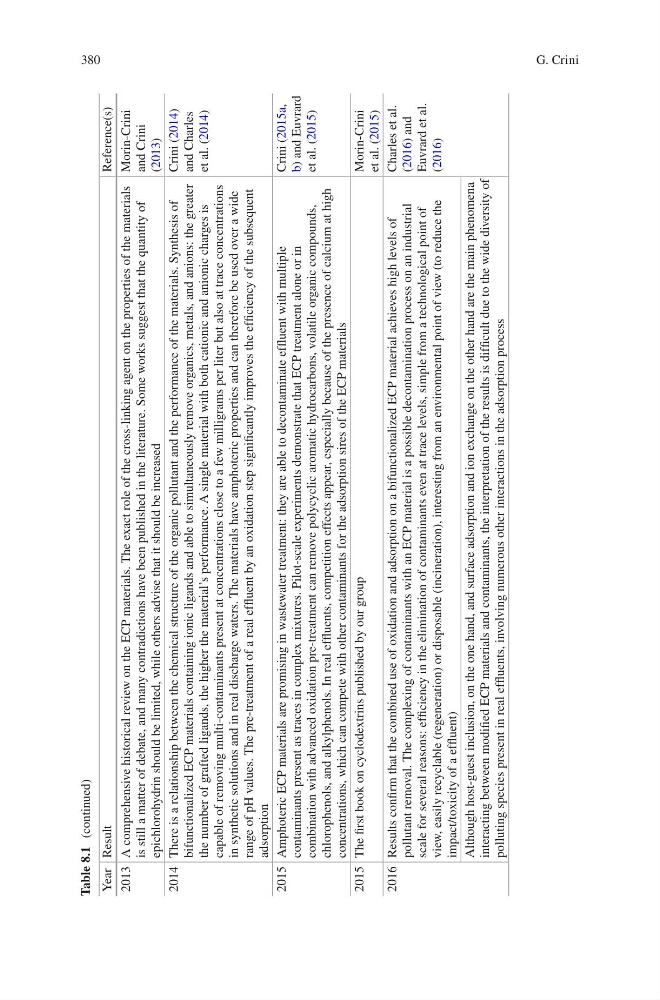
2013 A comprehensive historical review on the ECP materials. The exact role of the cross-linking agent on the properties of the materials
is still a matter of debate, and many contradictions have been published in the literature. Some works suggest that the quantity of
epichlorohydrin should be limited, while others advise that it should be increased
Morin-Crini
and Crini
(2013)
2014 There is a relationship between the chemical structure of the organic pollutant and the performance of the materials. Synthesis of
bifunctionalized ECP materials containing ionic ligands and able to simultaneously remove organics, metals, and anions: the greater
the number of grafted ligands, the higher the material’s performance. A single material with both cationic and anionic charges is
capable of removing multi-contaminants present at concentrations close to a few milligrams per liter but also at trace concentrations
in synthetic solutions and in real discharge waters. The materials have amphoteric properties and can therefore be used over a wide
range of pH values. The pre-treatment of a real effluent by an oxidation step significantly improves the efficiency of the subsequent
adsorption
Crini (2014)
and Charles
et al. (2014)
2015 Amphoteric ECP materials are promising in wastewater treatment: they are able to decontaminate effluent with multiple
contaminants present as traces in complex mixtures. Pilot-scale experiments demonstrate that ECP treatment alone or in
combination with advanced oxidation pre-treatment can remove polycyclic aromatic hydrocarbons, volatile organic compounds,
chlorophenols, and alkylphenols. In real effluents, competition effects appear, especially because of the presence of calcium at high
concentrations, which can compete with other contaminants for the adsorption sires of the ECP materials
Crini (2015a,
b) and Euvrard
et al. (2015)
2015 The first book on cyclodextrins published by our group
Morin-Crini
et al. (2015)
2016 Results confirm that the combined use of oxidation and adsorption on a bifunctionalized ECP material achieves high levels of
pollutant removal. The complexing of contaminants with an ECP material is a possible decontamination process on an industrial
scale for several reasons: efficiency in the elimination of contaminants even at trace levels, simple from a technological point of
view, easily recyclable (regeneration) or disposable (incineration), interesting from an environmental point of view (to reduce the
impact/toxicity of a effluent)
Charles et al.
(2016) and
Euvrard et al.
(2016)
Although host-guest inclusion, on the one hand, and surface adsorption and ion exchange on the other hand are the main phenomena
interacting between modified ECP materials and contaminants, the interpretation of the results is difficult due to the wide diversity of
polluting species present in real effluents, involving numerous other interactions in the adsorption process
G. Crini
Table 8.1 (continued)
Year Result
Reference(s)
2013 A comprehensive historical review on the ECP materials. The exact role of the cross-linking agent on the properties of the materials
is still a matter of debate, and many contradictions have been published in the literature. Some works suggest that the quantity of
epichlorohydrin should be limited, while others advise that it should be increased
Morin-Crini
and Crini
(2013)
2014 There is a relationship between the chemical structure of the organic pollutant and the performance of the materials. Synthesis of
bifunctionalized ECP materials containing ionic ligands and able to simultaneously remove organics, metals, and anions: the greater
the number of grafted ligands, the higher the material’s performance. A single material with both cationic and anionic charges is
capable of removing multi-contaminants present at concentrations close to a few milligrams per liter but also at trace concentrations
in synthetic solutions and in real discharge waters. The materials have amphoteric properties and can therefore be used over a wide
range of pH values. The pre-treatment of a real effluent by an oxidation step significantly improves the efficiency of the subsequent
adsorption
Crini (2014)
and Charles
et al. (2014)
2015 Amphoteric ECP materials are promising in wastewater treatment: they are able to decontaminate effluent with multiple
contaminants present as traces in complex mixtures. Pilot-scale experiments demonstrate that ECP treatment alone or in
combination with advanced oxidation pre-treatment can remove polycyclic aromatic hydrocarbons, volatile organic compounds,
chlorophenols, and alkylphenols. In real effluents, competition effects appear, especially because of the presence of calcium at high
concentrations, which can compete with other contaminants for the adsorption sires of the ECP materials
Crini (2015a,
b) and Euvrard
et al. (2015)
2015 The first book on cyclodextrins published by our group
Morin-Crini
et al. (2015)
2016 Results confirm that the combined use of oxidation and adsorption on a bifunctionalized ECP material achieves high levels of
pollutant removal. The complexing of contaminants with an ECP material is a possible decontamination process on an industrial
scale for several reasons: efficiency in the elimination of contaminants even at trace levels, simple from a technological point of
view, easily recyclable (regeneration) or disposable (incineration), interesting from an environmental point of view (to reduce the
impact/toxicity of a effluent)
Charles et al.
(2016) and
Euvrard et al.
(2016)
Although host-guest inclusion, on the one hand, and surface adsorption and ion exchange on the other hand are the main phenomena
interacting between modified ECP materials and contaminants, the interpretation of the results is difficult due to the wide diversity of
polluting species present in real effluents, involving numerous other interactions in the adsorption process
G. Crini