

379
Year Result
Reference(s)
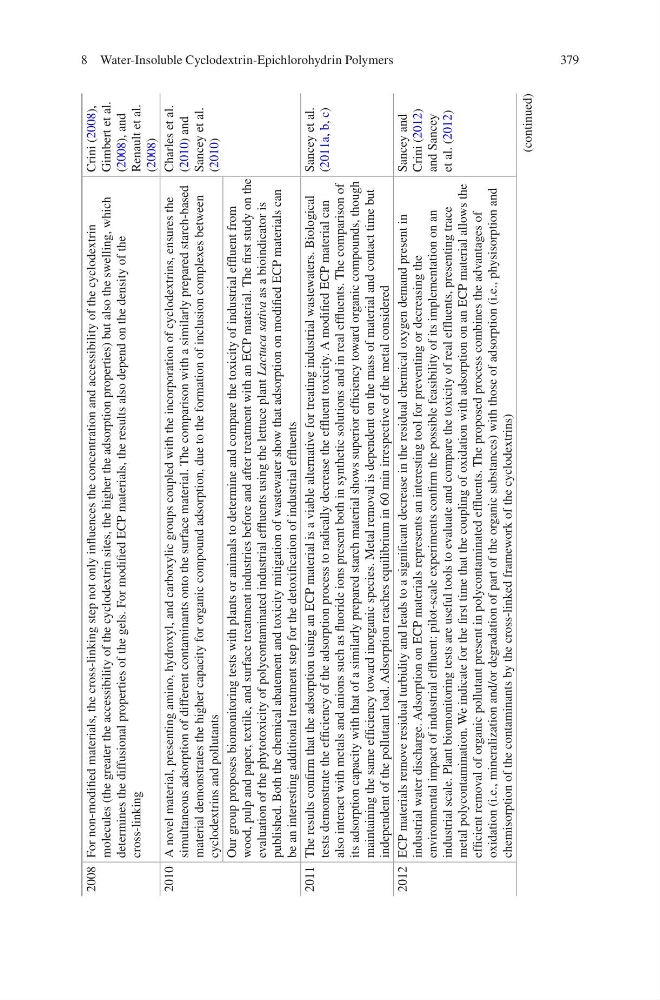
2008 For non-modified materials, the cross-linking step not only influences the concentration and accessibility of the cyclodextrin
molecules (the greater the accessibility of the cyclodextrin sites, the higher the adsorption properties) but also the swelling, which
determines the diffusional properties of the gels. For modified ECP materials, the results also depend on the density of the
cross-linking
Crini (2008),
Gimbert et al.
(2008), and
Renault et al.
(2008)
2010 A novel material, presenting amino, hydroxyl, and carboxylic groups coupled with the incorporation of cyclodextrins, ensures the
simultaneous adsorption of different contaminants onto the surface material. The comparison with a similarly prepared starch-based
material demonstrates the higher capacity for organic compound adsorption, due to the formation of inclusion complexes between
cyclodextrins and pollutants
Charles et al.
(2010) and
Sancey et al.
(2010)
Our group proposes biomonitoring tests with plants or animals to determine and compare the toxicity of industrial effluent from
wood, pulp and paper, textile, and surface treatment industries before and after treatment with an ECP material. The first study on the
evaluation of the phytotoxicity of polycontaminated industrial effluents using the lettuce plant Lactuca sativa
as a bioindicator is
published. Both the chemical abatement and toxicity mitigation of wastewater show that adsorption on modified ECP materials can
be an interesting additional treatment step for the detoxification of industrial effluents
2011 The results confirm that the adsorption using an ECP material is a viable alternative for treating industrial wastewaters. Biological
tests demonstrate the efficiency of the adsorption process to radically decrease the effluent toxicity. A modified ECP material can
also interact with metals and anions such as fluoride ions present both in synthetic solutions and in real effluents. The comparison of
its adsorption capacity with that of a similarly prepared starch material shows superior efficiency toward organic compounds, though
maintaining the same efficiency toward inorganic species. Metal removal is dependent on the mass of material and contact time but
independent of the pollutant load. Adsorption reaches equilibrium in 60 min irrespective of the metal considered
Sancey et al.
(2011a, b, c)
2012 ECP materials remove residual turbidity and leads to a significant decrease in the residual chemical oxygen demand present in
industrial water discharge. Adsorption on ECP materials represents an interesting tool for preventing or decreasing the
environmental impact of industrial effluent: pilot-scale experiments confirm the possible feasibility of its implementation on an
industrial scale. Plant biomonitoring tests are useful tools to evaluate and compare the toxicity of real effluents, presenting trace
metal polycontamination. We indicate for the first time that the coupling of oxidation with adsorption on an ECP material allows the
efficient removal of organic pollutant present in polycontaminated effluents. The proposed process combines the advantages of
oxidation (i.e., mineralization and/or degradation of part of the organic substances) with those of adsorption (i.e., physisorption and
chemisorption of the contaminants by the cross-linked framework of the cyclodextrins)
Sancey and
Crini (2012)
and Sancey
et al. (2012)
(continued)
8 Water-Insoluble Cyclodextrin-Epichlorohydrin Polymers
Year Result
Reference(s)
2008 For non-modified materials, the cross-linking step not only influences the concentration and accessibility of the cyclodextrin
molecules (the greater the accessibility of the cyclodextrin sites, the higher the adsorption properties) but also the swelling, which
determines the diffusional properties of the gels. For modified ECP materials, the results also depend on the density of the
cross-linking
Crini (2008),
Gimbert et al.
(2008), and
Renault et al.
(2008)
2010 A novel material, presenting amino, hydroxyl, and carboxylic groups coupled with the incorporation of cyclodextrins, ensures the
simultaneous adsorption of different contaminants onto the surface material. The comparison with a similarly prepared starch-based
material demonstrates the higher capacity for organic compound adsorption, due to the formation of inclusion complexes between
cyclodextrins and pollutants
Charles et al.
(2010) and
Sancey et al.
(2010)
Our group proposes biomonitoring tests with plants or animals to determine and compare the toxicity of industrial effluent from
wood, pulp and paper, textile, and surface treatment industries before and after treatment with an ECP material. The first study on the
evaluation of the phytotoxicity of polycontaminated industrial effluents using the lettuce plant Lactuca sativa
as a bioindicator is
published. Both the chemical abatement and toxicity mitigation of wastewater show that adsorption on modified ECP materials can
be an interesting additional treatment step for the detoxification of industrial effluents
2011 The results confirm that the adsorption using an ECP material is a viable alternative for treating industrial wastewaters. Biological
tests demonstrate the efficiency of the adsorption process to radically decrease the effluent toxicity. A modified ECP material can
also interact with metals and anions such as fluoride ions present both in synthetic solutions and in real effluents. The comparison of
its adsorption capacity with that of a similarly prepared starch material shows superior efficiency toward organic compounds, though
maintaining the same efficiency toward inorganic species. Metal removal is dependent on the mass of material and contact time but
independent of the pollutant load. Adsorption reaches equilibrium in 60 min irrespective of the metal considered
Sancey et al.
(2011a, b, c)
2012 ECP materials remove residual turbidity and leads to a significant decrease in the residual chemical oxygen demand present in
industrial water discharge. Adsorption on ECP materials represents an interesting tool for preventing or decreasing the
environmental impact of industrial effluent: pilot-scale experiments confirm the possible feasibility of its implementation on an
industrial scale. Plant biomonitoring tests are useful tools to evaluate and compare the toxicity of real effluents, presenting trace
metal polycontamination. We indicate for the first time that the coupling of oxidation with adsorption on an ECP material allows the
efficient removal of organic pollutant present in polycontaminated effluents. The proposed process combines the advantages of
oxidation (i.e., mineralization and/or degradation of part of the organic substances) with those of adsorption (i.e., physisorption and
chemisorption of the contaminants by the cross-linked framework of the cyclodextrins)
Sancey and
Crini (2012)
and Sancey
et al. (2012)
(continued)
8 Water-Insoluble Cyclodextrin-Epichlorohydrin Polymers