

378
Table 8.1 (continued)
Year Result
Reference(s)
2005 The complexation process results from a multitude of interactions between the three components of the adsorption system, i.e., the
cyclodextrin molecules of the material, the contaminants, and the effluent to be treated. The role of cyclodextrins fundamentally
occurs through the formation of inclusion and/or association complexes. We note the importance of the moieties at the surface of the
ECP material rather than inclusion to explain the mechanisms
Crini (2005a,
2005b) and
Delval et al.
(2005)
Materials composed of oligosaccharides (linear dextrins, sugars) or polysaccharides such as starches, prepared in the same crosslinking conditions as ECP materials, were studied in pollutant complexing experiments, and their different performances were
compared. The results demonstrate that the most important parameter is the degree of cross-linking: the higher the degree of
cross-linking, the lower the performance of the material. Cross-linked starches and cross-linked linear dextrins show adsorption
capacities that are higher than those of ECP materials even though they do not possess the type of cavity that participates in inclusion
complexes. Very high adsorption properties are described with respect to the same contaminants studied for several years. The
materials are also capable of treating real effluents. For modified polymers, the mechanism is mainly due to electrostatic interactions,
surface adsorption, and dye-dye interactions, which explain the rapid contact times
To obtain adsorbents able to efficiently process both minerals (including metals) and organics, it is necessary to modify or activate
the networks by grafting different types of moieties (neutral or ionic): new bifunctionalized ECP materials with high porosity and
surface area are synthetized
2006 Contaminants with a complex structure and a high molecular weight are more easily complexed, due to an effect of cooperation
between cyclodextrin molecules and the polymer network. The performance of the materials is strictly linked to the conditions of
their synthesis: the degree of cross-linking is a key element in the same way as the presence of the cyclodextrin molecules.
Adsorption kinetics are strongly dependent on the degree of cross-linking
Crini (2006)
and Crini and
Peindy (2006)
Inclusion aside, various mechanisms are proposed depending on the type of function or ligand grafted, e.g., ion exchange,
electrostatic attraction, chelation, and/or precipitation
2007 The structure and the polarity of the contaminants studied as well as the experimental conditions (e.g., dosage of material,
contaminant concentration, pH, ionic strength, etc.) of the batch used can contribute to complicating the interpretations on the
adsorption mechanism. The reproducibility of the performances of cyclodextrin polymers used as adsorbents for the removal of dyes
and the regeneration of the materials after saturation is reported
Crini et al.
(2007)
G. Crini
Table 8.1 (continued)
Year Result
Reference(s)
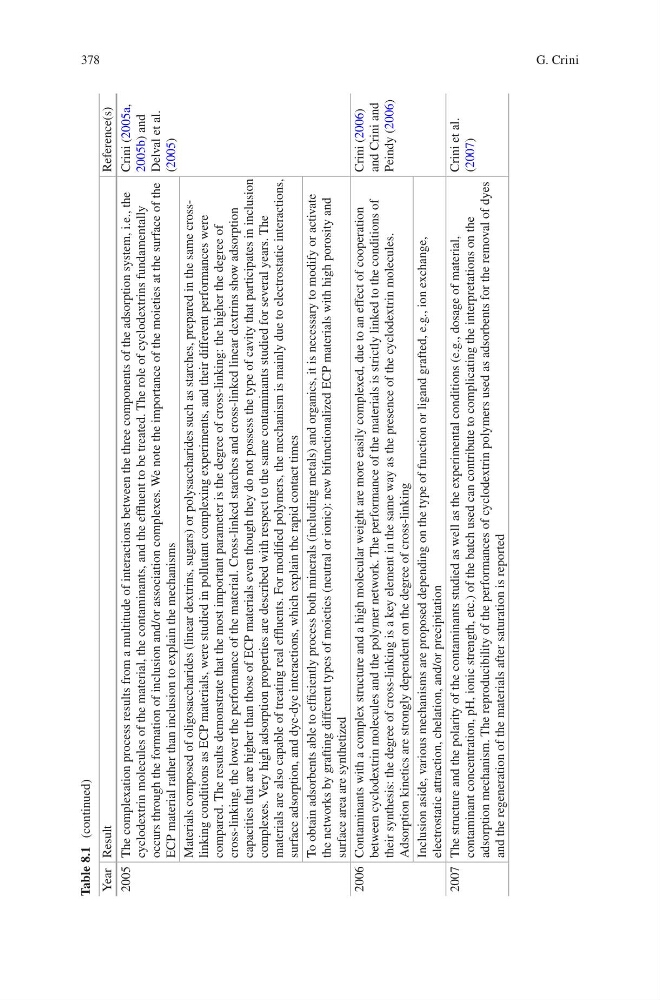
2005 The complexation process results from a multitude of interactions between the three components of the adsorption system, i.e., the
cyclodextrin molecules of the material, the contaminants, and the effluent to be treated. The role of cyclodextrins fundamentally
occurs through the formation of inclusion and/or association complexes. We note the importance of the moieties at the surface of the
ECP material rather than inclusion to explain the mechanisms
Crini (2005a,
2005b) and
Delval et al.
(2005)
Materials composed of oligosaccharides (linear dextrins, sugars) or polysaccharides such as starches, prepared in the same crosslinking conditions as ECP materials, were studied in pollutant complexing experiments, and their different performances were
compared. The results demonstrate that the most important parameter is the degree of cross-linking: the higher the degree of
cross-linking, the lower the performance of the material. Cross-linked starches and cross-linked linear dextrins show adsorption
capacities that are higher than those of ECP materials even though they do not possess the type of cavity that participates in inclusion
complexes. Very high adsorption properties are described with respect to the same contaminants studied for several years. The
materials are also capable of treating real effluents. For modified polymers, the mechanism is mainly due to electrostatic interactions,
surface adsorption, and dye-dye interactions, which explain the rapid contact times
To obtain adsorbents able to efficiently process both minerals (including metals) and organics, it is necessary to modify or activate
the networks by grafting different types of moieties (neutral or ionic): new bifunctionalized ECP materials with high porosity and
surface area are synthetized
2006 Contaminants with a complex structure and a high molecular weight are more easily complexed, due to an effect of cooperation
between cyclodextrin molecules and the polymer network. The performance of the materials is strictly linked to the conditions of
their synthesis: the degree of cross-linking is a key element in the same way as the presence of the cyclodextrin molecules.
Adsorption kinetics are strongly dependent on the degree of cross-linking
Crini (2006)
and Crini and
Peindy (2006)
Inclusion aside, various mechanisms are proposed depending on the type of function or ligand grafted, e.g., ion exchange,
electrostatic attraction, chelation, and/or precipitation
2007 The structure and the polarity of the contaminants studied as well as the experimental conditions (e.g., dosage of material,
contaminant concentration, pH, ionic strength, etc.) of the batch used can contribute to complicating the interpretations on the
adsorption mechanism. The reproducibility of the performances of cyclodextrin polymers used as adsorbents for the removal of dyes
and the regeneration of the materials after saturation is reported
Crini et al.
(2007)
G. Crini