

377
Year Result
Reference(s)
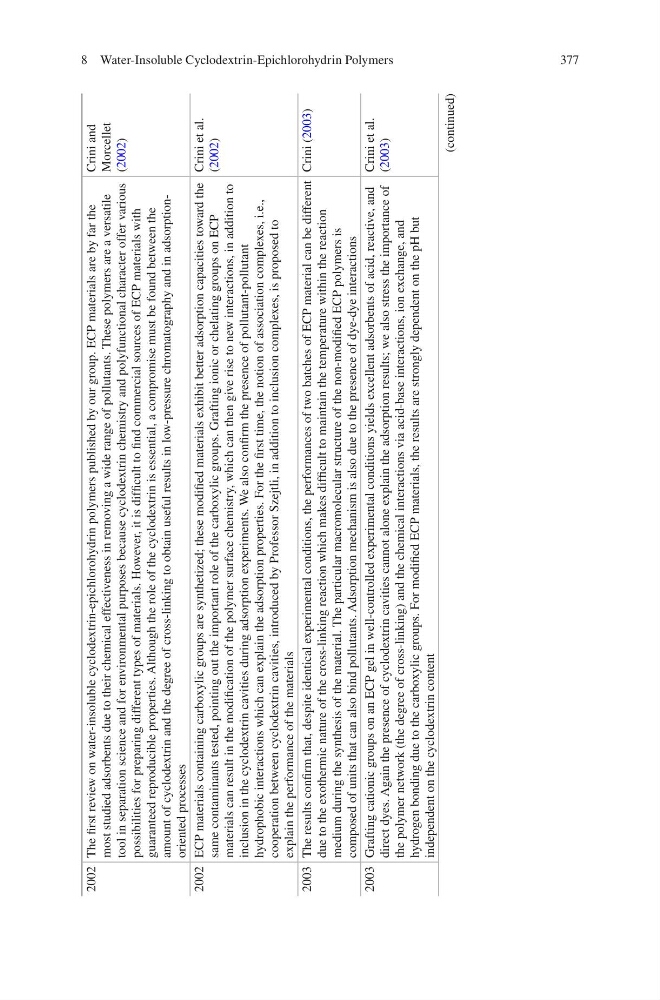
2002 The first review on water-insoluble cyclodextrin-epichlorohydrin polymers published by our group. ECP materials are by far the
most studied adsorbents due to their chemical effectiveness in removing a wide range of pollutants. These polymers are a versatile
tool in separation science and for environmental purposes because cyclodextrin chemistry and polyfunctional character offer various
possibilities for preparing different types of materials. However, it is difficult to find commercial sources of ECP materials with
guaranteed reproducible properties. Although the role of the cyclodextrin is essential, a compromise must be found between the
amount of cyclodextrin and the degree of cross-linking to obtain useful results in low-pressure chromatography and in adsorptionoriented processes
Crini and
Morcellet
(2002)
2002 ECP materials containing carboxylic groups are synthetized; these modified materials exhibit better adsorption capacities toward the
same contaminants tested, pointing out the important role of the carboxylic groups. Grafting ionic or chelating groups on ECP
materials can result in the modification of the polymer surface chemistry, which can then give rise to new interactions, in addition to
inclusion in the cyclodextrin cavities during adsorption experiments. We also confirm the presence of pollutant-pollutant
hydrophobic interactions which can explain the adsorption properties. For the first time, the notion of association complexes, i.e.,
cooperation between cyclodextrin cavities, introduced by Professor Szejtli, in addition to inclusion complexes, is proposed to
explain the performance of the materials
Crini et al.
(2002)
2003 The results confirm that, despite identical experimental conditions, the performances of two batches of ECP material can be different
due to the exothermic nature of the cross-linking reaction which makes difficult to maintain the temperature within the reaction
medium during the synthesis of the material. The particular macromolecular structure of the non-modified ECP polymers is
composed of units that can also bind pollutants. Adsorption mechanism is also due to the presence of dye-dye interactions
Crini (2003)
2003 Grafting cationic groups on an ECP gel in well-controlled experimental conditions yields excellent adsorbents of acid, reactive, and
direct dyes. Again the presence of cyclodextrin cavities cannot alone explain the adsorption results; we also stress the importance of
the polymer network (the degree of cross-linking) and the chemical interactions via acid-base interactions, ion exchange, and
hydrogen bonding due to the carboxylic groups. For modified ECP materials, the results are strongly dependent on the pH but
independent on the cyclodextrin content
Crini et al.
(2003)
(continued)
8 Water-Insoluble Cyclodextrin-Epichlorohydrin Polymers
Year Result
Reference(s)
2002 The first review on water-insoluble cyclodextrin-epichlorohydrin polymers published by our group. ECP materials are by far the
most studied adsorbents due to their chemical effectiveness in removing a wide range of pollutants. These polymers are a versatile
tool in separation science and for environmental purposes because cyclodextrin chemistry and polyfunctional character offer various
possibilities for preparing different types of materials. However, it is difficult to find commercial sources of ECP materials with
guaranteed reproducible properties. Although the role of the cyclodextrin is essential, a compromise must be found between the
amount of cyclodextrin and the degree of cross-linking to obtain useful results in low-pressure chromatography and in adsorptionoriented processes
Crini and
Morcellet
(2002)
2002 ECP materials containing carboxylic groups are synthetized; these modified materials exhibit better adsorption capacities toward the
same contaminants tested, pointing out the important role of the carboxylic groups. Grafting ionic or chelating groups on ECP
materials can result in the modification of the polymer surface chemistry, which can then give rise to new interactions, in addition to
inclusion in the cyclodextrin cavities during adsorption experiments. We also confirm the presence of pollutant-pollutant
hydrophobic interactions which can explain the adsorption properties. For the first time, the notion of association complexes, i.e.,
cooperation between cyclodextrin cavities, introduced by Professor Szejtli, in addition to inclusion complexes, is proposed to
explain the performance of the materials
Crini et al.
(2002)
2003 The results confirm that, despite identical experimental conditions, the performances of two batches of ECP material can be different
due to the exothermic nature of the cross-linking reaction which makes difficult to maintain the temperature within the reaction
medium during the synthesis of the material. The particular macromolecular structure of the non-modified ECP polymers is
composed of units that can also bind pollutants. Adsorption mechanism is also due to the presence of dye-dye interactions
Crini (2003)
2003 Grafting cationic groups on an ECP gel in well-controlled experimental conditions yields excellent adsorbents of acid, reactive, and
direct dyes. Again the presence of cyclodextrin cavities cannot alone explain the adsorption results; we also stress the importance of
the polymer network (the degree of cross-linking) and the chemical interactions via acid-base interactions, ion exchange, and
hydrogen bonding due to the carboxylic groups. For modified ECP materials, the results are strongly dependent on the pH but
independent on the cyclodextrin content
Crini et al.
(2003)
(continued)
8 Water-Insoluble Cyclodextrin-Epichlorohydrin Polymers