

376
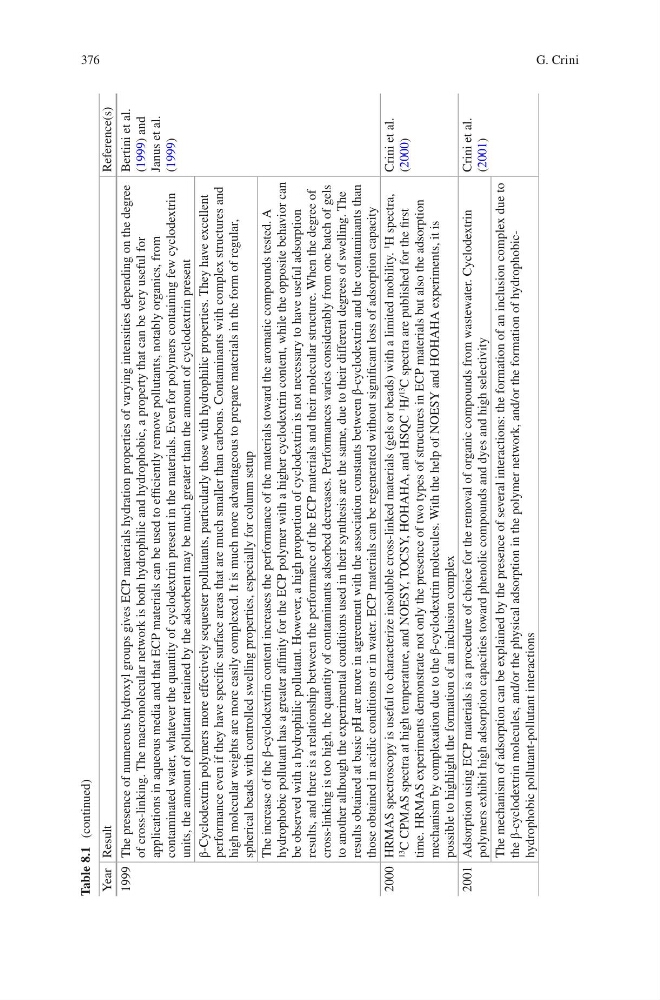
Table 8.1 (continued)
Year Result
Reference(s)
1999 The presence of numerous hydroxyl groups gives ECP materials hydration properties of varying intensities depending on the degree
of cross-linking. The macromolecular network is both hydrophilic and hydrophobic, a property that can be very useful for
applications in aqueous media and that ECP materials can be used to efficiently remove pollutants, notably organics, from
contaminated water, whatever the quantity of cyclodextrin present in the materials. Even for polymers containing few cyclodextrin
units, the amount of pollutant retained by the adsorbent may be much greater than the amount of cyclodextrin present
Bertini et al.
(1999) and
Janus et al.
(1999)
β-Cyclodextrin polymers more effectively sequester pollutants, particularly those with hydrophilic properties. They have excellent
performance even if they have specific surface areas that are much smaller than carbons. Contaminants with complex structures and
high molecular weights are more easily complexed. It is much more advantageous to prepare materials in the form of regular,
spherical beads with controlled swelling properties, especially for column setup
The increase of the
β-cyclodextrin content increases the performance of the materials toward the aromatic compounds tested. A
hydrophobic pollutant has a greater affinity for the ECP polymer with a higher cyclodextrin content, while the opposite behavior can
be observed with a hydrophilic pollutant. However, a high proportion of cyclodextrin is not necessary to have useful adsorption
results, and there is a relationship between the performance of the ECP materials and their molecular structure. When the degree of
cross-linking is too high, the quantity of contaminants adsorbed decreases. Performances varies considerably from one batch of gels
to another although the experimental conditions used in their synthesis are the same, due to their different degrees of swelling. The
results obtained at basic pH are more in agreement with the association constants between
β-cyclodextrin and the contaminants than
those obtained in acidic conditions or in water. ECP materials can be regenerated without significant loss of adsorption capacity
2000 HRMAS spectroscopy is useful to characterize insoluble cross-linked materials (gels or beads) with a limited mobility.
1
H spectra,
13
C CPMAS spectra at high temperature, and NOESY, TOCSY, HOHAHA, and HSQC
1
H/
13
C spectra are published for the first
time. HRMAS experiments demonstrate not only the presence of two types of structures in ECP materials but also the adsorption
mechanism by complexation due to the
β-cyclodextrin molecules. With the help of NOESY and HOHAHA experiments, it is
possible to highlight the formation of an inclusion complex
Crini et al.
(2000)
2001 Adsorption using ECP materials is a procedure of choice for the removal of organic compounds from wastewater. Cyclodextrin
polymers exhibit high adsorption capacities toward phenolic compounds and dyes and high selectivity
Crini et al.
(2001)
The mechanism of adsorption can be explained by the presence of several interactions: the formation of an inclusion complex due to
the
β-cyclodextrin molecules, and/or the physical adsorption in the polymer network, and/or the formation of hydrophobichydrophobic pollutant-pollutant interactions
G. Crini
Table 8.1 (continued)
Year Result
Reference(s)
1999 The presence of numerous hydroxyl groups gives ECP materials hydration properties of varying intensities depending on the degree
of cross-linking. The macromolecular network is both hydrophilic and hydrophobic, a property that can be very useful for
applications in aqueous media and that ECP materials can be used to efficiently remove pollutants, notably organics, from
contaminated water, whatever the quantity of cyclodextrin present in the materials. Even for polymers containing few cyclodextrin
units, the amount of pollutant retained by the adsorbent may be much greater than the amount of cyclodextrin present
Bertini et al.
(1999) and
Janus et al.
(1999)
β-Cyclodextrin polymers more effectively sequester pollutants, particularly those with hydrophilic properties. They have excellent
performance even if they have specific surface areas that are much smaller than carbons. Contaminants with complex structures and
high molecular weights are more easily complexed. It is much more advantageous to prepare materials in the form of regular,
spherical beads with controlled swelling properties, especially for column setup
The increase of the
β-cyclodextrin content increases the performance of the materials toward the aromatic compounds tested. A
hydrophobic pollutant has a greater affinity for the ECP polymer with a higher cyclodextrin content, while the opposite behavior can
be observed with a hydrophilic pollutant. However, a high proportion of cyclodextrin is not necessary to have useful adsorption
results, and there is a relationship between the performance of the ECP materials and their molecular structure. When the degree of
cross-linking is too high, the quantity of contaminants adsorbed decreases. Performances varies considerably from one batch of gels
to another although the experimental conditions used in their synthesis are the same, due to their different degrees of swelling. The
results obtained at basic pH are more in agreement with the association constants between
β-cyclodextrin and the contaminants than
those obtained in acidic conditions or in water. ECP materials can be regenerated without significant loss of adsorption capacity
2000 HRMAS spectroscopy is useful to characterize insoluble cross-linked materials (gels or beads) with a limited mobility.
1
H spectra,
13
C CPMAS spectra at high temperature, and NOESY, TOCSY, HOHAHA, and HSQC
1
H/
13
C spectra are published for the first
time. HRMAS experiments demonstrate not only the presence of two types of structures in ECP materials but also the adsorption
mechanism by complexation due to the
β-cyclodextrin molecules. With the help of NOESY and HOHAHA experiments, it is
possible to highlight the formation of an inclusion complex
Crini et al.
(2000)
2001 Adsorption using ECP materials is a procedure of choice for the removal of organic compounds from wastewater. Cyclodextrin
polymers exhibit high adsorption capacities toward phenolic compounds and dyes and high selectivity
Crini et al.
(2001)
The mechanism of adsorption can be explained by the presence of several interactions: the formation of an inclusion complex due to
the
β-cyclodextrin molecules, and/or the physical adsorption in the polymer network, and/or the formation of hydrophobichydrophobic pollutant-pollutant interactions
G. Crini