

375
Year Result
Reference(s)
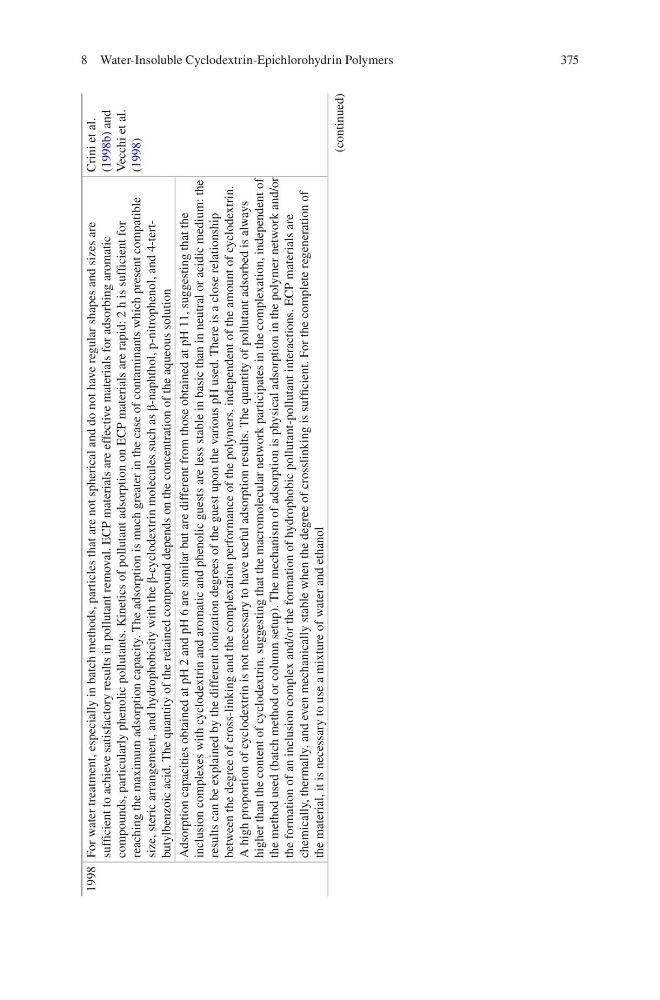
1998 For water treatment, especially in batch methods, particles that are not spherical and do not have regular shapes and sizes are
sufficient to achieve satisfactory results in pollutant removal. ECP materials are effective materials for adsorbing aromatic
compounds, particularly phenolic pollutants. Kinetics of pollutant adsorption on ECP materials are rapid: 2 h is sufficient for
reaching the maximum adsorption capacity. The adsorption is much greater in the case of contaminants which present compatible
size, steric arrangement, and hydrophobicity with the
β-cyclodextrin molecules such as
β-naphthol, p-nitrophenol, and 4-tertbutylbenzoic acid. The quantity of the retained compound depends on the concentration of the aqueous solution
Crini et al.
(1998b) and
Vecchi et al.
(1998)
Adsorption capacities obtained at pH 2 and pH 6 are similar but are different from those obtained at pH 11, suggesting that the
inclusion complexes with cyclodextrin and aromatic and phenolic guests are less stable in basic than in neutral or acidic medium: the
results can be explained by the different ionization degrees of the guest upon the various pH used. There is a close relationship
between the degree of cross-linking and the complexation performance of the polymers, independent of the amount of cyclodextrin.
A high proportion of cyclodextrin is not necessary to have useful adsorption results. The quantity of pollutant adsorbed is always
higher than the content of cyclodextrin, suggesting that the macromolecular network participates in the complexation, independent of
the method used (batch method or column setup). The mechanism of adsorption is physical adsorption in the polymer network and/or
the formation of an inclusion complex and/or the formation of hydrophobic pollutant-pollutant interactions. ECP materials are
chemically, thermally, and even mechanically stable when the degree of crosslinking is sufficient. For the complete regeneration of
the material, it is necessary to use a mixture of water and ethanol
(continued)
8 Water-Insoluble Cyclodextrin-Epichlorohydrin Polymers
Year Result
Reference(s)
1998 For water treatment, especially in batch methods, particles that are not spherical and do not have regular shapes and sizes are
sufficient to achieve satisfactory results in pollutant removal. ECP materials are effective materials for adsorbing aromatic
compounds, particularly phenolic pollutants. Kinetics of pollutant adsorption on ECP materials are rapid: 2 h is sufficient for
reaching the maximum adsorption capacity. The adsorption is much greater in the case of contaminants which present compatible
size, steric arrangement, and hydrophobicity with the
β-cyclodextrin molecules such as
β-naphthol, p-nitrophenol, and 4-tertbutylbenzoic acid. The quantity of the retained compound depends on the concentration of the aqueous solution
Crini et al.
(1998b) and
Vecchi et al.
(1998)
Adsorption capacities obtained at pH 2 and pH 6 are similar but are different from those obtained at pH 11, suggesting that the
inclusion complexes with cyclodextrin and aromatic and phenolic guests are less stable in basic than in neutral or acidic medium: the
results can be explained by the different ionization degrees of the guest upon the various pH used. There is a close relationship
between the degree of cross-linking and the complexation performance of the polymers, independent of the amount of cyclodextrin.
A high proportion of cyclodextrin is not necessary to have useful adsorption results. The quantity of pollutant adsorbed is always
higher than the content of cyclodextrin, suggesting that the macromolecular network participates in the complexation, independent of
the method used (batch method or column setup). The mechanism of adsorption is physical adsorption in the polymer network and/or
the formation of an inclusion complex and/or the formation of hydrophobic pollutant-pollutant interactions. ECP materials are
chemically, thermally, and even mechanically stable when the degree of crosslinking is sufficient. For the complete regeneration of
the material, it is necessary to use a mixture of water and ethanol
(continued)
8 Water-Insoluble Cyclodextrin-Epichlorohydrin Polymers