

374
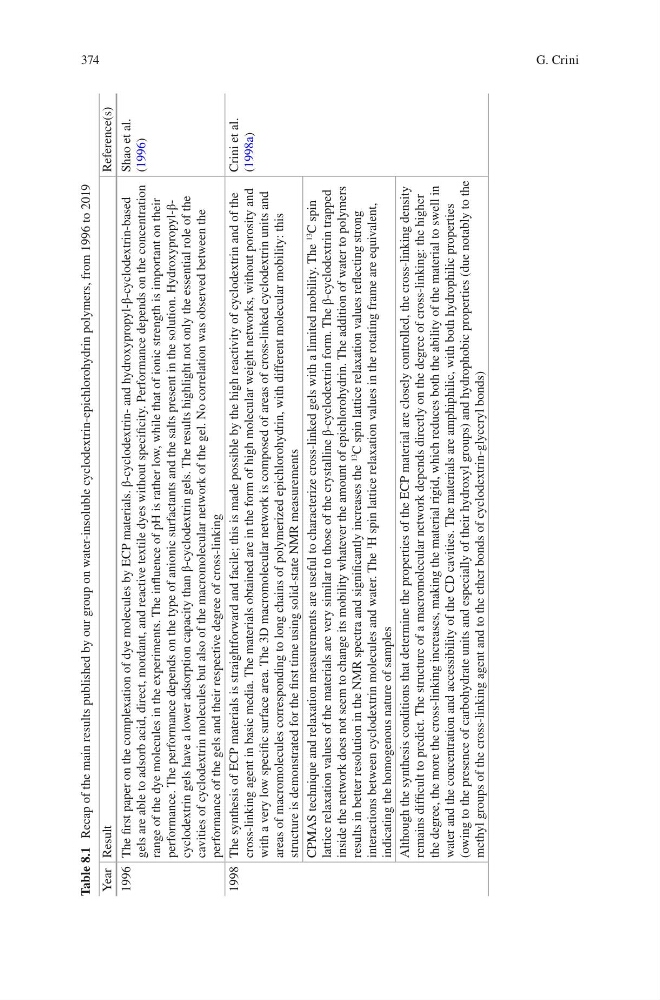
Table 8.1 Recap of the main results published by our group on water-insoluble cyclodextrin-epichlorohydrin polymers, from 1996 to 2019
Year Result
Reference(s)
1996 The first paper on the complexation of dye molecules by ECP materials.
β-cyclodextrin- and hydroxypropyl-β-cyclodextrin-based
gels are able to adsorb acid, direct, mordant, and reactive textile dyes without specificity. Performance depends on the concentration
range of the dye molecules in the experiments. The influence of pH is rather low, while that of ionic strength is important on their
performance. The performance depends on the type of anionic surfactants and the salts present in the solution. Hydroxypropyl-βcyclodextrin gels have a lower adsorption capacity than
β-cyclodextrin gels. The results highlight not only the essential role of the
cavities of cyclodextrin molecules but also of the macromolecular network of the gel. No correlation was observed between the
performance of the gels and their respective degree of cross-linking
Shao et al.
(1996)
1998 The synthesis of ECP materials is straightforward and facile; this is made possible by the high reactivity of cyclodextrin and of the
cross-linking agent in basic media. The materials obtained are in the form of high molecular weight networks, without porosity and
with a very low specific surface area. The 3D macromolecular network is composed of areas of cross-linked cyclodextrin units and
areas of macromolecules corresponding to long chains of polymerized epichlorohydrin, with different molecular mobility: this
structure is demonstrated for the first time using solid-state NMR measurements
Crini et al.
(1998a)
CPMAS technique and relaxation measurements are useful to characterize cross-linked gels with a limited mobility. The
13
C spin
lattice relaxation values of the materials are very similar to those of the crystalline
β-cyclodextrin form. The
β-cyclodextrin trapped
inside the network does not seem to change its mobility whatever the amount of epichlorohydrin. The addition of water to polymers
results in better resolution in the NMR spectra and significantly increases the
13
C spin lattice relaxation values reflecting strong
interactions between cyclodextrin molecules and water. The
1
H spin lattice relaxation values in the rotating frame are equivalent,
indicating the homogenous nature of samples
Although the synthesis conditions that determine the properties of the ECP material are closely controlled, the cross-linking density
remains difficult to predict. The structure of a macromolecular network depends directly on the degree of cross-linking: the higher
the degree, the more the cross-linking increases, making the material rigid, which reduces both the ability of the material to swell in
water and the concentration and accessibility of the CD cavities. The materials are amphiphilic, with both hydrophilic properties
(owing to the presence of carbohydrate units and especially of their hydroxyl groups) and hydrophobic properties (due notably to the
methyl groups of the cross-linking agent and to the ether bonds of cyclodextrin-glyceryl bonds)
G. Crini
Table 8.1 Recap of the main results published by our group on water-insoluble cyclodextrin-epichlorohydrin polymers, from 1996 to 2019
Year Result
Reference(s)
1996 The first paper on the complexation of dye molecules by ECP materials.
β-cyclodextrin- and hydroxypropyl-β-cyclodextrin-based
gels are able to adsorb acid, direct, mordant, and reactive textile dyes without specificity. Performance depends on the concentration
range of the dye molecules in the experiments. The influence of pH is rather low, while that of ionic strength is important on their
performance. The performance depends on the type of anionic surfactants and the salts present in the solution. Hydroxypropyl-βcyclodextrin gels have a lower adsorption capacity than
β-cyclodextrin gels. The results highlight not only the essential role of the
cavities of cyclodextrin molecules but also of the macromolecular network of the gel. No correlation was observed between the
performance of the gels and their respective degree of cross-linking
Shao et al.
(1996)
1998 The synthesis of ECP materials is straightforward and facile; this is made possible by the high reactivity of cyclodextrin and of the
cross-linking agent in basic media. The materials obtained are in the form of high molecular weight networks, without porosity and
with a very low specific surface area. The 3D macromolecular network is composed of areas of cross-linked cyclodextrin units and
areas of macromolecules corresponding to long chains of polymerized epichlorohydrin, with different molecular mobility: this
structure is demonstrated for the first time using solid-state NMR measurements
Crini et al.
(1998a)
CPMAS technique and relaxation measurements are useful to characterize cross-linked gels with a limited mobility. The
13
C spin
lattice relaxation values of the materials are very similar to those of the crystalline
β-cyclodextrin form. The
β-cyclodextrin trapped
inside the network does not seem to change its mobility whatever the amount of epichlorohydrin. The addition of water to polymers
results in better resolution in the NMR spectra and significantly increases the
13
C spin lattice relaxation values reflecting strong
interactions between cyclodextrin molecules and water. The
1
H spin lattice relaxation values in the rotating frame are equivalent,
indicating the homogenous nature of samples
Although the synthesis conditions that determine the properties of the ECP material are closely controlled, the cross-linking density
remains difficult to predict. The structure of a macromolecular network depends directly on the degree of cross-linking: the higher
the degree, the more the cross-linking increases, making the material rigid, which reduces both the ability of the material to swell in
water and the concentration and accessibility of the CD cavities. The materials are amphiphilic, with both hydrophilic properties
(owing to the presence of carbohydrate units and especially of their hydroxyl groups) and hydrophobic properties (due notably to the
methyl groups of the cross-linking agent and to the ether bonds of cyclodextrin-glyceryl bonds)
G. Crini