

296
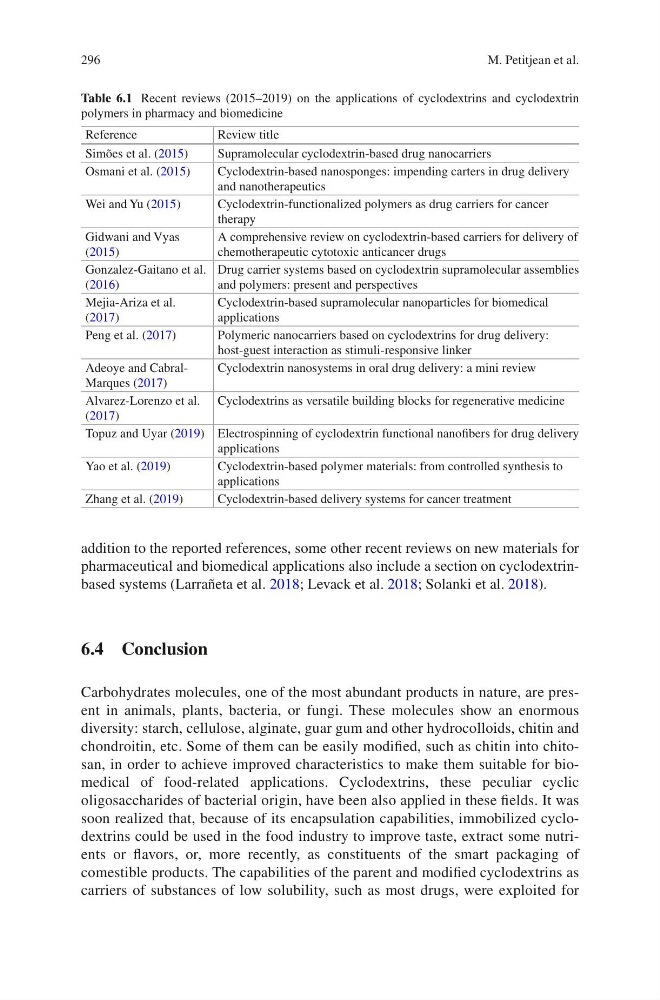
addition to the reported references, some other recent reviews on new materials for
pharmaceutical and biomedical applications also include a section on cyclodextrinbased systems (Larrañeta et al. 2018; Levack et al. 2018; Solanki et al. 2018).
6.4 Conclusion
Carbohydrates molecules, one of the most abundant products in nature, are present in animals, plants, bacteria, or fungi. These molecules show an enormous
diversity: starch, cellulose, alginate, guar gum and other hydrocolloids, chitin and
chondroitin, etc. Some of them can be easily modified, such as chitin into chitosan, in order to achieve improved characteristics to make them suitable for biomedical of food- related applications. Cyclodextrins, these peculiar cyclic
oligosaccharides of bacterial origin, have been also applied in these fields. It was
soon realized that, because of its encapsulation capabilities, immobilized cyclodextrins could be used in the food industry to improve taste, extract some nutrients or flavors, or, more recently, as constituents of the smart packaging of
comestible products. The capabilities of the parent and modified cyclodextrins as
carriers of substances of low solubility, such as most drugs, were exploited for
Table 6.1 Recent reviews (2015–2019) on the applications of cyclodextrins and cyclodextrin
polymers in pharmacy and biomedicine
Reference
Review title
Simões et al. (2015)
Supramolecular cyclodextrin-based drug nanocarriers
Osmani et al. (2015)
Cyclodextrin-based nanosponges: impending carters in drug delivery
and nanotherapeutics
Wei and Yu (2015)
Cyclodextrin-functionalized polymers as drug carriers for cancer
therapy
Gidwani and Vyas
(2015)
A comprehensive review on cyclodextrin-based carriers for delivery of
chemotherapeutic cytotoxic anticancer drugs
Gonzalez-Gaitano et al.
(2016)
Drug carrier systems based on cyclodextrin supramolecular assemblies
and polymers: present and perspectives
Mejia-Ariza et al.
(2017)
Cyclodextrin-based supramolecular nanoparticles for biomedical
applications
Peng et al. (2017)
Polymeric nanocarriers based on cyclodextrins for drug delivery:
host-guest interaction as stimuli-responsive linker
Adeoye and CabralMarques (2017)
Cyclodextrin nanosystems in oral drug delivery: a mini review
Alvarez-Lorenzo et al.
(2017)
Cyclodextrins as versatile building blocks for regenerative medicine
Topuz and Uyar (2019) Electrospinning of cyclodextrin functional nanofibers for drug delivery
applications
Yao et al. (2019)
Cyclodextrin-based polymer materials: from controlled synthesis to
applications
Zhang et al. (2019)
Cyclodextrin-based delivery systems for cancer treatment
M. Petitjean et al.
addition to the reported references, some other recent reviews on new materials for
pharmaceutical and biomedical applications also include a section on cyclodextrinbased systems (Larrañeta et al. 2018; Levack et al. 2018; Solanki et al. 2018).
6.4 Conclusion
Carbohydrates molecules, one of the most abundant products in nature, are present in animals, plants, bacteria, or fungi. These molecules show an enormous
diversity: starch, cellulose, alginate, guar gum and other hydrocolloids, chitin and
chondroitin, etc. Some of them can be easily modified, such as chitin into chitosan, in order to achieve improved characteristics to make them suitable for biomedical of food- related applications. Cyclodextrins, these peculiar cyclic
oligosaccharides of bacterial origin, have been also applied in these fields. It was
soon realized that, because of its encapsulation capabilities, immobilized cyclodextrins could be used in the food industry to improve taste, extract some nutrients or flavors, or, more recently, as constituents of the smart packaging of
comestible products. The capabilities of the parent and modified cyclodextrins as
carriers of substances of low solubility, such as most drugs, were exploited for
Table 6.1 Recent reviews (2015–2019) on the applications of cyclodextrins and cyclodextrin
polymers in pharmacy and biomedicine
Reference
Review title
Simões et al. (2015)
Supramolecular cyclodextrin-based drug nanocarriers
Osmani et al. (2015)
Cyclodextrin-based nanosponges: impending carters in drug delivery
and nanotherapeutics
Wei and Yu (2015)
Cyclodextrin-functionalized polymers as drug carriers for cancer
therapy
Gidwani and Vyas
(2015)
A comprehensive review on cyclodextrin-based carriers for delivery of
chemotherapeutic cytotoxic anticancer drugs
Gonzalez-Gaitano et al.
(2016)
Drug carrier systems based on cyclodextrin supramolecular assemblies
and polymers: present and perspectives
Mejia-Ariza et al.
(2017)
Cyclodextrin-based supramolecular nanoparticles for biomedical
applications
Peng et al. (2017)
Polymeric nanocarriers based on cyclodextrins for drug delivery:
host-guest interaction as stimuli-responsive linker
Adeoye and CabralMarques (2017)
Cyclodextrin nanosystems in oral drug delivery: a mini review
Alvarez-Lorenzo et al.
(2017)
Cyclodextrins as versatile building blocks for regenerative medicine
Topuz and Uyar (2019) Electrospinning of cyclodextrin functional nanofibers for drug delivery
applications
Yao et al. (2019)
Cyclodextrin-based polymer materials: from controlled synthesis to
applications
Zhang et al. (2019)
Cyclodextrin-based delivery systems for cancer treatment
M. Petitjean et al.