

263
(3-glycidoxypropyl)methyltriethoxysilane and silica SIPERNAT. The modified silica, Si-GPMS, reacted with 10-undecynil-1-amine under microwave irradiation to
afford Si-G- Und. The latter reacted with 6-monoazido-β-cyclodextrin in the presence of ascorbic acid and CuSO 4 ·4H 2 O to furnish Si-cyclodextrin which subsequently tolerated reaction with Pd(OAc) 2 . Pd nanoparticle immobilization on
Si-cyclodextrin was achieved through reduction of Pd salt in EtOH or H 2 O. This
step could be carried out under ultrasonic irradiation. It was found that the presence
of cyclodextrin could increase the Pd content in the final catalyst. Moreover, this
value was affected by the solvent and the reaction condition used in the final step.
The highest loading, 6 wt%, was observed upon using EtOH under reflux conditions. Noteworthy, cyclodextrin also affected the size distribution of Pd nanoparticles. Studying the reusability of the catalyst for four reuses established only slight
loss of the catalytic activity. High yields, low reaction times, and low amount of the
catalyst were other benefits of this protocol.
Considering the potential of cyclodextrin as both reducing agent and dispersant,
Li et al. (2015) designed and synthesized a β-cyclodextrin and multiwalled carbon
nanotube hybrid material for deposition of PtRh nanoparticles through a one-pot
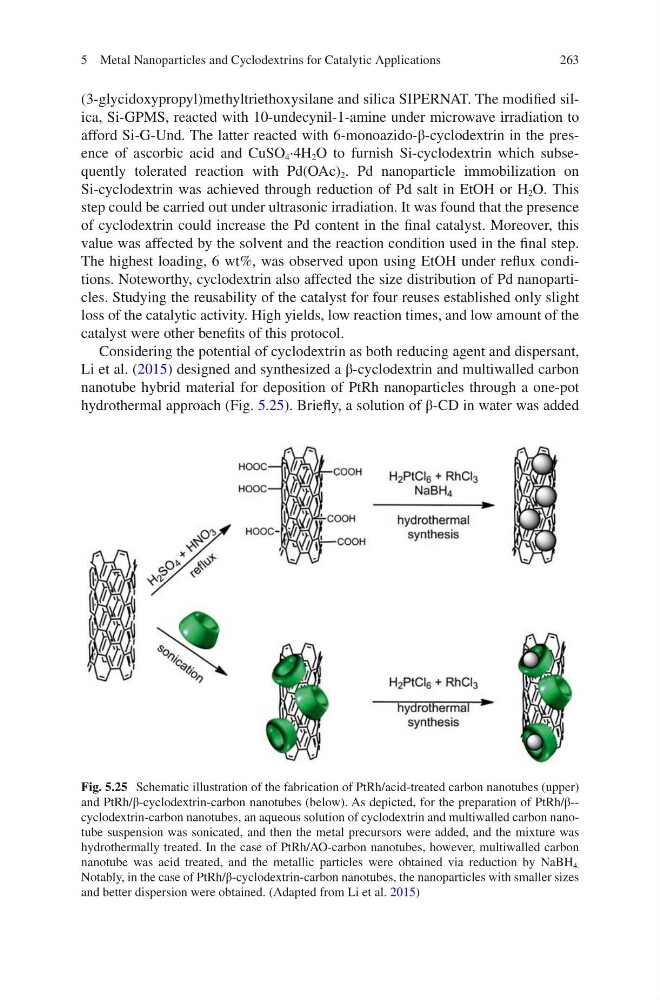
hydrothermal approach (Fig. 5.25). Briefly, a solution of β-CD in water was added
Fig. 5.25 Schematic illustration of the fabrication of PtRh/acid-treated carbon nanotubes (upper)
and PtRh/β-cyclodextrin-carbon nanotubes (below). As depicted, for the preparation of PtRh/β- -
cyclodextrin- carbon nanotubes, an aqueous solution of cyclodextrin and multiwalled carbon nanotube suspension was sonicated, and then the metal precursors were added, and the mixture was
hydrothermally treated. In the case of PtRh/AO-carbon nanotubes, however, multiwalled carbon
nanotube was acid treated, and the metallic particles were obtained via reduction by NaBH 4.
Notably, in the case of PtRh/β-cyclodextrin-carbon nanotubes, the nanoparticles with smaller sizes
and better dispersion were obtained. (Adapted from Li et al. 2015)
5 Metal Nanoparticles and Cyclodextrins for Catalytic Applications
(3-glycidoxypropyl)methyltriethoxysilane and silica SIPERNAT. The modified silica, Si-GPMS, reacted with 10-undecynil-1-amine under microwave irradiation to
afford Si-G- Und. The latter reacted with 6-monoazido-β-cyclodextrin in the presence of ascorbic acid and CuSO 4 ·4H 2 O to furnish Si-cyclodextrin which subsequently tolerated reaction with Pd(OAc) 2 . Pd nanoparticle immobilization on
Si-cyclodextrin was achieved through reduction of Pd salt in EtOH or H 2 O. This
step could be carried out under ultrasonic irradiation. It was found that the presence
of cyclodextrin could increase the Pd content in the final catalyst. Moreover, this
value was affected by the solvent and the reaction condition used in the final step.
The highest loading, 6 wt%, was observed upon using EtOH under reflux conditions. Noteworthy, cyclodextrin also affected the size distribution of Pd nanoparticles. Studying the reusability of the catalyst for four reuses established only slight
loss of the catalytic activity. High yields, low reaction times, and low amount of the
catalyst were other benefits of this protocol.
Considering the potential of cyclodextrin as both reducing agent and dispersant,
Li et al. (2015) designed and synthesized a β-cyclodextrin and multiwalled carbon
nanotube hybrid material for deposition of PtRh nanoparticles through a one-pot
hydrothermal approach (Fig. 5.25). Briefly, a solution of β-CD in water was added
Fig. 5.25 Schematic illustration of the fabrication of PtRh/acid-treated carbon nanotubes (upper)
and PtRh/β-cyclodextrin-carbon nanotubes (below). As depicted, for the preparation of PtRh/β- -
cyclodextrin- carbon nanotubes, an aqueous solution of cyclodextrin and multiwalled carbon nanotube suspension was sonicated, and then the metal precursors were added, and the mixture was
hydrothermally treated. In the case of PtRh/AO-carbon nanotubes, however, multiwalled carbon
nanotube was acid treated, and the metallic particles were obtained via reduction by NaBH 4.
Notably, in the case of PtRh/β-cyclodextrin-carbon nanotubes, the nanoparticles with smaller sizes
and better dispersion were obtained. (Adapted from Li et al. 2015)
5 Metal Nanoparticles and Cyclodextrins for Catalytic Applications