

264
to the suspension of multiwalled carbon nanotubes and then sonicated. The solutions of metal precursors were introduced, and the obtained mixture was subjected
to the hydrothermal treatment. FTIR analysis of this composite material was done,
and it clearly showed that β-cyclodextrin was attached to the surface of the pristine
carbon nanotubes. Moreover, the amount of β-cyclodextrin attached to the multiwalled carbon nanotubes was determined by thermogravimetric analysis experiment and was about 9.3% in the PtRh/β-cyclodextrin-CNT material. The obtained
hybrid system, PtRh/β-cyclodextrin-CNTs, was used as an electrocatalyst for promoting methanol oxidation. The authors also compared the efficiency of the
cyclodextrin- containing hybrid with the PtRh nanoparticles supported on multiwalled acid-treated carbon nanotubes (AO-CNTs) which was obtained through
reduction by NaBH 4 . The results established the smallest size and highest dispersion of the metallic components in PtRh/β-cyclodextrin-CNTs and consequently
excellent electrocatalytic activity compared to PtRh/AO-CNTs. Notably, the authors
studied the effect of Pt/Rh atomic ratio and found the atomic ratio of 1:1 as the
best choice.
In another report, Sadjadi et al. (2018b) covalently conjugated carbon nanotubes
(CNT) with cyclodextrin nanosponges (CDNS) and applied the hybrid system as a
heterogeneous support for the immobilization of Pd nanoparticles. The hybrid system Pd@CDNS-CNT that benefited from the chemistry of both carbon nanotubes
and cyclodextrin nanosponges chemistry was then used as an efficient catalyst for
catalyzing the ligand and copper-free Sonogashira and Heck coupling reactions in
aqueous media. The comparison of the catalytic activity of Pd@CDNS-CNT with
that of control catalysts, Pd@CNT, Pd@CDNS, and Pd@CNT + CDNS, established that the hybrid catalyst exhibited superior catalytic activity, indicating that
hybridization of carbon nanotubes and cyclodextrin nanosponges was more effective than the use of each one separately or as individual. The recyclability of the
catalyst up to six reaction runs was also confirmed.
Taking advantage of β-cyclodextrin-decorated reduced graphene oxide (rGO) as
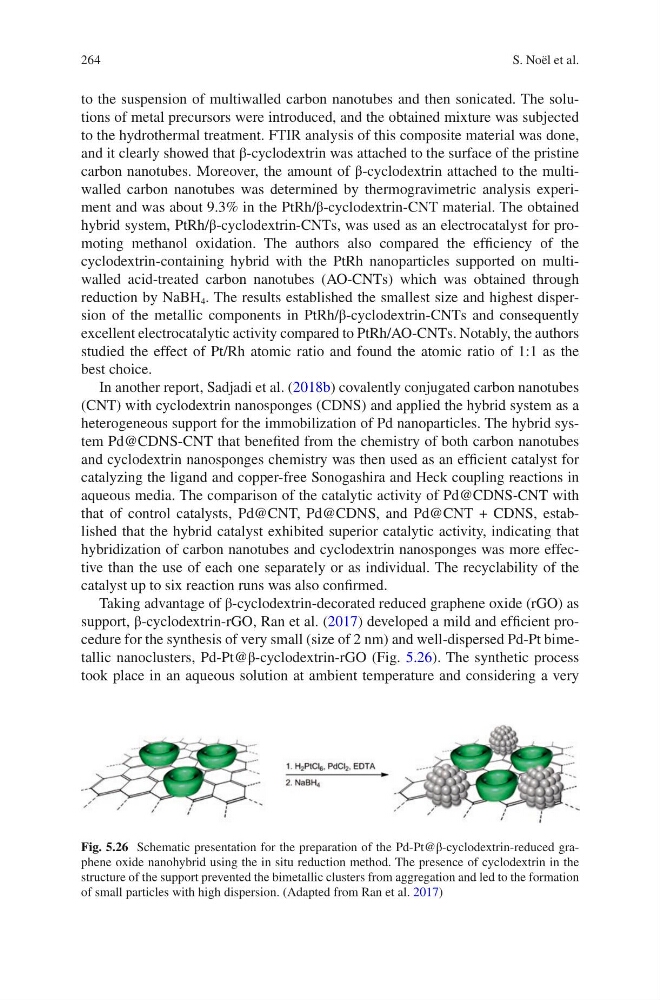
support, β-cyclodextrin-rGO, Ran et al. (2017) developed a mild and efficient procedure for the synthesis of very small (size of 2 nm) and well-dispersed Pd-Pt bimetallic nanoclusters, Pd-Pt@β-cyclodextrin-rGO (Fig. 5.26). The synthetic process
took place in an aqueous solution at ambient temperature and considering a very
Fig. 5.26 Schematic presentation for the preparation of the Pd-Pt@β-cyclodextrin-reduced graphene oxide nanohybrid using the in situ reduction method. The presence of cyclodextrin in the
structure of the support prevented the bimetallic clusters from aggregation and led to the formation
of small particles with high dispersion. (Adapted from Ran et al. 2017)
S. Noël et al.
to the suspension of multiwalled carbon nanotubes and then sonicated. The solutions of metal precursors were introduced, and the obtained mixture was subjected
to the hydrothermal treatment. FTIR analysis of this composite material was done,
and it clearly showed that β-cyclodextrin was attached to the surface of the pristine
carbon nanotubes. Moreover, the amount of β-cyclodextrin attached to the multiwalled carbon nanotubes was determined by thermogravimetric analysis experiment and was about 9.3% in the PtRh/β-cyclodextrin-CNT material. The obtained
hybrid system, PtRh/β-cyclodextrin-CNTs, was used as an electrocatalyst for promoting methanol oxidation. The authors also compared the efficiency of the
cyclodextrin- containing hybrid with the PtRh nanoparticles supported on multiwalled acid-treated carbon nanotubes (AO-CNTs) which was obtained through
reduction by NaBH 4 . The results established the smallest size and highest dispersion of the metallic components in PtRh/β-cyclodextrin-CNTs and consequently
excellent electrocatalytic activity compared to PtRh/AO-CNTs. Notably, the authors
studied the effect of Pt/Rh atomic ratio and found the atomic ratio of 1:1 as the
best choice.
In another report, Sadjadi et al. (2018b) covalently conjugated carbon nanotubes
(CNT) with cyclodextrin nanosponges (CDNS) and applied the hybrid system as a
heterogeneous support for the immobilization of Pd nanoparticles. The hybrid system Pd@CDNS-CNT that benefited from the chemistry of both carbon nanotubes
and cyclodextrin nanosponges chemistry was then used as an efficient catalyst for
catalyzing the ligand and copper-free Sonogashira and Heck coupling reactions in
aqueous media. The comparison of the catalytic activity of Pd@CDNS-CNT with
that of control catalysts, Pd@CNT, Pd@CDNS, and Pd@CNT + CDNS, established that the hybrid catalyst exhibited superior catalytic activity, indicating that
hybridization of carbon nanotubes and cyclodextrin nanosponges was more effective than the use of each one separately or as individual. The recyclability of the
catalyst up to six reaction runs was also confirmed.
Taking advantage of β-cyclodextrin-decorated reduced graphene oxide (rGO) as
support, β-cyclodextrin-rGO, Ran et al. (2017) developed a mild and efficient procedure for the synthesis of very small (size of 2 nm) and well-dispersed Pd-Pt bimetallic nanoclusters, Pd-Pt@β-cyclodextrin-rGO (Fig. 5.26). The synthetic process
took place in an aqueous solution at ambient temperature and considering a very
Fig. 5.26 Schematic presentation for the preparation of the Pd-Pt@β-cyclodextrin-reduced graphene oxide nanohybrid using the in situ reduction method. The presence of cyclodextrin in the
structure of the support prevented the bimetallic clusters from aggregation and led to the formation
of small particles with high dispersion. (Adapted from Ran et al. 2017)
S. Noël et al.