

262
microscopy analysis revealed that the nanocrystals had the mean diameter of 12 nm
and core of about 9 nm. The hybrid system was used as a photocatalyst for the degradation of bisphenol A and dibutyl phthalate, in aqueous media. Notably, the catalytic performance of cyclodextrin-functionalized Fe 3 O 4 @TiO 2 core-shell
nanoparticle was higher than that of Fe 3 O 4 @TiO 2 core-shell nanoparticles. This
could be attributed to the role of carboxymethyl-β-cyclodextrin coming from its
ability to disperse the nanoparticles in the aqueous phase and to form an inclusion
complex with pollutants. The authors believed that this cost-effective catalyst could
be simply recovered and reused.
Sadjadi (2018) reported β-cyclodextrin-decorated halloysite nanoclay (Hal) as a
potential support for the immobilization of Pd nanoparticles. The hybrid catalyst,
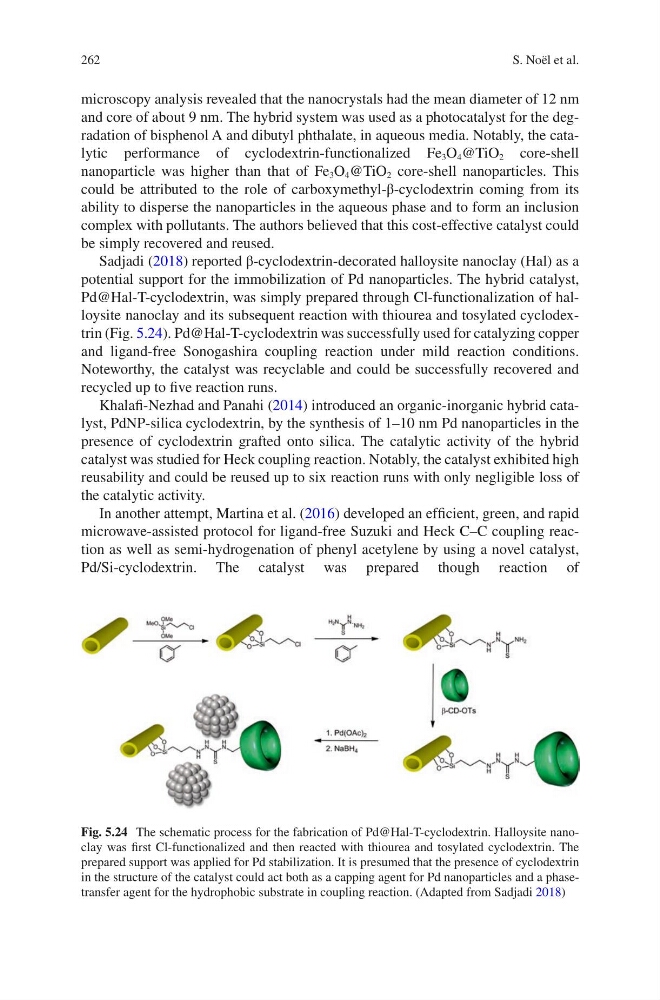
Pd@Hal-T-cyclodextrin, was simply prepared through Cl-functionalization of halloysite nanoclay and its subsequent reaction with thiourea and tosylated cyclodextrin (Fig. 5.24). Pd@Hal-T-cyclodextrin was successfully used for catalyzing copper
and ligand-free Sonogashira coupling reaction under mild reaction conditions.
Noteworthy, the catalyst was recyclable and could be successfully recovered and
recycled up to five reaction runs.
Khalafi-Nezhad and Panahi (2014) introduced an organic-inorganic hybrid catalyst, PdNP-silica cyclodextrin, by the synthesis of 1–10 nm Pd nanoparticles in the
presence of cyclodextrin grafted onto silica. The catalytic activity of the hybrid
catalyst was studied for Heck coupling reaction. Notably, the catalyst exhibited high
reusability and could be reused up to six reaction runs with only negligible loss of
the catalytic activity.
In another attempt, Martina et al. (2016) developed an efficient, green, and rapid
microwave-assisted protocol for ligand-free Suzuki and Heck C–C coupling reaction as well as semi-hydrogenation of phenyl acetylene by using a novel catalyst,
Pd/Si-cyclodextrin. The catalyst was prepared though reaction of
Fig. 5.24 The schematic process for the fabrication of Pd@Hal-T-cyclodextrin. Halloysite nanoclay was first Cl-functionalized and then reacted with thiourea and tosylated cyclodextrin. The
prepared support was applied for Pd stabilization. It is presumed that the presence of cyclodextrin
in the structure of the catalyst could act both as a capping agent for Pd nanoparticles and a phasetransfer agent for the hydrophobic substrate in coupling reaction. (Adapted from Sadjadi 2018)
S. Noël et al.
microscopy analysis revealed that the nanocrystals had the mean diameter of 12 nm
and core of about 9 nm. The hybrid system was used as a photocatalyst for the degradation of bisphenol A and dibutyl phthalate, in aqueous media. Notably, the catalytic performance of cyclodextrin-functionalized Fe 3 O 4 @TiO 2 core-shell
nanoparticle was higher than that of Fe 3 O 4 @TiO 2 core-shell nanoparticles. This
could be attributed to the role of carboxymethyl-β-cyclodextrin coming from its
ability to disperse the nanoparticles in the aqueous phase and to form an inclusion
complex with pollutants. The authors believed that this cost-effective catalyst could
be simply recovered and reused.
Sadjadi (2018) reported β-cyclodextrin-decorated halloysite nanoclay (Hal) as a
potential support for the immobilization of Pd nanoparticles. The hybrid catalyst,
Pd@Hal-T-cyclodextrin, was simply prepared through Cl-functionalization of halloysite nanoclay and its subsequent reaction with thiourea and tosylated cyclodextrin (Fig. 5.24). Pd@Hal-T-cyclodextrin was successfully used for catalyzing copper
and ligand-free Sonogashira coupling reaction under mild reaction conditions.
Noteworthy, the catalyst was recyclable and could be successfully recovered and
recycled up to five reaction runs.
Khalafi-Nezhad and Panahi (2014) introduced an organic-inorganic hybrid catalyst, PdNP-silica cyclodextrin, by the synthesis of 1–10 nm Pd nanoparticles in the
presence of cyclodextrin grafted onto silica. The catalytic activity of the hybrid
catalyst was studied for Heck coupling reaction. Notably, the catalyst exhibited high
reusability and could be reused up to six reaction runs with only negligible loss of
the catalytic activity.
In another attempt, Martina et al. (2016) developed an efficient, green, and rapid
microwave-assisted protocol for ligand-free Suzuki and Heck C–C coupling reaction as well as semi-hydrogenation of phenyl acetylene by using a novel catalyst,
Pd/Si-cyclodextrin. The catalyst was prepared though reaction of
Fig. 5.24 The schematic process for the fabrication of Pd@Hal-T-cyclodextrin. Halloysite nanoclay was first Cl-functionalized and then reacted with thiourea and tosylated cyclodextrin. The
prepared support was applied for Pd stabilization. It is presumed that the presence of cyclodextrin
in the structure of the catalyst could act both as a capping agent for Pd nanoparticles and a phasetransfer agent for the hydrophobic substrate in coupling reaction. (Adapted from Sadjadi 2018)
S. Noël et al.