

261
Nanoparticles Immobilized on a Cyclodextrin-Grafted Support
Another strategy consisted in the use of cyclodextrin-decorated magnetic nanoparticles. In this context, γ-Fe 2 O 3 @SiO 2 -cyclodextrin core-shell hollow sphere can be
mentioned (Sadjadi et al. 2017). The hybrid system was developed by initial synthesis of γ-Fe 2 O 3 @SiO 2 core-shell system followed by amine functionalization by
using 3-N-(2-(trimethoxysilyl)ethyl)methanediamine and subsequent reaction with
tosylated cyclodextrin. The system was then applied for the immobilization of silver
nanoparticles which were reduced and capped by Hollyhock flower extract. Notably,
upon introduction of non-magnetic component, the maximum saturation magnetization (Ms) value of the hybrid system did not decreased remarkably compared to
bare Fe 2 O 3 . Finally, the catalytic activity of the ternary hybrid was studied for
ultrasonic- assisted A
3
and KA
2
coupling reactions of phenyl acetylene, amines,
aldehydes, or ketones. The results established the excellent performance of the magnetic hybrid system, which was superior to some of previous reports. Hot filtration
test confirmed that the silver leaching was considerably controlled and the catalyst
could be reused up to four reaction runs.
In another example, Azaroon and Kiasat (2018) developed an organometallic
magnetic catalyst for selective reduction of nitro functionality to corresponding
amine compounds. To prepare the catalyst, magnetic hydroxyapatite (HAp)
γ-Fe 2 O 3 @HAp was first synthesized, and its surface was amine functionalized. The
final catalyst was obtained through reaction with 1,1-carbonyldiimidazole-βcyclodextrin followed by incorporation of silver nanoparticles. The authors believed
that the cavity of cyclodextrin could stabilize silver nanoparticles and avoid them
from aggregation. Notably, the catalyst, γ-Fe 2 O 3 @HAp-cyclodextrin.Ag, could be
recovered magnetically and recycled for five reaction runs with negligible loss of
the catalytic activity.
Chalasani and Vasudevan (2013) developed cyclodextrin-functionalized Fe 3 O 4 @
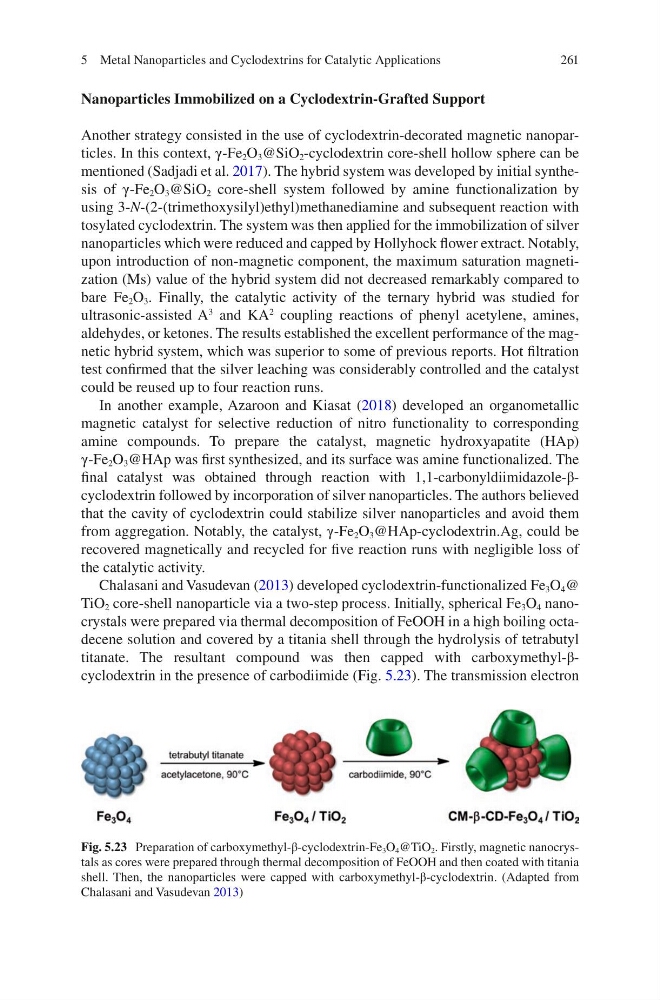
TiO 2 core-shell nanoparticle via a two-step process. Initially, spherical Fe 3 O 4 nanocrystals were prepared via thermal decomposition of FeOOH in a high boiling octadecene solution and covered by a titania shell through the hydrolysis of tetrabutyl
titanate. The resultant compound was then capped with carboxymethyl-βcyclodextrin in the presence of carbodiimide (Fig. 5.23). The transmission electron
Fig. 5.23 Preparation of carboxymethyl-β-cyclodextrin-Fe 3 O 4 @TiO 2 . Firstly, magnetic nanocrystals as cores were prepared through thermal decomposition of FeOOH and then coated with titania
shell. Then, the nanoparticles were capped with carboxymethyl-β-cyclodextrin. (Adapted from
Chalasani and Vasudevan 2013)
5 Metal Nanoparticles and Cyclodextrins for Catalytic Applications
Nanoparticles Immobilized on a Cyclodextrin-Grafted Support
Another strategy consisted in the use of cyclodextrin-decorated magnetic nanoparticles. In this context, γ-Fe 2 O 3 @SiO 2 -cyclodextrin core-shell hollow sphere can be
mentioned (Sadjadi et al. 2017). The hybrid system was developed by initial synthesis of γ-Fe 2 O 3 @SiO 2 core-shell system followed by amine functionalization by
using 3-N-(2-(trimethoxysilyl)ethyl)methanediamine and subsequent reaction with
tosylated cyclodextrin. The system was then applied for the immobilization of silver
nanoparticles which were reduced and capped by Hollyhock flower extract. Notably,
upon introduction of non-magnetic component, the maximum saturation magnetization (Ms) value of the hybrid system did not decreased remarkably compared to
bare Fe 2 O 3 . Finally, the catalytic activity of the ternary hybrid was studied for
ultrasonic- assisted A
3
and KA
2
coupling reactions of phenyl acetylene, amines,
aldehydes, or ketones. The results established the excellent performance of the magnetic hybrid system, which was superior to some of previous reports. Hot filtration
test confirmed that the silver leaching was considerably controlled and the catalyst
could be reused up to four reaction runs.
In another example, Azaroon and Kiasat (2018) developed an organometallic
magnetic catalyst for selective reduction of nitro functionality to corresponding
amine compounds. To prepare the catalyst, magnetic hydroxyapatite (HAp)
γ-Fe 2 O 3 @HAp was first synthesized, and its surface was amine functionalized. The
final catalyst was obtained through reaction with 1,1-carbonyldiimidazole-βcyclodextrin followed by incorporation of silver nanoparticles. The authors believed
that the cavity of cyclodextrin could stabilize silver nanoparticles and avoid them
from aggregation. Notably, the catalyst, γ-Fe 2 O 3 @HAp-cyclodextrin.Ag, could be
recovered magnetically and recycled for five reaction runs with negligible loss of
the catalytic activity.
Chalasani and Vasudevan (2013) developed cyclodextrin-functionalized Fe 3 O 4 @
TiO 2 core-shell nanoparticle via a two-step process. Initially, spherical Fe 3 O 4 nanocrystals were prepared via thermal decomposition of FeOOH in a high boiling octadecene solution and covered by a titania shell through the hydrolysis of tetrabutyl
titanate. The resultant compound was then capped with carboxymethyl-βcyclodextrin in the presence of carbodiimide (Fig. 5.23). The transmission electron
Fig. 5.23 Preparation of carboxymethyl-β-cyclodextrin-Fe 3 O 4 @TiO 2 . Firstly, magnetic nanocrystals as cores were prepared through thermal decomposition of FeOOH and then coated with titania
shell. Then, the nanoparticles were capped with carboxymethyl-β-cyclodextrin. (Adapted from
Chalasani and Vasudevan 2013)
5 Metal Nanoparticles and Cyclodextrins for Catalytic Applications