

249
reduced the intermolecular interactions, thus allowing a better mobility and diffusion of the substrate at the vicinity of the metal surface.
More recently, Thanh Chau et al. (2016) developed a novel protective agent for
the formation of very fine Rh nanoparticles. To prepare the inclusion complexes, the
authors used randomly methylated β-cyclodextrin or its leucine-grafted analogue
(RaMeCDLeu) and an optically active ammonium salt (QCD16Br = (1S,2R,4S,5R)(+)-N-hexadecyl-5-vinyl-2-quinuclidinium-methanol bromide) or N, N-dimethyl-Nhexadecyl-N-(2-hydroxyethyl)-ammonium chloride (HEA16Cl) as surfactants.
Typically, catalysts were synthesized by reduction of Rh salts by NaBH 4 in the
presence of cyclodextrin and surfactant. Notably, to reach stable nanoparticles, the
cyclodextrin/surfactant ratio must be optimized. By transmission electron microscopy analyses, it was found that the dispersion of the spherical Rh nanoparticles was
very good and their size varied from 1.2 nm to 1.5 nm depending on the type of
cyclodextrin and surfactant. It was also proven that these systems could act as efficient and stable catalysts for promoting biphasic hydrogenation of various substrates including ketones and olefins such as methyl-2-acetamidoacrylate, ethyl
pyruvate, or acetophenone with high catalytic activities and interesting specific
activity under mild experimental conditions.
In another study, gold nanoparticles were synthesized using α-cyclodextrin as
stabilizing agent in aqueous medium (Peng et al. 2014). The addition of a trans-azobenzene-based surfactant led to the phase transfer of the gold nanoparticles. By UV
irradiation, the azo-benzene compound isomerized itself giving the cis-azo-benzene
and consequently leading to the inverse phase transfer in water (Fig. 5.17). These
gold nanoparticles were tested in the 4-nitrophenol reduction using NaBH 4 . The
recovery and recycling can be achieved by a visible irradiation which gave again
trans form which bring the nanoparticles in organic phase.
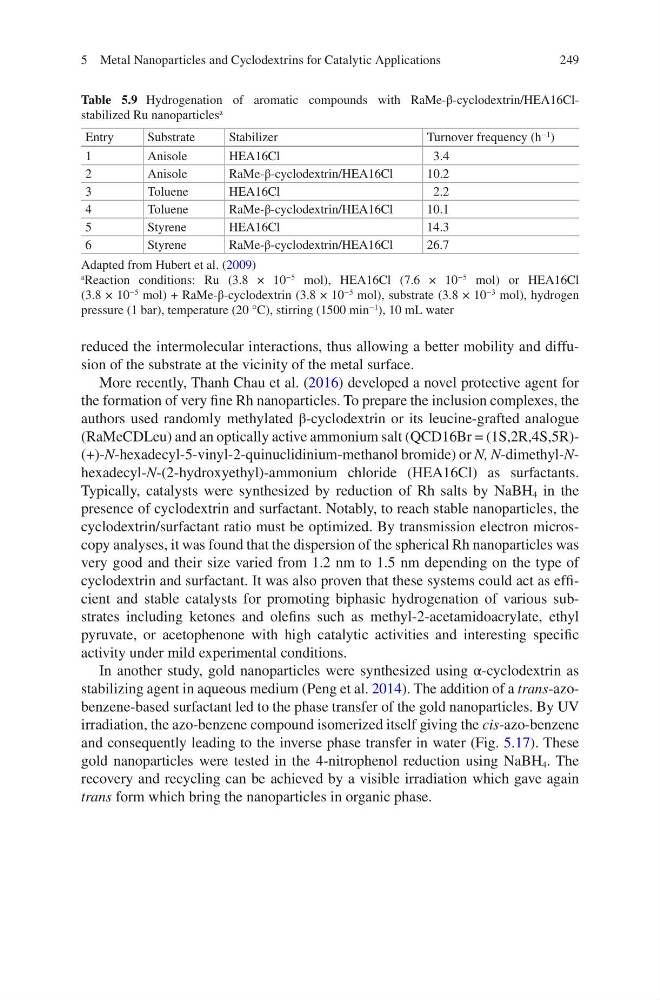
Table 5.9 Hydrogenation of aromatic compounds with RaMe-β-cyclodextrin/HEA16Clstabilized Ru nanoparticles
a
Entry
Substrate
Stabilizer
Turnover frequency (h
−1 )
1
Anisole
HEA16Cl
3.4
2
Anisole
RaMe-β-cyclodextrin/HEA16Cl
10.2
3
Toluene
HEA16Cl
2.2
4
Toluene
RaMe-β-cyclodextrin/HEA16Cl
10.1
5
Styrene
HEA16Cl
14.3
6
Styrene
RaMe-β-cyclodextrin/HEA16Cl
26.7
Adapted from Hubert et al. (2009)
a
Reaction conditions: Ru (3.8 × 10
−5 mol), HEA16Cl (7.6 × 10
−5
mol) or HEA16Cl
(3.8 × 10
−5
mol) + RaMe-β-cyclodextrin (3.8 × 10
−5 mol), substrate (3.8 × 10
−3 mol), hydrogen
pressure (1 bar), temperature (20 °C), stirring (1500 min
−1 ), 10 mL water
5 Metal Nanoparticles and Cyclodextrins for Catalytic Applications
reduced the intermolecular interactions, thus allowing a better mobility and diffusion of the substrate at the vicinity of the metal surface.
More recently, Thanh Chau et al. (2016) developed a novel protective agent for
the formation of very fine Rh nanoparticles. To prepare the inclusion complexes, the
authors used randomly methylated β-cyclodextrin or its leucine-grafted analogue
(RaMeCDLeu) and an optically active ammonium salt (QCD16Br = (1S,2R,4S,5R)(+)-N-hexadecyl-5-vinyl-2-quinuclidinium-methanol bromide) or N, N-dimethyl-Nhexadecyl-N-(2-hydroxyethyl)-ammonium chloride (HEA16Cl) as surfactants.
Typically, catalysts were synthesized by reduction of Rh salts by NaBH 4 in the
presence of cyclodextrin and surfactant. Notably, to reach stable nanoparticles, the
cyclodextrin/surfactant ratio must be optimized. By transmission electron microscopy analyses, it was found that the dispersion of the spherical Rh nanoparticles was
very good and their size varied from 1.2 nm to 1.5 nm depending on the type of
cyclodextrin and surfactant. It was also proven that these systems could act as efficient and stable catalysts for promoting biphasic hydrogenation of various substrates including ketones and olefins such as methyl-2-acetamidoacrylate, ethyl
pyruvate, or acetophenone with high catalytic activities and interesting specific
activity under mild experimental conditions.
In another study, gold nanoparticles were synthesized using α-cyclodextrin as
stabilizing agent in aqueous medium (Peng et al. 2014). The addition of a trans-azobenzene-based surfactant led to the phase transfer of the gold nanoparticles. By UV
irradiation, the azo-benzene compound isomerized itself giving the cis-azo-benzene
and consequently leading to the inverse phase transfer in water (Fig. 5.17). These
gold nanoparticles were tested in the 4-nitrophenol reduction using NaBH 4 . The
recovery and recycling can be achieved by a visible irradiation which gave again
trans form which bring the nanoparticles in organic phase.
Table 5.9 Hydrogenation of aromatic compounds with RaMe-β-cyclodextrin/HEA16Clstabilized Ru nanoparticles
a
Entry
Substrate
Stabilizer
Turnover frequency (h
−1 )
1
Anisole
HEA16Cl
3.4
2
Anisole
RaMe-β-cyclodextrin/HEA16Cl
10.2
3
Toluene
HEA16Cl
2.2
4
Toluene
RaMe-β-cyclodextrin/HEA16Cl
10.1
5
Styrene
HEA16Cl
14.3
6
Styrene
RaMe-β-cyclodextrin/HEA16Cl
26.7
Adapted from Hubert et al. (2009)
a
Reaction conditions: Ru (3.8 × 10
−5 mol), HEA16Cl (7.6 × 10
−5
mol) or HEA16Cl
(3.8 × 10
−5
mol) + RaMe-β-cyclodextrin (3.8 × 10
−5 mol), substrate (3.8 × 10
−3 mol), hydrogen
pressure (1 bar), temperature (20 °C), stirring (1500 min
−1 ), 10 mL water
5 Metal Nanoparticles and Cyclodextrins for Catalytic Applications