

250
Nanoparticles Stabilized by Phosphanes/Cyclodextrin Inclusion Complexes
Cyclodextrins have been used as mass transfer promoters in biphasic aqueous phase
catalysis processes using water-soluble organometallic complexes with sulfonated
phosphines as ligands since a long time. Spectroscopic studies demonstrated that,
depending on the nature and the position of the substituents on the aromatic ring,
sulfonated phosphines could interact with RaMe-β-cyclodextrin by forming inclusion complexes and tune the catalytic performances of the metal centers. The idea
was to combine the advantages of a sulfonated diphosphine as water-soluble stabilizer of nanoparticles with a cyclodextrin for its shuttle and supramolecular control
effects in biphasic aqueous phase catalysis (Monflier et al. 1999). Thus, ruthenium
nanoparticles were synthesized by hydrogen reduction of the organometallic ruthenium complex [Ru(cod)(cot)] and stabilized either with 1,4-bis[(di-msulfonatophenyl)phosphine]butane
(dppbs)
or
its
combination
with
RaMe-β-cyclodextrin in tetrahydrofuran (Guerrero et al. 2013, 2014) (Fig. 5.18).
The so-obtained Ru nanoparticles were isolated by precipitation and finally easily
re-dispersed in water.
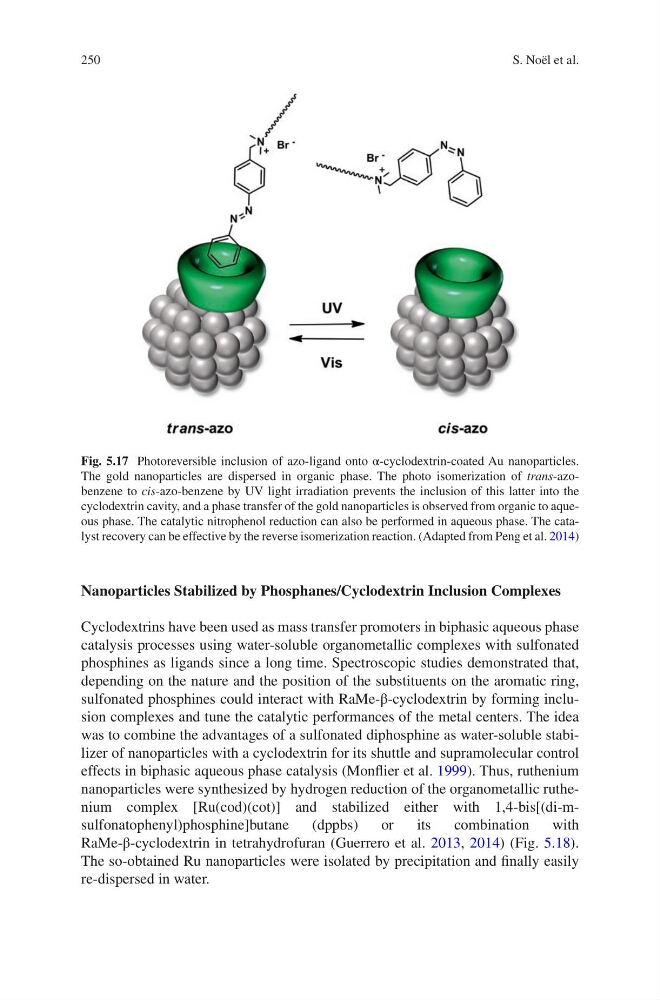
Fig. 5.17 Photoreversible inclusion of azo-ligand onto α-cyclodextrin-coated Au nanoparticles.
The gold nanoparticles are dispersed in organic phase. The photo isomerization of trans-azobenzene to cis-azo-benzene by UV light irradiation prevents the inclusion of this latter into the
cyclodextrin cavity, and a phase transfer of the gold nanoparticles is observed from organic to aqueous phase. The catalytic nitrophenol reduction can also be performed in aqueous phase. The catalyst recovery can be effective by the reverse isomerization reaction. (Adapted from Peng et al. 2014)
S. Noël et al.
Nanoparticles Stabilized by Phosphanes/Cyclodextrin Inclusion Complexes
Cyclodextrins have been used as mass transfer promoters in biphasic aqueous phase
catalysis processes using water-soluble organometallic complexes with sulfonated
phosphines as ligands since a long time. Spectroscopic studies demonstrated that,
depending on the nature and the position of the substituents on the aromatic ring,
sulfonated phosphines could interact with RaMe-β-cyclodextrin by forming inclusion complexes and tune the catalytic performances of the metal centers. The idea
was to combine the advantages of a sulfonated diphosphine as water-soluble stabilizer of nanoparticles with a cyclodextrin for its shuttle and supramolecular control
effects in biphasic aqueous phase catalysis (Monflier et al. 1999). Thus, ruthenium
nanoparticles were synthesized by hydrogen reduction of the organometallic ruthenium complex [Ru(cod)(cot)] and stabilized either with 1,4-bis[(di-msulfonatophenyl)phosphine]butane
(dppbs)
or
its
combination
with
RaMe-β-cyclodextrin in tetrahydrofuran (Guerrero et al. 2013, 2014) (Fig. 5.18).
The so-obtained Ru nanoparticles were isolated by precipitation and finally easily
re-dispersed in water.
Fig. 5.17 Photoreversible inclusion of azo-ligand onto α-cyclodextrin-coated Au nanoparticles.
The gold nanoparticles are dispersed in organic phase. The photo isomerization of trans-azobenzene to cis-azo-benzene by UV light irradiation prevents the inclusion of this latter into the
cyclodextrin cavity, and a phase transfer of the gold nanoparticles is observed from organic to aqueous phase. The catalytic nitrophenol reduction can also be performed in aqueous phase. The catalyst recovery can be effective by the reverse isomerization reaction. (Adapted from Peng et al. 2014)
S. Noël et al.